
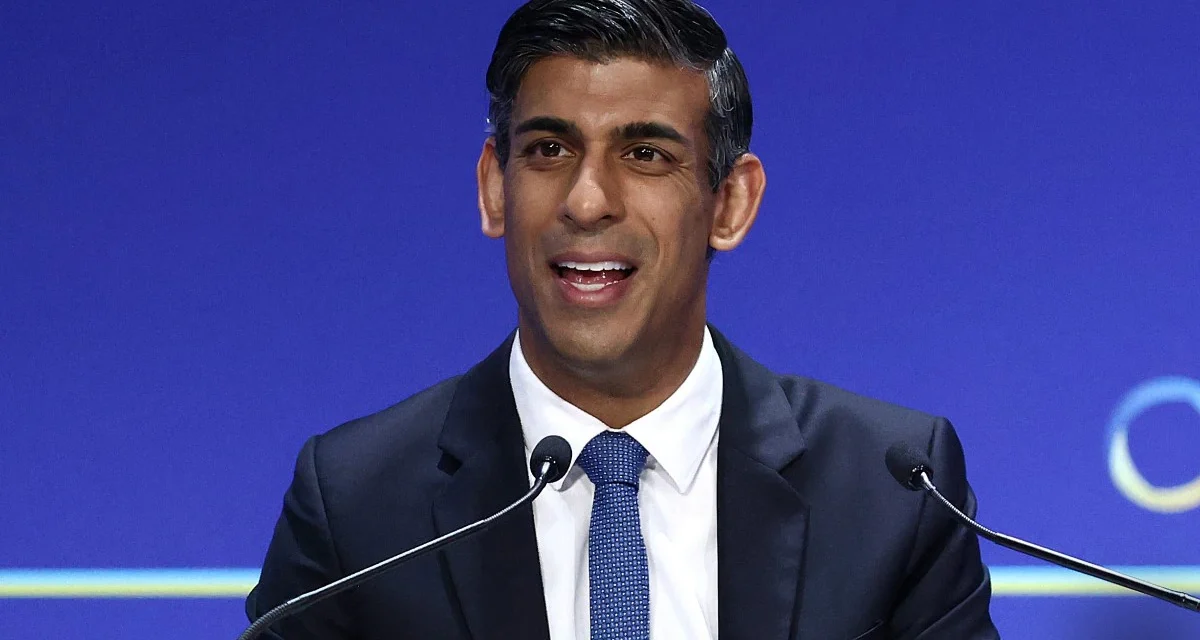
When Rishi Sunak walked into Downing Street in October 2022, the world was watching a country that had cycled through three prime ministers in a matter of weeks. His immediate task was domestic stability, but the foreign policy challenges awaiting him were no less urgent. His premiership was dominated by the Russian invasion of Ukraine, the Gaza war, and a broader recalibration of Britain’s place in a rapidly shifting geopolitical landscape.
What emerged over his nearly two years in office was a foreign policy defined more by pragmatic continuity than bold reinvention, though that consistency carried its own strategic logic and Sunak’s foreign policy was not without criticism.
Ukraine: Standing Firm
From the moment he assumed office, Sunak’s first phone call was made to President Zelensky, reaffirming Britain’s commitment to Ukraine and signalling that domestic economic pressures would not erode the country’s international standing. He followed through with action. His first European trip in November 2022 was a visit to Kyiv, where he met Zelensky in person, pledged substantial aid packages, and urged diplomatic allies to take an assertive approach to Russian aggression.
Sunak promised to stand with Ukraine for as long as it takes, continuing the approach championed by Boris Johnson, who had built deep goodwill in Kyiv through fervent early support. Critics argued Sunak was simply maintaining Johnson’s policy rather than elevating it, but given the political turbulence Britain had just endured, providing a reliable and consistent partner to Kyiv was itself no small achievement. His government authorised significant weapons shipments and maintained sustained pressure within NATO for allied members to increase their own contributions.
Europe: Reset Without Reconciliation
One of Sunak’s more tangible foreign policy achievements was the Windsor Framework, agreed with the European Union in February 2023. It delivered a new set of dual regulations to replace the original Northern Ireland Protocol, with goods remaining in Northern Ireland facing minimal checks while goods destined for the EU would be more tightly regulated. A Stormont brake mechanism allowed the Northern Irish Assembly to object to the application of EU goods rules, giving unionist politicians a meaningful veto they had long demanded.
Sunak also pursued a warmer bilateral relationship with France, securing a deal on Channel migration that had eluded his predecessors. He signalled that the goodwill extended broadly to Europe and framed the Framework as the beginning of a wider reinvigoration of British relationships with the continent. Yet the ambition of a genuine European reset remained incomplete. Hard Eurosceptics within his own party ensured the boundaries of any rapprochement were tightly constrained, and Sunak was never in a position to make the kind of sweeping overtures that European capitals might have welcomed.
The Indo-Pacific: Following the Tilt
Sunak embraced the Indo-Pacific strategy he inherited with genuine conviction, even if the architecture for it had largely been constructed before he arrived. He leaned on two defining commitments from the Johnson era: the AUKUS pact between Britain, the United States and Australia, and the 2021 Integrated Review, which had established the Indo-Pacific tilt as a cornerstone of Global Britain ambitions.
Under Sunak, the tilt was given real substance through a series of landmark agreements. In December 2022, Britain concluded the Global Combat Air Programme with Italy and Japan, a trilateral accord to develop a next generation stealth fighter jet operational by 2035. In July 2023, Britain became the only non-regional nation to accede to the Comprehensive and Progressive Agreement for Trans-Pacific Partnership, embedding the country into the economic architecture of the Asia-Pacific for decades to come. AUKUS was advanced further at the San Diego summit in March 2023, where the three leaders set out a detailed submarine acquisition roadmap that gave the pact genuine military credibility rather than symbolic weight.
China: Clarity Without Confrontation
Sunak’s position on China marked a meaningful shift in language even if the underlying policy remained measured. He declared an end to Britain’s so-called golden era with Beijing and rejected what he described as naive former approaches. He characterised China as increasingly authoritarian at home and assertive abroad. Yet he stopped short of formally designating China as a threat in the way that some within his own cabinet had demanded. China hawks within the Conservative Party pushed consistently for a harder line, and the tension between strategic caution and political pressure was never fully resolved during his tenure.
The Middle East: Support Under Pressure
Following the October 7 Hamas attacks in 2023, Sunak moved swiftly to pledge British support for Israel. He was among the first Western leaders to visit the region and express solidarity. However, as the civilian toll in Gaza mounted over subsequent months, he faced growing pressure domestically and internationally to change course. Sunak eventually called for a ceasefire in the Gaza Strip, a position that reflected both the humanitarian scale of the conflict and the political realities of a divided public at home.
A Calculated Diplomat
The appointment of David Cameron as Foreign Secretary in November 2023 was the most dramatic single moment of Sunak’s foreign policy tenure. Cameron had not held elected office since his resignation in 2016 and was elevated to the House of Lords to make the role possible. The move signalled that Sunak wanted a seasoned diplomat with established international relationships handling Britain’s most sensitive dossiers, from the Middle East to transatlantic ties, while he focused on domestic survival ahead of an election he knew was coming.
Sunak’s foreign policy legacy is one of steadiness over spectacle. He inherited a country with diminished diplomatic standing after years of Brexit turbulence and internal Conservative chaos, and he worked methodically to restore credibility on the world stage.
The foundations he laid across Ukraine, the Indo-Pacific and EU relations proved durable enough to outlast his premiership, even if history may judge him as a custodian of existing strategy rather than an architect of a genuinely new one.
