
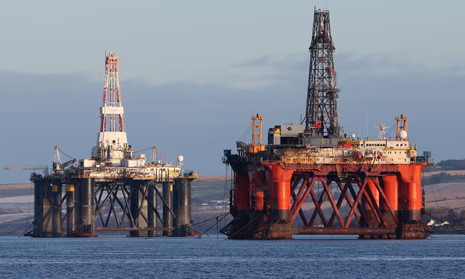
The United Kingdom government has confirmed it will introduce legislation permanently prohibiting new oil and gas exploration licences in the North Sea, enshrining a key Labour Party manifesto commitment into statute law through the new Energy Independence Bill announced in the King’s Speech.
The move, reported by Argus Media, has drawn immediate and widespread criticism from opposition parties, industry groups, and international partners, with critics arguing the policy does more harm to Britain’s economy and energy security than to the environment.
Oil and gas currently accounts for approximately three-quarters of the UK’s energy mix. The majority of those fossil fuels are now imported from abroad, meaning the benefit of job creation and tax revenues associated with extraction and refining flows to other countries rather than to British workers and the exchequer.
The ban would foreclose any new domestic production even as global supply chains remain under pressure from the closure of the Strait of Hormuz following the outbreak of the Iran conflict, which has driven crude oil prices sharply higher in recent weeks.
The timing has intensified political pressure on Energy Secretary Ed Miliband. Norway, which drills in the same North Sea area as Britain, recently approved the reopening of three gasfields that had been shut for decades to help address the global supply shock created by the Hormuz closure.
That contrast has given Labour’s opponents powerful ammunition. Shadow energy secretary Claire Coutinho accused Miliband of being deluded, arguing the policy increases reliance on foreign fossil fuel imports rather than building energy independence. Reform UK and the Conservatives have both pledged to overturn the ban if they enter government.
The US ambassador to the UK has used multiple public appearances to urge Britain to develop more of its North Sea reserves, adding a diplomatic dimension to the domestic political argument.
The government has maintained that enshrining the ban in law helps insulate Britain from volatile fossil fuel markets over the long term, though critics counter that the near-term consequence is deeper exposure to precisely the kind of global supply disruption now affecting energy prices across Europe.
