
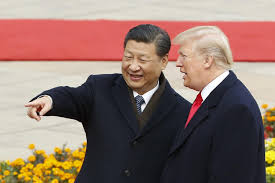
President Donald Trump departed for a state visit to Beijing on Tuesday, embarking on the first trip to China by a sitting US president in nearly a decade under circumstances dramatically different from those originally planned when the trip was conceived as a trade reset.
The visit, scheduled for May 14-15, was originally planned for late March but was postponed by Trump, who said at the time he could not leave the country while the war with Iran was ongoing; now, more than ten weeks into the conflict, the trip is going ahead with the ceasefire Trump himself described on Monday as being on “massive life support.”
Trump dismissed Iran’s latest response to a US peace proposal as “the weakest” and said he did not even finish reading it, calling it “a piece of garbage,” and has tasked Xi Jinping with applying pressure on Tehran to make a deal that would reopen the Strait of Hormuz and end the conflict.
Iran’s foreign minister had previously travelled to Beijing and met with Chinese counterparts, and China is credited with helping push Iran to accept the initial ceasefire that is now fraying, giving Xi significant diplomatic leverage heading into the summit that he was not anticipated to have at the start of the year.
A senior US official confirmed that Washington will press Beijing over its financial support for Iran and Russia, as well as Chinese exports of dual-use goods with potential weapons applications, though analysts expect limited breakthroughs on those fronts given China’s comfortable strategic positioning.
Trump’s delegation includes more than a dozen major US corporate executives, among them Apple CEO Tim Cook and Tesla’s Elon Musk, and expected deliverables include agreements on aerospace, agriculture, and energy, as well as continued progress toward formalising the US-China trade truce.
The closure of the Strait of Hormuz has affected China significantly, with roughly 40% of the country’s oil imports transiting the waterway before the conflict, though analysts note Beijing has weathered the disruption better than most due to its strategic reserves and overland pipeline infrastructure.
The visit carries broad symbolic significance as a reinforcement of the personal relationship between Trump and Xi, with Trump recounting that Xi had previously promised to put on the biggest welcome display in the history of China, and describing their relationship publicly as exceptionally strong.
Analysts at the Atlantic Council and International Crisis Group cautioned that as of departure, many of the economic deliverables for the summit had not yet been finalised, with negotiations still continuing in the days leading up to arrival, leaving the summit’s concrete outcomes uncertain until the last possible moment.
Republican foreign policy scholars noted the inherent tension in a US president visiting his country’s principal strategic rival during an active military conflict, with Georgetown’s Dennis Wilder observing that Trump believes he personally understands Xi and can negotiate good deals with China in ways that institutional advisers cannot.
