
Pam Bondi spent three decades building a legal and political career that took her from a prosecutor’s desk in Tampa to the highest law enforcement office in the United States. Her trajectory was defined at almost every critical turn by her relationship with Donald Trump, a bond that ultimately proved both the making and the unmaking of her tenure as Attorney General. When Trump fired her on April 2, 2026, ending a turbulent 14-month stint at the head of the Justice Department, it brought to a close a career arc that critics had long argued was shaped more by personal loyalty than by institutional principle.
Born and raised in the Tampa Bay area, Bondi graduated from the University of Florida and Stetson Law School before serving as an assistant state attorney in Hillsborough County from 1994 to 2009. It was a grounding in criminal prosecution that gave her the credibility she needed when she entered electoral politics. In 2010 she was elected attorney general of Florida, becoming the first woman to hold the position, and was re-elected in 2014, making her the first Republican to win a second consecutive term in the role. She served the maximum two four-year terms permitted under Florida law before leaving office in 2019.
Her time as Florida’s top law enforcement officer was not without controversy, and the most damaging chapter of that period concerned her relationship with Trump long before his presidency began. In 2013, Bondi’s office had received at least 22 fraud complaints relating to Trump University from members of the public. Around that same time, Bondi personally solicited a $25,000 donation from the Donald J. Trump Foundation toward a political action committee supporting her re-election campaign.
The donation was later found to have violated federal laws prohibiting private foundations from making political contributions. Her office subsequently decided not to pursue a formal investigation into Trump University. The IRS ordered Trump to pay a fine over the contribution. In November 2019, a New York state court ordered the closure of the Trump Foundation and directed Trump to pay $2 million in damages for misusing it, with the illegal donation to Bondi among the conduct cited. Neither Bondi nor her PAC were fined or criminally charged in connection with the matter.
The episode cast a long shadow but did little to slow the development of her alliance with Trump. During the 2016 Republican National Convention she joined in chants targeting Hillary Clinton, and she endorsed Trump in the Florida Republican presidential primary that same year, describing him as a longstanding personal friend. When her time as Florida attorney general ended, she joined lobbying firm Ballard Partners, where she worked as a registered foreign agent representing the Qatari government on anti-human-trafficking efforts ahead of the 2022 FIFA World Cup. She departed that role when Trump’s first impeachment proceedings began.
In late 2019 she was brought in by the Trump White House to assist with communications around the impeachment inquiry, with her role specifically described at the time as being to attack the process itself. By January 2020 she had been formally named as a member of Trump’s Senate impeachment trial defence team, during which she made allegations linking Joe Biden and his son Hunter to corruption in Ukraine. After Trump’s 2020 election defeat, Bondi became a prominent voice amplifying his claims of widespread voter fraud, pushing those arguments in states including Pennsylvania and Wisconsin despite repeated court rulings finding no evidence to support them. By 2024 she was leading the legal arm of the Trump-aligned America First Policy Institute.
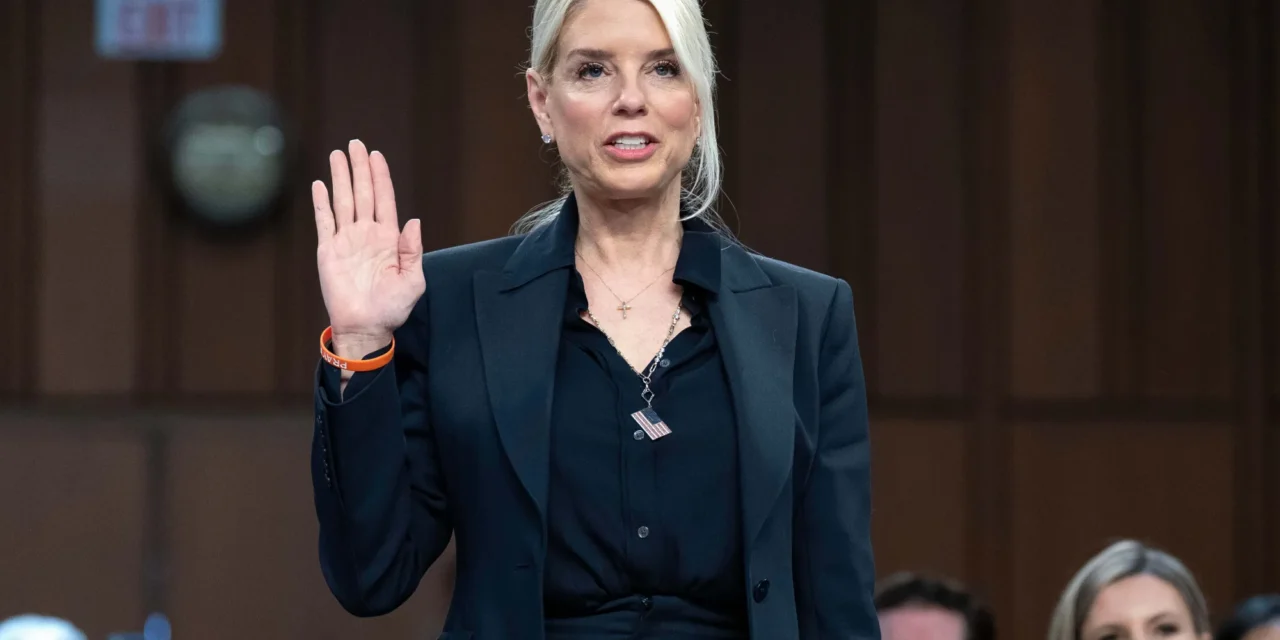
When Trump won the 2024 presidential election, his original nominee for Attorney General was former Florida congressman Matt Gaetz. Following Gaetz’s withdrawal from consideration amid controversy, Trump turned to Bondi. She was confirmed by the Senate and assumed office in early 2025, becoming the first Florida attorney general to serve as the nation’s top law enforcement official.
Her tenure was defined from the outset by the expectation that she would direct the Justice Department toward Trump’s political priorities. She authorised investigations into a number of his prominent political opponents, including New York Attorney General Letitia James and former FBI Director James Comey. The department secured indictments in both cases, but courts threw them out after ruling that the prosecutors involved were serving in those roles illegally. The failed prosecutions were a source of deep frustration for Trump, who felt Bondi had not been aggressive enough in pursuing his enemies.
The Epstein files became the other major flashpoint of her tenure. After months of promising transparency around documents relating to convicted sex offender Jeffrey Epstein, the Justice Department abruptly announced in the summer of 2025 that no further material would be made public, shutting the investigation down entirely. Reports subsequently emerged that Bondi had privately informed Trump that his name appeared in the files, a disclosure that only deepened public scepticism about the handling of the matter. The House Oversight Committee went as far as subpoenaing Bondi over what it described as mismanagement of the Epstein case.
Trump had come close to firing Bondi as early as January 2026, when he publicly berated her and a group of US attorneys as weak and ineffective. His chief of staff Susie Wiles, who had known Bondi since her first campaign for Florida attorney general in 2010, is said to have intervened to protect her at that stage. But the tension continued to build. On the morning of April 2, 2026, Bondi accompanied Trump to the Supreme Court for oral arguments on the birthright citizenship case, having already been told on the car journey over that her removal was coming. She sat beside the president throughout the hearing, attended his address to the nation that evening on the conflict in Iran, and even pushed for charges against one of his political opponents in a meeting with a senior Florida prosecutor. By the time news of her firing had leaked to the press the following day, she was already in Florida for a pre-scheduled meeting with local sheriffs.
Trump announced her departure on Truth Social, describing her as a great American patriot and a loyal friend, and stating she would be transitioning to a new role in the private sector. No specific reasons were given publicly. Behind the scenes, sources indicated Trump felt she had not executed on his vision in the way he required. Deputy Attorney General Todd Blanche, who had previously served as Trump’s personal criminal defence lawyer, was named acting attorney general. Environmental Protection Agency administrator Lee Zeldin was reported to be under consideration for the permanent role.
Bondi left without another job lined up, despite Trump’s suggestion that something would be announced in due course. She was the second Cabinet secretary fired in quick succession, following the removal of Homeland Security Secretary Kristi Noem weeks earlier. In her own statement, she said she remained grateful for the trust Trump had placed in her and that her transition would take place over the following month.
