
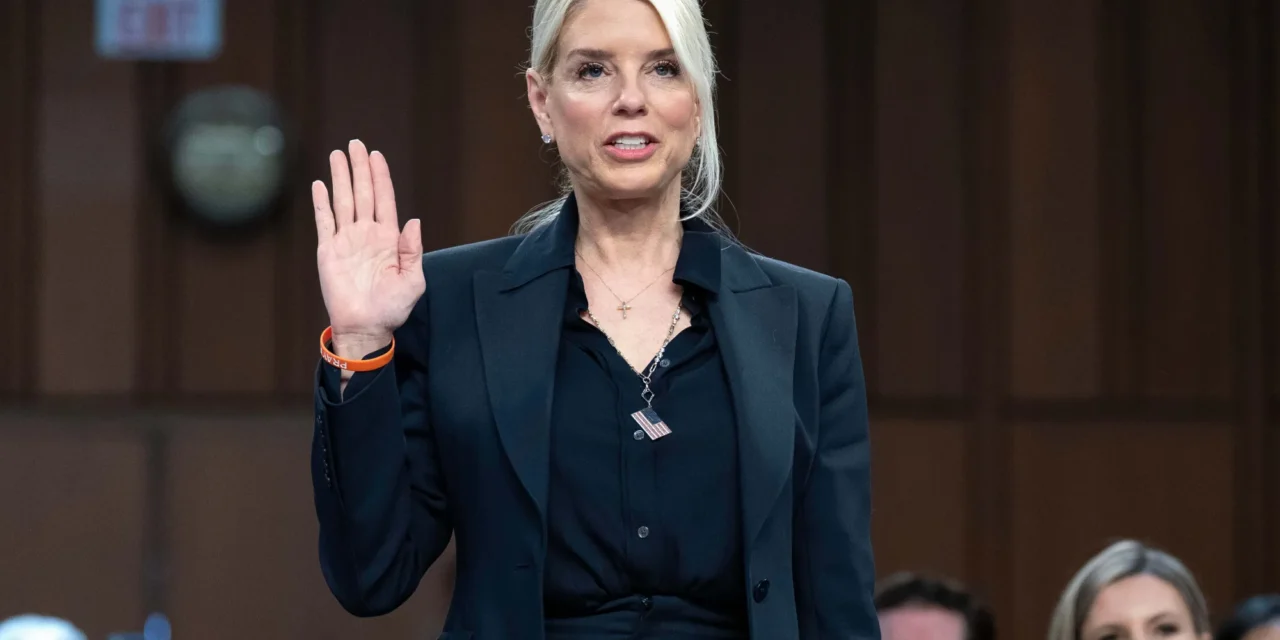
Pam Bondi’s final days as Attorney General were more humiliating than the public record initially suggested, with reporting from the Daily Mail and Wall Street Journal now detailing a sequence of events that turned what could have been a dignified transition into an extended display of the contemptuous informality with which Donald Trump discards senior officials who have outlived their usefulness in his administration.
Trump informed Bondi of his decision to fire her during a meeting at the White House on Thursday April 2, according to Daily Mail sources, and Bondi did not take the news with resignation: she was unhappy and tried to change his mind, the sources said, pleading with him to give her more time in the role.
Trump was unmoved, telling Bondi that he had made his decision and that an announcement would be made on Friday, though it was ultimately rushed out one day early overnight as media speculation began to swirl around the personnel change before the administration was ready to announce it.
The Wall Street Journal subsequently added a detail that sharpened the humiliation considerably: Trump had in fact decided to fire Bondi earlier in the week, but chose to deliver the news during their shared ride in the presidential limousine to the Supreme Court on Wednesday, using the intimate setting not as an honour but as the backdrop for a dismissal that forced Bondi to enter one of Washington’s most prestigious buildings already knowing her tenure was over.
Even after Trump delivered his “I think it’s time” verdict in the back of the limousine, the Journal reported that Bondi continued to beg to stay, a detail that speaks to either genuine commitment to a job she believed she could still do or a miscalculation about the finality of Trump’s decision-making once he has reached a conclusion.
The trigger that pushed Trump over the edge into action, according to sources cited by the Daily Mail, was Bondi’s decision to inform Democratic Congressman Eric Swalwell that the FBI was working to release documents related to Swalwell’s alleged relationship with Chinese spy Christine Fang, a disclosure that the White House viewed as a profound breach of trust driven by Bondi’s personal friendship with Swalwell.
The White House was not pleased she was intervening due to her personal friendship with Swalwell, according to the source, and her perceived willingness to protect a Democratic political figure from information the administration wanted to use as leverage created exactly the kind of loyalty question that Trump cannot tolerate in senior positions regardless of the surrounding circumstances.
Bondi received none of the courtesy extended to other departing officials: no new title, no face-saving transition role, no ceremonial send-off that would allow her to frame the departure on her own terms, a contrast the Daily Beast specifically noted against the consolation prize of a vague diplomatic role that was at least created for Kristi Noem when she was removed from DHS.
The subsequent appointment of Lee Zeldin as acting attorney general, and the broader signals about the direction of DOJ under new leadership, have since made clear that Trump’s frustration with Bondi was not simply about the Swalwell incident but about a broader sense that she was insufficiently willing to use the department as an instrument of political combat in the way the administration wanted.
The Epstein document question, which had been a persistent undercurrent in coverage of the administration’s relationship with Bondi, is also referenced by CNN reporting that noted the possibility of replacing Bondi with Zeldin had first arisen in January when Epstein coverage was at its most intense, before temporarily receding as media attention shifted, then returning decisively in the final days before her firing, suggesting the Swalwell incident was the triggering event rather than the sole cause.
