
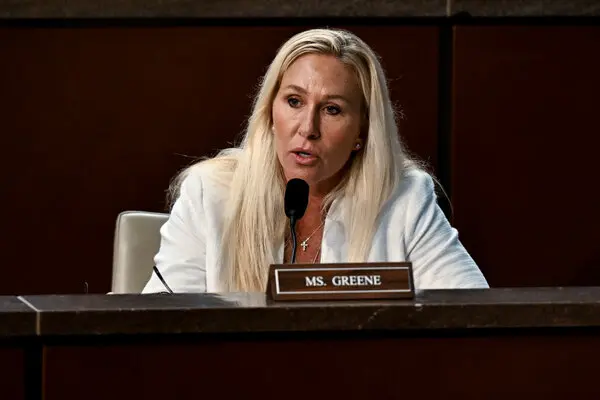
Marjorie Taylor Greene has gone further than almost any figure in American conservative politics in her open break with Donald Trump, questioning the president’s mental fitness, calling for his removal via the 25th Amendment, and accusing him of blasphemy after he posted an AI-generated image depicting himself in a Christ-like role.
The former Georgia congresswoman’s transformation from Trump’s most vocal congressional ally to one of his most pointed public critics is now one of the defining political storylines of the 2026 cycle.
Greene, who resigned from Congress in January citing her dispute with Trump over the handling of Epstein-related files, lit up social media on April 10 when she publicly backed invoking the 25th Amendment. The trigger was Trump’s Truth Social post during the height of the Iran conflict, in which he wrote that “a whole civilization will die tonight.” Greene said: “25TH AMENDMENT!!! Not a single bomb has dropped on America. We cannot kill an entire civilization. This is evil and madness.”
The language was striking even by the standards of a politician known for escalating rhetoric. Greene later gave an interview to CNN in which she pushed the point further. “I think we have to truly question the mental stability of any president that threatens to wipe out an entire civilization,” she said. “That would include all the innocent people in that country who have nothing to do with the war, especially after President Trump said this was about freeing the Iranian people from the Iranian regime.”
The White House fired back swiftly. Spokesperson Davis Ingle said: “There is nothing more ‘America Last’ than quitting on your constituents and the MAGA movement in the middle of your term.” Trump himself had previously branded Greene “Marjorie Traitor Greene” in social media posts, a label that stuck as their feud intensified through the early months of 2026.
Greene’s criticism of the AI image was a separate flashpoint. Trump shared a post showing himself with divine light emanating from his hands, apparently healing a man in a hospital bed with patriotic imagery surrounding the scene. Greene called it blasphemy. “I thought that was blasphemy. As a Christian, I was very offended,” she told CNN. The post was subsequently deleted without explanation from Trump’s account, though the White House offered no formal comment on its removal.
Her earlier frustrations with Trump date back to November 2025, when she announced her resignation from Congress citing the Epstein files dispute. She had been one of his most reliable foot soldiers in the House, voting with his positions at every opportunity and leading efforts to impeach several Biden-era officials. The break, when it came, was abrupt and total.
Georgia’s 14th Congressional District special election, called to fill her vacant seat, ended with Republican Clay Fuller defeating Democrat Shawn Harris in a runoff on April 7. Fuller, a former district attorney backed explicitly by Trump, took more than 55% of the vote against Harris, a retired Army brigadier general. Trump used the victory as a direct rebuke of Greene, publicly highlighting Fuller’s win as a referendum on her departure.
The Democratic performance in the race drew its own attention. Harris outperformed the Democratic 2024 presidential result in the district by 25 percentage points, losing by around 12 points in a constituency Trump carried by 37 points just two years ago. Harris conceded, saying: “It was a fair race, it was a hard-fought race.” He confirmed he will run again in November for the full term.
Fuller described his victory as a “completely dominating performance” and pledged full support for Trump’s national security decisions. His arrival in Congress gives the Republican House majority a reading of 218-214 with one independent and two vacancies still to be filled, providing slim but meaningful breathing room for Republican leadership.
Greene’s political future remains uncertain. She is no longer in Congress, has broken with the movement she helped build, and is increasingly aligned with a growing but still marginal current within the Republican Party that has broken publicly with Trump over the Iran war. That coalition includes figures like Candace Owens and Alex Jones, alongside some libertarian-leaning conservatives who backed Trump’s original “no new wars” foreign policy platform.
Whether that coalition represents a durable political force or a temporary protest movement depends in large part on how the Iran situation resolves. If Trump achieves a peace deal and gas prices fall, the “WAR WAR WAR” critique loses its most powerful populist edge. If the conflict drags on and economic conditions worsen, Greene may find herself at the front of a genuine intraparty faction with real electoral consequences heading into November.
