
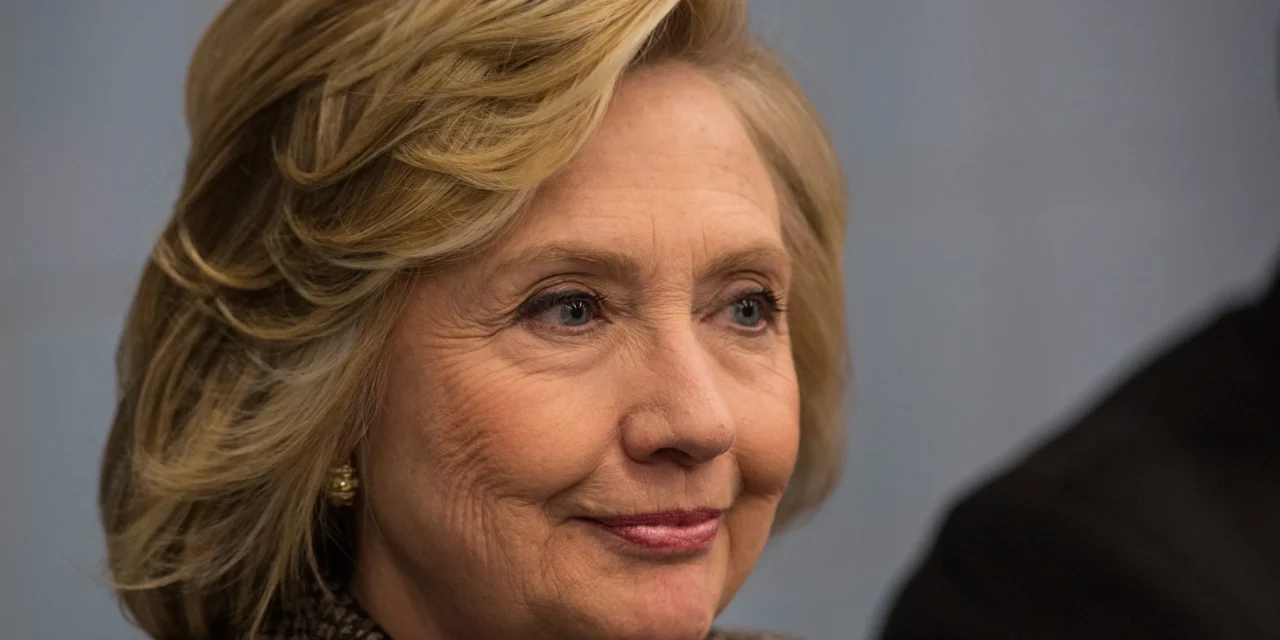
Hillary Clinton has emerged as one of the sharpest and most prominent Democratic voices targeting the Trump administration this week, using a wide-ranging Monday morning appearance on MSNBC’s Morning Joe to deliver a sustained assault on the president’s conduct across social media, the Iran war, and what she described as a fundamental breakdown in American leadership on the world stage.
The former Secretary of State and 2016 Democratic presidential nominee called in by phone on April 13, a day after peace talks between the United States and Iran collapsed in Islamabad following a 21-hour negotiating session that JD Vance departed empty-handed. Her tone from the opening minutes was one of controlled fury rather than political point-scoring, though the interview ranged across territory that carries unmistakable midterm implications.
“Words, especially from an American president, have real consequences,” Clinton told hosts Mika Brzezinski and Joe Scarborough. “And when you look at the last week of unhinged rants coming from Trump’s social media account, it’s just disgraceful.” She cited specifically Trump’s threat to wipe out an entire Iranian civilisation, his sustained attacks on Pope Leo XIV, and an AI-generated image of himself in the likeness of Jesus Christ that was subsequently deleted.
The former first lady made clear she was not reading those posts as a detached observer. “I read those like — I think, I hope — the majority of Americans, both shaking my head, and really just feeling sick at heart that we have a president who is such a disgrace,” she said. The phrase carried an intensity that reflected both personal exasperation and strategic intent, delivered to a format that amplifies Democratic base sentiment while also reaching the persuadable voters her party is targeting ahead of November.
On Iran specifically, Clinton drew directly on her experience as Secretary of State under Barack Obama, during which she laid the groundwork for the negotiations that eventually produced the 2015 nuclear deal. She was unsparing about the current administration’s diplomatic capacity. “You don’t just show up in Geneva or Islamabad, talk for a bunch of hours, and just go away. This is hard, disciplined effort.” She noted that the Obama-era negotiation involved physicists and nuclear weapons practitioners at the table, and contrasted that with what she characterised as the Trump administration’s reliance on the same small group of unqualified figures cycling between crises.
“I don’t see this administration either wanting to do it or frankly being capable of doing it because they send the same three people around the world,” Clinton said. “You know, two of them, Jared Kushner and Steve Witkoff, they’re supposed to solve Ukraine, Iran, Gaza, it’s a joke.” The dismissal of Vance, Witkoff and Kushner as collectively incapable of serious sustained diplomacy was delivered with a precision that reflected genuine familiarity with the mechanics of international negotiation rather than partisan hostility.
Her assessment of the United States’ current strategic position was stark. “We’re in a situation now where we are weak, where we essentially have lost the leverage and initiative that we had,” Clinton explained, noting that Iran now holds the Strait of Hormuz as a bargaining chip of extraordinary economic power. “I worry that the United States is now in a very weak position vis-à-vis Iran, which should be the outlier, should be on the back foot and should be the one held to account.” That inversion, America weakened while the designated adversary dictates terms, was the analytical spine of her foreign policy critique.
Clinton also responded to Trump and Vance’s repeated invocations of Western civilisation as a rhetorical framework, delivering a line that drew significant social media attention. “You hear Trump and Vance and these people prattle on and on about Western Civilisation. I don’t think they’ve ever taken a course in Western Civilisation,” she said. “This country of ours is a result of the development over centuries of Western civilisation. It is about how we hold leaders accountable so they don’t become autocrats and dictators, and how they don’t lead us into reckless wars.”
The most direct political moment came near the interview’s close. “And this is a call to the Congress, including the Republicans, to step up and do your constitutional duty, rein in this president before he causes absolutely irreparable damage to our country, to our military standing, to our authority and leadership,” Clinton said. “Do not let him continue to be a rogue player in the international arena, because I fear he will get more reckless.”
She then offered an explicit electoral prediction. “And I will tell you, when we win these midterm elections — because look, if the elections were today or next week or the following week, we would win both the House and the Senate — and I hope that’s what happens in November.” The confidence of the forecast reflected recent polling showing Democrats with a structural advantage in the generic ballot, an advantage driven in significant part by the Iran war’s damage to Republican standing with suburban and independent voters.
Her appearance on Morning Joe followed the publication of a New York Times opinion essay earlier in the week in which Clinton criticised Trump’s budget priorities and the broader Republican economic approach. The combination of the essay and the broadcast interview represented a more sustained public presence than Clinton has maintained for much of the past two years.
Clinton is confirmed as the keynote speaker at the McIntyre-Shaheen 100 Club Dinner in New Hampshire on April 25, marking her first public visit to the state since 2019. The choice of venue is not incidental. New Hampshire remains one of the most competitive states in the Senate map, and Clinton’s return signals that Democratic leadership views her profile as an asset rather than a complication in the fight to reclaim Congress.
