
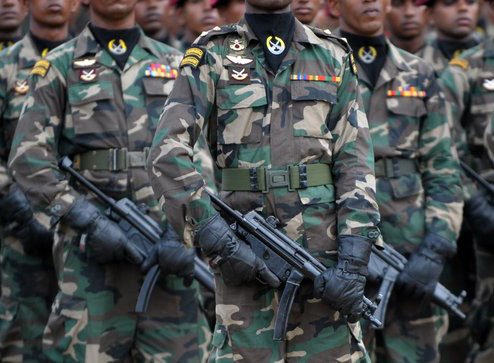
From recent travels to Sri Lanka, Blake could not have been blind to the current resettlement of Sinhalese people in the Tamil areas in the north and east of the island, but he seemed to be when he did not acknowledge it as a major human rights issue needing to be addressed. Also ignored by everyone with the power to take progressive humanitarian action have been the needs of an estimated 86,000 Tamil war widows, some of whom do not know if their husbands are dead or still detained two and a half years after the war has ended. In a male-dominated culture, these women are largely innocent victims of both impoverishing circumstance and prejudicial public cultural attitude against unmarried women who have no male protector to look after their needs.
The need for positive action on human rights in Sri Lanka was addressed in early November in a letter to Secretary of State Hillary Clinton from Senators Patrick Leahy (D-VT), Ben Cardin (D-MD), and Robert P. Casey, Jr. (D-PA). In the letter, the senators noted:
…Ambassador Susan Rice stated when the LLRC was established…, “commission members should be and (should) be perceived (to be)… independent, impartial and competent; their mandate should enable them fully to investigate serious allegations of violations and to make public recommendations; commission members and potential witnesses must enjoy adequate and effective protection; the commission must receive adequate resources to carry out its mandate; and the Government should undertake to give serious consideration to its recommendations.”
In the same paragraph the authors continued,
“On August 11, 2010, the State Department’s War Crimes Office reported that the LLRC failed to meet many of these criteria, as it was not clear whether its investigations would be ‘linked to violations of international law,’ and the LLRC did not possess the requisite level of ‘independence and impartiality’ because its members include former Sri Lankan government officials with close ties to President Rajapaksa.”
The staff-level thinking at the State Department was clear, but higher-level willingness to act on the clarity was missing. The Obama administration seemed morally immobilized much as they were in relations with the Congress and their Republican opponents, but no international Occupy Wall Street movement has shaken them from their human rights lethargy, as it seems to have done on domestic election-related politics. The demands for human rights leadership seemed patiently and timidly missing both domestically and internationally, and no electoral pressures seemed likely to change that for the Tamil benefit as long as only three senators were bringing pressure for change.
The domestic political reasons for backing off on the peace process in Palestine during an election season were apparent, but the same need was not clear in relation to Sri-Lanka unless other matters were felt to have greater electoral value—to the extent any foreign policy issues could bring electoral benefit in a nation focused on the need for jobs. The votes of the Sri Lankan diaspora in the United States were not at issue despite the existence of both Tamil and Sinhala communities in the United States.
The three Democratic senators were trying to help get the U.S. priorities focused as they felt was needed in the broad national and international human rights interest, but neither domestic nor international priorities were on their side. They had waited long enough for the Sri Lankan government to take sufficiently positive unifying action, and possibly, they wanted to apply their own pressure for a positive message before the LLRC report was delivered. Their letter was not enough with three signatures, and other help was missing.
Following reports of severe human rights abuse and war crimes during the final weeks of fighting in the spring of 2009, a U.N. Panel of Experts on Accountability had been dispatched to write a report of their findings and make a recommendation. In their March 2011 conclusion, an impartial, independent U.N. inquiry was proposed to further investigate the war crimes allegation the panel members found credible. The panel’s report was reported in the Washington Post in April, and two months later in June, the New York Times published an op-ed column by David Miliband and Bernard Kouchner reporting on their own investigation in Sri Lanka. They, too, found credible the “allegations of war crimes and crimes against humanity” and supported the Expert Panel’s call for investigation of the facts by the United Nations and the international community, but no action followed.
Faulted for abuses by the U.N. panel and Miliband-Kouchner were both the Sri Lankan government forces and the Tamil Tigers, but with the Tigers defeated and their leaders dead, scrutiny focused on the behavior of the Sri Lankan government and its soldiers. They were charged with deliberately bombing hospitals and other lawfully-recognized “no-fire” facilities occupied by non-combatant civilians, as well as for murdering tens of thousands of Tamil citizens in cold blood. The Sri Lankan government denied all charges and called the evidence against them a “total fabrication.” This denial was repeated in the LLRC as if it could have reconciliatory impact. Instead, it could only express unconstructive, nose-thumbing, and punitive triumphalism.
Without an international investigation immediately called for by the U.N. to establish the facts, international law was mocked and “becomes an ass,” as Miliband and Kouchner put it in the Times. They believed affirmative action was needed to “win the peace,” with international support considered essential to promote a positive outcome locally and in the broad interest of human rights everywhere, but these statements moved neither the United States nor the United Nations to take action on the call for a commission of inquiry. Despite authority to act on his own, Secretary General Ban Ki-Moon deferred to the Security Council and perhaps particularly the United States, though China and Russia also supported the Sri Lankan government position for their own long-established reasons.
Lacking U.S. and U.N. leadership, western pressure on the Sri Lankan government to redress grievances and promote national reunification with the Tamils was relaxed as both the U.N. and the U.S. waited passively for soft diplomacy to be enough. The will to invest more time or political capital in the matter did not exist. The minority Tamils were effectively punished for not repudiating the Tiger leaders on their own over the prior quarter century, but that would have been beyond their capacity under the circumstances. Some positive Sri Lankan government follow-up has occurred, but mostly it has planted seeds for the future among young people. In relation to the need, it has been window dressing and a smokescreen hiding the more significant punitive response. Mostly, the Sri Lankan government has taken steps similar to those taken by Israel in building additional West Bank settlements, as if that kind of confiscatory settlement activity could build positive, reconciliatory relations.
Sri Lankan government officials were criticized for this behavior by former President Kumaratunga in her November 14th University of Virginia speech and for not more promptly moving many homeless Tamils out of temporary shelter and into permanent housing. She advocated for a vigorously inclusive and reconciliatory policy whether or not she had done everything possible when in power herself during the war. She faced the same anti-Tamil political realities seen now with opposition from legislators, but former U.S. Ambassador to Sri Lanka Ashley Wills, who was ambassador at the beginning in 2002 of the seven-year peace process, has suggested she could have done more to help advance the peace when the chance existed.
Now, suggested government plans to provide economic opportunity and address social rights for the Tamils in the interest of reconciliation have come to little, as the administration of President Rajapaksa has used his strong parliamentary majority to assert dominance over the Tamil minority through continuing military occupation of their areas. The Sri Lankan government has failed to produce a promising resolution and reconciliation even two and a half years after the war ended. Without an end to past antagonism, closure, and hopeful signs they will be included as equals in the national life, the Tamil future cannot move forward with a hopeful attitude. Someone is needed to provide leadership, internally or from elsewhere. With the conditions for domestic leadership lacking, the international community offer the only other option—if the will would exist, but so far it does not.
Because the Tamils are held in a state of humiliating degradation, the prospect for continuing antipathy grows. In the face of the unresolved violations of international law and foot-dragging by the international community in tacit support of the Sri Lankan government, the United States has limited itself to diplomatic persuasion, taking public pressure for civilian justice off the table. Blake confirmed this policy and spoke for it in Charlottesville as if it could reflect wise management, nationally and internationally.
In response to a follow-up question, Blake said the U.S. might support the call for a United Nations Commission of Inquiry during the weeks ahead, but he showed clear desire to protect U.S. relations with the Sri Lankan government virtually as if its leaders were solid members of the club of sovereign good old boys. Justification for this accommodationalist policy could lie in a desire to keep Sri Lanka from falling under increased Chinese influence. As fellow Buddhists, the Chinese have become closer to the Sri Lankan government with port accommodations made for the Chinese Navy, and during the war weapons were also acquired from Pakistan and Iran, further complicating regional relations. The Tamils lack similar international leverage even in India, despite its large Tamil population.
More than India takes an interest in the role of Sri Lanka in the south Asian scheme, and more than India have a memory of the Tiger terrorism, even against their own interests. Many regional relationships complicate the U.S. response on behalf of the Tamils, reducing U.S. leverage, especially in an environment where many interests supersede principle. A high human rights price is paid for the awkward diplomatic connections and disconnections. Much as it was under President George W. Bush when all Tamils were judged with hostility for their shared ethnicity with the Tigers and for their helpless and hapless support for them, Blake seemed ready to avert his eyes, even though similar positions have not recently been taken against the Iraqi population because of Saddam Hussein, against the people of Afghanistan on account of the Taliban, or even against Pakistan on account of their continuing relations with the pro-Taliban Haqqani network. In all three of these places, more nuanced and better balanced understandings have been shown than in Sri Lanka.
