
Feedback Loops within Complex Adaptive Systems
Figure 1 addresses the logical failures that this article argues all of the disarmament and reintegration programs apply in their respective strategy. Although seizing (or registering) weapons and disarming illegal groups represents an important step towards improving the security of Afghanistan, failure to address the feedback loops that illustrate illicit commodity cycles means that disarmed groups will likely re-arm, and criminal enterprises will continue to apply escalating combinations of violence and corruption to supply those illicit artifacts. A ‘feedback loop’ presents a relationship between various actors or phenomenon within a complex system where an emerging pattern becomes identifiable amid the vast complexity. In the Afghan system, there is a very strong link between insurgencies and criminal activity where one enterprise often benefits the other.[29] The drug market operates in tandem, and short-sighted efforts to simply eliminate poppy field cultivation create similar feedback loops in Afghanistan as do the continued seizure of illegal weapons. In order to impact long-term effects on this complex system, a holistic understanding of these illicit commodity cycles and how disarmed yet disenfranchised Afghans relate to them requires exploration and critical thinking.
The American Office of National Drug Policy uses the terms ‘source zone’, ‘transit zone’, and ‘arrival zone’ to describe the abstract cycle of how any illegal commodity moves within what this article terms an ‘illicit commodity cycle.’[30] This abstract concept works with poppy fields in Afghanistan, cocaine crops in Columbia, or a basement methamphetamine lab in a local American suburb. In each case, the geography changes but the theoretical concept continues to self-organize and adapt. ‘Self-organization’ reflects the decentralized yet collective behaviors such as ants or bees in nature. Just as one can interfere with an ant trail and the ants will eventually restore the trail, limited efforts to disrupt an illicit commodity cycle for weapons, drugs, or insurgent supplies continues to adapt and restore itself to a prosperous state.
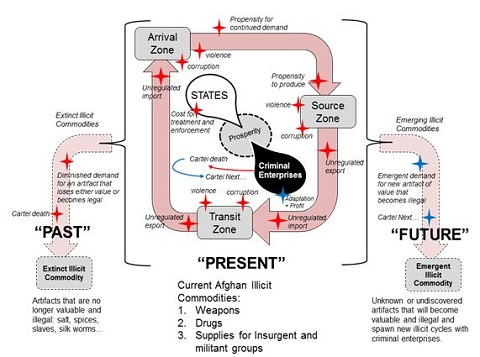
For Afghanistan in particular, this article focuses on the illicit commodity cycles of opium, illegal weapons, and insurgency-related physical supplies and how this cycle perpetually destabilizes all security efforts. Building upon the highly abstract relationships and tensions illustrated in figure 1, this article depicts one way of explaining the cycle of illicit commodities in Afghanistan in figure 2 where each zone reflects any of the disarmament and reintegration, counter-terrorism, counter-insurgency, or counter-drug efforts. The arrival zone for disarmament and reintegration efforts would be any region where Coalition and host-nation security forces create a high demand for illegal weapons by disarming illegally armed groups and seizing weapons. For counter-drug efforts, the arrival zone morphs into neighboring countries such as Iran, Pakistan, and other Central Asian nations where 60% of global consumption occurs.[31] Figure 2 illustrates how any illicit item in the complex Afghan system accelerates through this conceptual cycle where corruption and violence spawn greater innovation and adaptation by criminal enterprises as well as insurgent groups. The overarching explanation of figure 2 goes to the principle argument against the current disarmament fixation on weapon-centric metrics. Simply focusing on weapon seizures not only fails to disrupt the illicit commodity cycle, but it may actually strengthen it.[32]

Figure 2 - One Way to Depict the Abstract Illicit Commodity Cycle for Opium and Weapons
The above graphic reflects one way of illustrating the explanatory qualities of critical thinking and Design with respect to the complex Afghan system. The first emergent quality from this abstract cycle are the self-organizing and adapting criminal enterprises; security forces can target and eliminate one criminal enterprise, but the destruction of one evokes the growth of another to take the place and adapt new behaviors. Attempting to target one organization or cell may begin to feel like a game of ‘whack a mole’ for Coalition and Afghan security forces. Essentially, the next iteration of gun, drug, or insurgent supply smugglers learn from predecessors and innovate.[33] As criminal enterprises advance through multiple iterations of this cycle, they apply greater levels of corruption and violence which disrupt and weaken state institutions in all three zones; simply targeting illegal weapons in the arrival zone fails to address the entire system from an ontological perspective.[34] Or, taking away heroin from drug addicts in a region of Southern California without subsequently treating their addiction problems only increases the propensity of the drug cycle and actually benefits criminal enterprise because the addict continues to desire the illicit commodity.
Seizing 117,538 light weapons from combatants and illegally armed groups over eight years (DDR and DIAG cumulative) without adequately addressing a quantifiable and systemic reintegration process demonstrates a similar short-sighted application of metrics that treat only symptoms of the larger illicit cycle.[35] As an unnamed Australian Special Operations Commander explained to a reporter after a recent drug and weapon cache seizure, “so the more it’s reduced the better it is for Afghanistan.”[36] Perhaps in the short term, but until the military as an organization begins considering effects beyond one element of the entire illicit commodity cycle will long-term conditions actually change for Afghans? Have the past decade of disarmament and reintegration initiatives been overly focused on disarmament without the same level of emphasis on post-disarmament reintegration?
Reintegration: Integral Component or Obligatory Afterthought?
The DIAG 2010 annual report’s conclusion on post-disarmament compliance acknowledges this oversight in understanding illicit commodity cycles tacitly by stating, “developmental and livelihood incentives may be enough to cause certain [illegally armed groups] to disband and to achieve initial compliance in a target district, depending on the circumstances, socio-economic development and sustainable livelihood provision for locals may not be enough to present a relapse into insurgency.”[37] The DIAG report, while rich in detail and charts on describing the weapons seizure metrics of success, provide significantly less quantifiable data on the post-disarmament ‘alternate livelihood packages’ for targeted beneficiaries and acknowledge that this portion of the program only started in June 2009, over seven years after Coalition and host-nation forces started disarming and disbanding Afghans.[38]
Reintegration metrics and efforts appear to be less prominent in DDR and DIAG strategic planning than the more tangible and metric-friendly weapon seizure and illegal group disbandment efforts. The Afghan Peace and Reintegration Program (APRP) takes the inverse approach by registering weapons and paying ex-combatants to cease fighting, yet “wage grades will be low enough to avoid pulling people out of other stable occupations yet high enough to compel continued enrollment in the program.”[39] Additionally, APRP stipulates in its highly abstract draft plan that a basic principle of the community based reintegration program should “avoid the appearance of giving special benefits to people who joined the insurgency compared to villagers who remained peaceful.”[40] Following the APRP reintegration logic, they will pay combatants with international donations enough money to win them over, but not more than what legitimate salaries are in that area, and combatants should not get more money than those that did not fight in the first place. If this sounds confusing to you, how will it appear to citizens of a war-torn nation with some of the lowest literacy rates, life expectancy rates, and extreme poverty rates in the world?
Returning to figure 1 and the quad-chart of value-legality tensions, disarmament and reintegration efforts appear to focus on eliminating weapons and armed groups that self-organize in Q4 where weapons, drugs, and other illicit commodities are valued yet outlawed. Seizing these items does temporarily inhibit any violence or criminal activity of disarmed persons, yet only focused reintegration efforts will subsequently move those disarmed persons from Q4 to Q2 where they support a legal economy, enhance security efforts, and support national prosperity. Therefore, any strategic planning for overarching disarmament and reintegration objectives must synergize lines of effort that coordinate Coalition, Host Nation, and intra-agency efforts to simultaneously and holistically transform each of the major cycles disrupting Afghanistan. This article argues that illegal weapons, drugs, and terrorist support all are in perpetual illicit commodity cycles that adapt and apply greater forms of violence and corruption to gain prosperity and generate entropy for the Afghan state. The concept of ‘greater forms of violence and corruption’ does not necessarily imply ‘more’ violence than a previous year or period- but a more effective and adaptive form that strengthens the criminal enterprise and makes it more resistance to Coalition efforts. By engaging in strategic level campaign planning across the military and other instruments of national and international power, the Coalition might target all of these illicit commodity cycles and require new metrics that go beyond the linear causality associated with DIAG ‘weapons-centric’ quantification.
Transition represents the greatest concern for proper allocation of limited Coalition resources for the period the Afghanistan conflict is currently entering in 2011-2014. As Coalition forces begin their draw-down of combat forces and the Afghan security forces begin complete transition to essentially independent operations with Coalition enablers, where and how assets, time and treasure are dedicated will likely determine whether the long-term future features an Afghanistan where more weapons circulate in a perpetual disarmament cycle of instability, or where a holistic approach to conflict management accomplishes enduring security accomplishments through precise and coordinated action.
As reasoned earlier, the over-emphasis on weapons-related metrics for disarmament and reintegration strategies undermines the very behavior of illicit commodity cycles and generally fails to really address reintegration beyond the initial fighter conversion. Instead of removing weapons from Afghans that have little alternative for income other than fighting the Coalition or committing crimes, we ought to emphasize creating persistent conditions where economic and social improvements drive combatants and illegally armed groups to choose to conduct legal actions and abandon weapon-related violence and corruption. In other words, if more Afghans had legitimate employment and income, they might find it harder to risk their livelihood for the costs associated with criminal activity and weapon-related violence; the very market for illegal weapons that DIAG continues to target would become merely a police-able requirement as it remains in most stable nations. Seizing or registering weapons does not appear to improve the economy, yet disarmament and reintegration strategies essentially throw money at the reintegration phase of their concept in the hopes of sparking some economic revival. Even the Najibullah government of the Soviet era hired Mujahedeen fighters and kept them armed in static security positions in order to employ more armed men and reduce the recruiting pool for the remaining insurgency and criminal networks threatening his regime. Disarming Afghans may not be a useful ends to a means, at least not from a historical context.[41] As this article attempts to explain, illicit commodity cycles are quite resistant phenomenon that will not succumb to short-sighted yet well intentioned efforts of existing disarmament and reintegration programs. Legal economies have as little chance in Afghanistan as a flower pot choked out with weeds. Sprinkling water on it will not help the flower grow.
