
Former CIA official and current Georgetown professor Paul Pillar, reacting to Bronner’s obfuscations, responds eloquently in a post in The National Interest:
There is no moral or legal equivalence between the fate of refugees forced by a conquering army from homes their families had occupied for generations, and the status of settlers installed by a conquering regime that later pulls them out. Nonetheless, it is ironic that the Israeli government appears to be employing the same technique—of using displaced persons to support an argument about an international dispute—that Israelis have long accused Arab regimes of utilizing.
As if to add insult to injury for the poor uprooted colonists, Bronner also reveals that “what was the settlement of Gan Or, part of the fields ha[ve] been renamed Mavi Marmara” (he describes last year’s execution of nine peace activists as the result of “tussles onboard”) and sorrowfully reports that the synagogue of the illegal Gaza settlement of Gadid, a “six-sided structure dear to the hearts of many former settlers,” has suffered an even more unspeakable fate: “Today it is a mosque.”
Bronner quotes former colonial farmer Shlomo Wasserteil, founder and curator of the Gush Katif Museum in Jerusalem, echoing the Zionist line of desert-bloomism when recalling his arrival in Gaza all those years ago. “There was nothing but sand, not even a bird, like the Sahara,” Wasserteil says. “We produced the best tomatoes in the world. We revolutionized cultivation in sand and taught our neighbors in Jordan how to do it.”
The idea of land redemption and development was enshrined in Israel’s own unilateral Proclamation of Independence which declared, “Pioneers… and defenders, they made deserts bloom, revived the Hebrew language, built villages and towns, and created a thriving community controlling its own economy and culture, loving peace but knowing how to defend itself, bringing the blessings of progress to all the country’s inhabitants, and aspiring towards independent nationhood.” (emphasis added)
That sentiment was reiterated last May during an Independence Day celebration by Israeli President Shimon Peres, who praised Zionist achievements this way: “We proved we can create a budding garden out of obstinate ground.”
And just last week, Prime Minister Benjamin Netanyahu, addressing the World Zionist Organization in Jerusalem, connected Zionist land redemption to the ongoing illegal colonization of the West Bank. “We are settling and developing the land – it is possible to see towns in Ariel, Ma’ale Adumim and Gush Etzion,” he said, “But we are also obligated to develop all parts of the country – the Galilee and the Negev.”
Israeli journalist and historian Meron Benvenisti has explained that such statements are the essence of classical Zionist mythology, reinforcing “the image of all Arabs as sons of the desert” and pitting “the barbarous desert against progress and development.”
Netanyahu’s own father, Ben Zion Milikovsky, revealed the depth of this ideology during an interview with the Israeli newspaper Maariv in 2009. When asked of his feelings about Arabs, the elder Netanyahu replied:
The bible finds no worse image than this of the man from the desert. And why? Because he has no respect for any law. Because in the desert he can do as he pleases. The tendency towards conflict is in the essence of the Arab. He is an enemy by essence. His personality won’t allow him any compromise or agreement. It doesn’t matter what kind of resistance he will meet, what price he will pay. His existence is one of perpetuate war.
In his seminal 2001 book, Sacred Landscape: The Buried History of the Holy Land since 1948, Benvenisti explains the purpose and consequence of such a narrative:
The Arab was “not only the son of the desert but also the father of the desert,” in the famous words of Major C.S. Jarvis – the British governor of Sinai – which were adopted by the Zionists. And thus the fallahin [non-nomadic Palestinians] – tillers of the soil for generation upon generation – could easily be transformed into “bloodthirsty desert savages,” who not only sought to annihilate the Jewish community but also were guilty of turning Eretz Israel – flowing with milk and honey – into desolate desert. In the textbooks for course in Knowing the Land, the Arabs are portrayed as being responsible for the ecological ruin of the entire country: they destroyed the ancient farming terraces, thereby causing soil erosion and exposing bare mountain rock; because of them the streams were blocked and the coastal valley became a land of malarial swamps; their goats ravaged the ancient forests that had covered the Land; with their violent feuds and their murderous hostility toward all agents of progress, they turned the Land into a perpetual battlefield.
Hence the Zionists did not rob the country’s inhabitants of their land; they redeemed it from desolation.
But the truth is that the Palestinian soil didn’t actually require expert Jewish agricultural know-how to produce fruits, vegetables, and the myriad other crops native to the land. Pre-Israel Palestine was not quite the barren dustbowl of Zionist fantasy – far from it.

In December 1945 and January 1946, a comprehensive Survey of Palestine was conducted and published by British Mandate authorities on behalf of the United Nations Special Committee on Palestine. The survey revealed that the land was rather prosperous for Arab Palestinians and Jewish farmers alike.
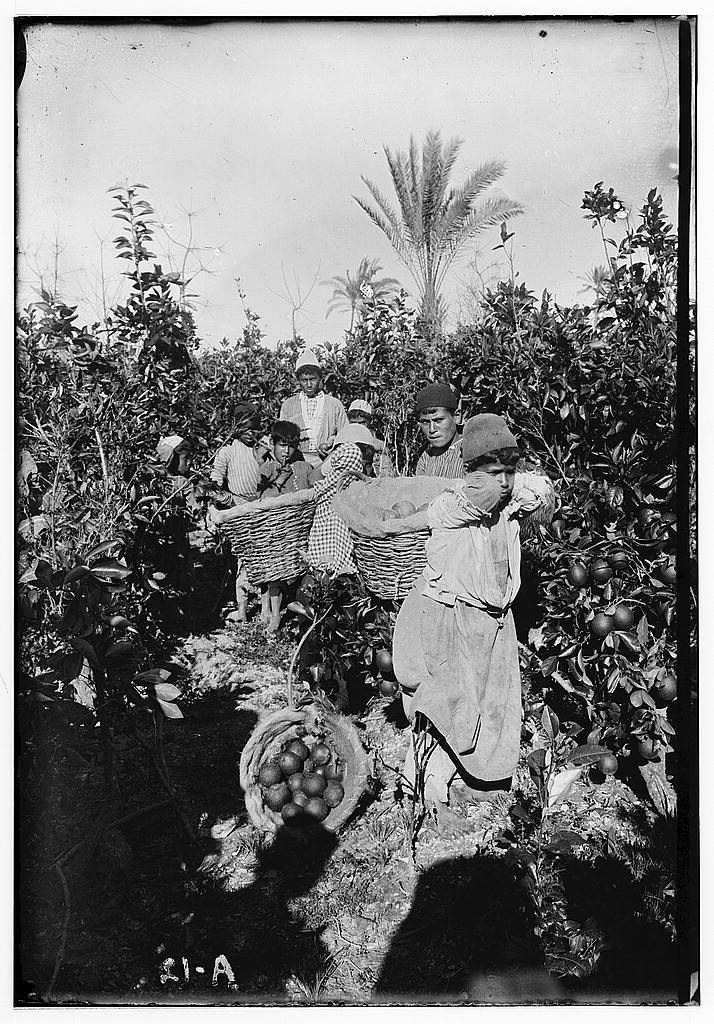
During the 1944-1945 planting season, nearly 210,000 tons of grain were cultivated in Palestine, of which 193,376 tons (92%) were Arab crops, compared to 16,579 tons of Jewish crops. Almost 80,000 tons of olives were cultivated that year, over 78,000 tons (98%) of which were grown by Arab Palestinians. Of the over 244,800 tons of vegetables produced in Palestine that season, Arab farmers were responsible for more than 189,000 tons (77%); of the 94,700 tons of fruit, Arab orchards produced 73,000 tons (77%). Almost all of the region’s citrus groves were Palestinian owned and operated. Nearly 143,000 tons of melons were cultivated, over 135,600 tons (95%) of which were Arab-produced, while almost all of the more than 1,680 tons of tobacco grown were on Arab farms, as were 20,000 tons of figs and 3,000 tons of almonds. Eighty percent of the 40-50,000 tons of grapes and 4-5 million liters of wine were produced in Arab vineyards. The survey found that in Jericho, Tiberias, and in the central coastal plain, “about 60 per cent. of the area (nearly 8,000 dunums) planted with bananas is Arab owned.” The overall price of the Palestinian agricultural yield that season was more than £21,800,000. Jewish cultivation was responsible for nearly £4,711,000 compared with Palestinian Arab production of over £17,100,000, accounting for almost 80% of total value.
