
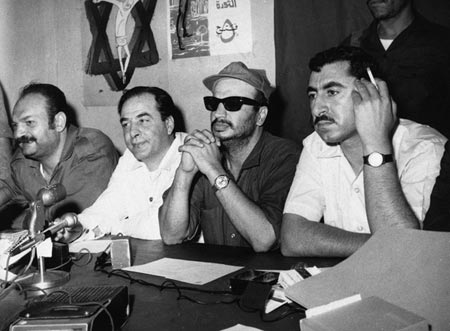
Yasser Arafat
Yasser Arafat (1929- 2004) was trained at the University of Cairo in engineering. He founded Fatah in 1957 as a guerilla group, which took its first action against Israel in 1965. Fatah joined the PLO in 1968. In 1969, he was elected as PLO Chairman. Arafat’s long leadership saw many trials and few successes. Under his leadership, Palestinians fought not only Israel but also fellow Arabs in Jordan and Lebanon. The Israelis soundly defeated his Palestine Liberation Army in 1982, as Israel invaded and occupied most of Lebanon, where the PLO had its headquarters. He and the PLO then moved to Tunisia.
Arafat proceeded to redirect the PLO from a Pan-Arab movement, as advocated by Shukairy, to one that is essentially a movement of Palestinian nationalism. He succeeded in getting the Arab states to agree; in 1988, the Arab states formally abdicated the Palestinian cause by simply proclaiming a Palestinian state, and in essence letting the Palestinians face the Israelis alone. Shortly thereafter, the Central Committee of the Palestine National Council (not the entire National Council) elected Mr. Arafat as President of Palestine. Mr. Arafat began to behave as a head of state instead of a leader of people trying to assert their rights for independence. Much of his trouble thereafter consisted of his inability to reconcile obligations of a head of a state (under occupation) with limited authority, with his role as leader of a resistance movement.
Mr. Arafat repeated many of the errors committed by the Grand Mufti. Supporting the Saddam regime in Iraq against an array of international powers, Mr. Arafat lost when the Saddam regime lost the 1991 war, and the Palestinian people paid a heavy price. Nearly half a million Palestinians were forced to leave Kuwait, losing much of their life savings. The Arab Gulf states, heretofore a mainstay of political and financial support to Palestinian organizations, froze their support.
Continuing the pace of unilateral action, i.e. without coordination with Arab allies, Mr. Arafat negotiated a separate agreement with the Israelis, the Oslo Accords, revised the Palestine Charter, and announced his recognition of Israel’s existence . In 1994, the Israelis withdrew from Gaza and Jericho. Mr. Arafat was allowed to return to Palestine. In 1996, he was elected president of the newly formed Palestine National Authority (PNA), the governing structure for areas that Israel was supposed to vacate. Presidential elections were accompanied by elections for a legislative council. Upon “advice” from the United States and Israel, no one who did not publicly support the Oslo Accords was allowed to be nominated. While the majority of Palestinians supported the basic direction of the Accords there were significant numbers, perhaps as many as one third or more, who did not buy-into the Accords. Even potential candidates who were not sure did not have a chance of being elected. The result was to marginalize significant numbers of Palestinians, leaving them no seat at the political table, and forcing them even farther from the dominant Fatah group. The Palestinians have spent the years since trying to bring these groups within the larger political umbrella, with some measure of success.
Mr. Arafat’s legacy as the symbol of Palestinian resistance to Israeli excesses cannot be underestimated. For nearly four decades he championed the cause of his people. He tried guerilla tactics and peaceful negotiations. He succeeded in keeping the cause of Palestinians alive. He helped tremendously in preserving Palestinian identity. He did not allow setbacks, and there were many, to distract him from the Palestinian ultimate goal, shedding Israel’s control and preserving Palestinian rights. He succeeded, when Al-Husayni and Shukairy failed, to bring into the PLO sons and daughters of all Palestinians, not only those of prominent families.
Unlike the two first Palestinian leaders, Arafat had an opportunity to lay the foundations for a Palestinian state. The Oslo Accords did not establish a Palestinians state, but outlined intermediate steps after which a state could be established. A five-year preparatory stage was to see gradual Israeli withdrawal, followed by Palestinian gradual assertion of authority. Even under very difficult conditions there was a chance for Palestine leaders, especially Mr. Arafat, to show the Palestinian people and the world at large what kind of a state the Palestinians would establish, if given a chance. What transpired under Arafat was not encouraging. Palestinian leadership did not seem to want, seek, or encourage wide consideration of its actions by the Palestinians within or outside the territories. Secretive deliberations necessary in a resistance movement continued under the PNA as did the autocratic behavior of the one leader and his close cohorts. Neither Mr. Arafat nor any of the other Palestinian leaders found it necessary or convenient to ask too many Palestinians what their vision for a new state may be, nor consulted them widely on issues of vital importance to the future of Palestinians, such as the Oslo Accords, the first Palestinian elections, participation in the negotiations that followed the Madrid Conference, or any of the similar crucial issues.
The high-handed attitude permeated the first Palestinian elections. Many questioned the results of the elections primarily because there were no opposition candidates, and because there were numerous violations of election procedures that threatened the integrity of the elections results. Arafat, according to CNN (January 20, 1996) was “criticized for conducting the election the way he ran the revolutionary Palestinian Liberation Organization: autocratically, arbitrarily, and without accountability”. Islamic groups boycotted the elections, as did many poor Palestinians who were convinced that the elections could only benefit the rich; others boycotted the elections believing that Oslo was insufficient. Despite lack of opposition, candidates Palestinians from all political persuasions participated in the elections. This is a testimonial for the thirst for participation in the political process among Palestinians; about a million Palestinians registered to vote, and participation was described as “heavy”. The head of the Palestinian Election Commission (the same Mahmoud Abbas now President and former prime minister) told news media four hours after the polls opened that “the biggest problem is that ballot boxes which were designed to international standards filled up”. A sample of party affiliation showed: 57.4% Fatah, 6.9% Hamas, 4.5% PFLP, 3.3% Hizb Al-Sha’b, 2.0% Islamic Jihad, and about 24.5% Independents. Ten years later, in 2006, Hamas and Fatah reversed roles.
Arafat was allowed to return to Palestine with a significant number of his Palestine Liberation Army, now designated as security forces and equipped with a limited number of small arms. Israel thought this force was necessary to achieve “security” in the territories it was to evacuate. Israel also knew that this force could not be a threat to Israel in terms of numbers, training, or armaments. It did not take long before the PNA began to use its security forces against its own people. The PNA acted much like any repressive neighboring regime. Security forces employed informers in the universities, and other social organizations. Security forces beat and tortured other Palestinians for political reasons. Prominent Palestinians who signed a statement critical of the PNA were detained. Hundreds were arrested without charge or trial. A few were executed by state security courts or unlawfully killed during demonstrations. The PNA’s record in protecting and promoting Palestinian human rights cannot be excused.
In 2000 the second Intifada began as a tool to counteract Israeli pressures. It did not accomplish much other than result in the death of thousands of Palestinians, devastation of the Palestinian economy, and extensive damage to the Palestinian social fabric. Relations with Israeli peace activists suffered. International support turned more to the process of peace rather than to the content of peace with Israel. It is tragic that the second Intifada cost Palestinians almost as many lives as did the 1936 uprising led by the Grand Mufti and turned out to be equally as poorly led.
Arafat departed the scene a controversial leader. Towards the end of his life he was marginalized by the Israelis and the Americans and forced to spend the balance of his life in deplorable conditions amounting to house arrest in a British-built regional government building and prison. The cause of his death is still unknown, many Palestinians believing that he was poisoned. It is rumored that Arafat himself told associates that Israelis finally “got to me through the kitchen”.
There were many Palestinians who did not like Arafat’s one-man leadership style, but few challenged him. First, there was a general and understandable feeling that, given the fateful struggle against Israel, it would be a disservice to the Palestinian cause for Palestinians to engage in personality struggle for leadership; Palestinians had to rally behind their leader in time of war regardless of the leader’s apparent weaknesses. Second, Arafat was a charismatic leader. Third, Israel had embarked on a deliberate policy to assassinate budding and potential challengers to Arafat, who could have been more effective anti-Israeli leaders. One can name even close associates of Arafat who were assassinated by Israeli hands, such as Khalil al-Wazir and Salah Khalaf, who may not have been as agreeable to the provisions of Oslo. Tens of other potential Palestinian leaders, including leaders of Hamas and other Palestinian political organizations, were assassinated. A fourth reason may be that the largest group of Palestinians outside of the occupied areas are now in Jordan and since 1969 Palestinians in Jordan have been very careful about asserting being Jordanians first, thus avoiding taking leading roles in Palestinian organizations.
