
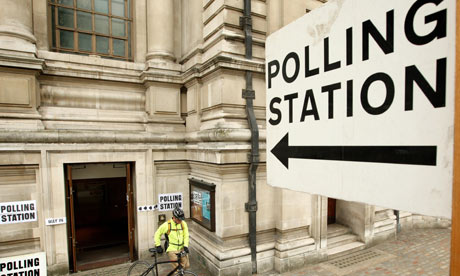
The additional member system means that voters can still look to one Member of Parliament as the person responsible for the concerns of the unique geographical area (constituency) in which the voter lives. It retains a part of the traditional British election process that is a legacy to many other countries, including the United States. With the second component in place – the party list voting – voters can make a statement as to their party preferences. Most analysts believe that the Liberal-Democrats would have won considerably more seats under AMS, to the detriment of the two larger parties, than they can now claim. This proposal is fair and relatively simple – two criteria for an effective election system. It retains a part of the traditional arrangement but adds a new element which takes into account of Britain’s emerging two party plus political process.
Readers who are not familiar with parliamentary politics in the UK might find the language in the agreement to the effect that “Both parties will whip their Parliamentary Parties” a bit extreme. What the agreement means is that the leaders of Conservative and Liberal Democrats will make a vote on this measure a matter of party policy which the members are obligated to support. Nearly straight party voting in the House of Commons is the norm and members elected to that body know of this requirement when running as the candidate of a particular party. This feature of British politics always distresses Americans but it is understood there.
The Conservative party, at least many of its members in Parliament, do not want to see the alternative vote enacted because some of them will lose their positions. Party leaders agreed to bring the issue to the public in a referendum as a price to be paid to entice the Liberal Democrats into a coalition; so the whip will be applied and the outcome will be determined by the voters.
The Liberal Democrats no doubt sought a commitment from the Conservative leaders to support a positive vote on the referendum, but being cognizant of the membership’s misgivings they promised only to put the issue to a popular vote. This leaves options open. I predict that the Conservative Party leadership will offer a tepid, pro forma endorsement of the referendum, but will release its members in Parliament from the whip and allow them to campaign and vote for or against the measure as they see fit.
I also believe that the opposition Labor Party will probably follow a similar strategy, both in Parliament and in the referendum, based on the same rationale as that of the Conservatives. In supporting the authorization of the referendum the party leaders can avoid being accused of resisting change but by releasing members to do what they want with respect to the popular vote they can hope that it will be defeated.
The eventual referendum – on the alternative vote or the additional member system – will probably fail without the total support of either the Conservative or the Labor party, which together won almost two thirds of the popular vote in the last election. Although the two larger parties have officially endorsed electoral reform, neither is enthusiastic any change which will reduce its power. The Liberal Democrats do not have a sufficient popular following to carry the day alone.
The entire text of the Coalition Agreement is available here:
Additional details about the three election systems discussed in this article and about other processes can be found at the website of the Electoral Reform Society:
http://www.electoral-reform.org.uk/article.php?id=5
My primary purpose in writing on this topic is to initiate a discussion in the Foreign Policy Journal Forum. I raise and comment briefly on two questions I believe to be relevant and invite others to add their expertise and observations. In addition, I think participants could broaden their reading on the topic by sharing links to other stories and analyses they have found. Interested readers can participate here.

Thank you for initiating this discussion!
The Liberal Democrats do not advocate replacing the FPP with the Alternative Vote. A referendum on AV was simply the best concession they could wring out of the Conservatives at this time.
The Lib Dems advocate using the Single Transferable Vote, a proportional system that uses a preferential ballot like AV, but in multi-member constituencies. They hope that AV will be a stepping stone to a fully proportional system.
AV is not a proportional voting system, and it remains to be seen whether it will help the Lib Dems. As can be seen in Australia and Nauru, the only places to use this voting system to elect their national legislatures, It tends to stifle diversity even more than FPP.
The Lib Dems also obtained a commitment to a House of Lords fully elected through a proportional system. This may turn out to be their most important achievement.
As for a single national party list, it works well enough in Israel and Holland, two places that are small and relatively coherent, at least geographically, but most countries, especially federations, use regional lists. It would never fly in the UK, a place with strong and fiercely independent regional identities.