
The question is not how Turkey can be integrated into Europe, but rather how the Turks can become Europeans
New Turks are needed to achieve a new Turkey
The formation of the Turkish nation—that is, of the Turkish identity—is a process that has not yet ended, and the West should not lose the chance to get actively involved to help the Turkish nation become more modern.
Today, there really are three geographical and three political Turkeys. The “European” Turkey has the greatest potential to integrate with Europe. If Turkey was comprised solely of Istanbul, Eastern Thrace, and Izmir, and a population of 25-30 million, it would have fewer problems in terms of its integration with Europe. However, Turkey’s central and eastern parts are burdensome in this regard to its western parts.
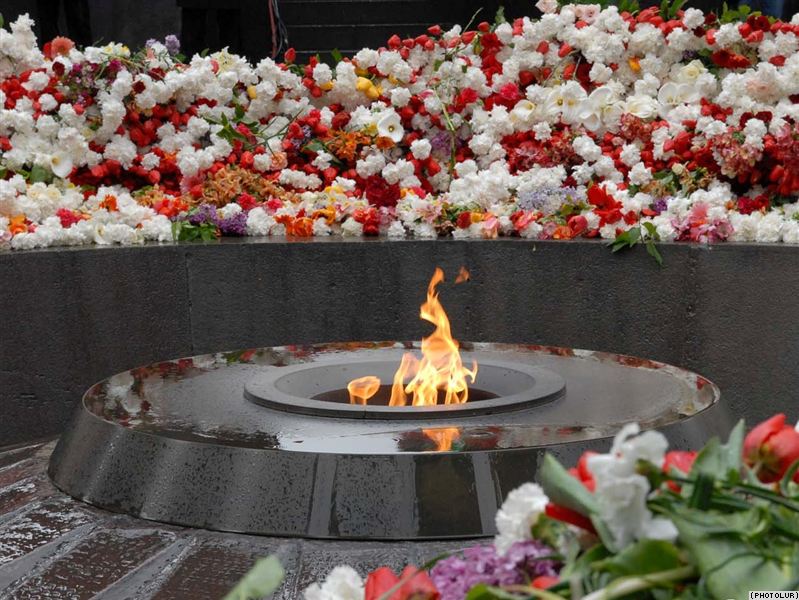
The Armenian Genocide Memorial in Yerevan. April 24 marked the 95th anniversary of the genocide perpetrated against Armenians in Ottoman Turkey (Photo: RFE/RL)
The “political” Turkey, too, is divided into three parts. The Islamists, who dominate the modern-day Turkish society, have taken advantage of the opportunity endowed by democracy and are gradually “conquering” the secular nationalists, who were in power until 2002. The latter are the second major power in the political domain. The followers of Kemal Ataturk still have an overwhelming influence on the army and within the “deep state”.[1] And third, the weakest political division is comprised of the liberals and the Kurds who, even though they have different objectives, are nonetheless united against the clerical-nationalist political elite that rules the country, and against this elite’s characteristic mentality. And those who think that the creation of an independent Kurdistan in southeast Turkey can resolve this country’s main political and ethnic problems need to consider the fact that if this happens, Turkey’s progressive society could lose an ally in the form of the Kurds.
So, which of these Turkeys will the West support? What kind of a Turkey do the United States and the European Union want to encourage? That of Orhan Pamuk and Hrant Dink, Ibrahim Baylan and Yilmaz Kerimo, or that of Talat and Erdogan?[2]
After eight years of governance by the Islamists, it has become clear that their mindset does not differ all that much from that of the nationalists. Perhaps the most significant difference, however, is the fact that the modern-day Turkish republic has renewed its nationalist foundation with a clerical influence, which existed under Ottoman rule but has now become even stronger. Turkey, to that end, is not even hesitating to take steps that run counter to the interests of the democratic world. The Turkish diplomats continue to “urinate”—in both the literal and figurative sense—on the walls of Western embassies.[3]
Former Sovietologists must deal with Turkey
In actual fact, the former powerful empire, today’s Turkey still remains—albeit smaller—an empire; and its working mechanisms are virtually similar to those of the former USSR. Turkey has to go through the path of social democratization, ridding of ideological rhetoric, and the decolonization of its nations and nationalities, which the USSR went through by way of honoring and defending the rights of national, religious, and other minorities. Therefore the former Western Sovietologists and those new Turkologues who have received political and academic schooling from these Sovietologists can more efficiently deal with Turkey’s problems.
Despite the fact that in 2009 the Armenian-Turkish Protocols were signed with the goal of improving relations, the correlations between the two countries and peoples were much better in the past than today. This demonstrates how important it is, and specifically for its neighbors, that Turkey faces its history and that its citizens fundamentally change their way of thinking.
Some Western political scientists are hopeful that democracy will sooner or later come to Turkey, that its two extreme poles will ultimately discredit one another, and that, until then, the moderates will remain Turkey’s partners with the West.[4] But the true picture in Turkey shows something different: its society is becoming more fundamental, both in terms of Islam and nationalism.
The West failed in Turkey’s social and human modernization
In fact, in the past 65 years, the West has not been able to comprehensively assist in instilling civilizational and human values in Turkey. Hence, out of Turkey’s current population of 70 million, its liberal and civil societies are comprised of a mere 4-5 million, at best. And if we factor in the verity that this number is greatly constituted of the different national, religious and other minorities, just like at the turn of the past century, the fiasco for the West becomes especially apparent. Thus, when the Turkish Prime Minister Erdogan declares that he might deport all Armenian citizens living in Turkey, the protests against such statements coming from within Turkey are hardly audible.
The fact is that, even after Turkey’s 65-year permanent presence in the Euro-Atlantic mainstream, open-minded writers, journalists, and social and political figures are still being persecuted in that country, such as the prominent liberal-thinking Armenian journalist Hrant Dink, who was murdered. Before arresting his murderer, police officers first took their photographs with that killer, seen as a national hero. After all this, several tens of thousands of freethinking Turks took to the Istanbul streets to protest, shouting “We are Hrant Dink,” and “We are Armenian.” But the fact that such relatively few numbers of people spoke out leaves a lot to think about.
Moreover, the tremendous amounts that Western democratic funds have spent in order to “Europeanize” this Asian nation have in effect brought discomforting results, and this is a basis for concern. The strong “machine” of the “United” Europe, which is able to assimilate Iranian, Afghan, Indian and Lebanese immigrants even to this day, has, over the course of numerous years, demonstrated its incapability to assimilate the Turkish immigrant minority. It is not surprising that the Europeans are not in a hurry to grant Turkey access into the EU; otherwise what will the concept of a “European” transform into?
It is apparent that immediate and fundamental measures are needed to resolve this problematic issue. A new and effective plan is indispensable, or else the problem will become more complicated. And Turkey is already doing this. Based on the death of several scores of people during the street clashes in China’s Xinjiang province, it is accusing China of carrying out genocide against the Uighurs and Israel of organizing genocide in Gaza, but at the same time it is considering as absurd the fact of genocide in Darfur, where the Sudanese government—which is cordial to the Turkish government—and its lackeys have exterminated hundreds of thousands. And after all this, how can we hope that modern-day Turkey will acknowledge the sin of the Ottoman leaders, in 1915, of not only organizing and executing the genocide of the Armenians, but also of leaving the genocide survivors without ninety percent of their homeland, where the Armenian people had continuously lived for over three millennia?
So, let us call it like it is. The majority of Turkey’s ruling elites need to overcome nationalism. Will “political correctness” force the social and political figures of the West to persistently remain silent? Wouldn’t this tolerance cause the further deepening of nationalism, which we have already seen in Europe many years ago? In the event its demands are not implemented, Turkey is already threatening the world with destabilization in the Caucasus; that is to say, with instigating its “younger brother” Azerbaijan to start a war against Armenia. Azerbaijan is already spending more for just its military needs than all of Armenia’s state budget, and Turkish military instructors are teaching their Azerbaijani kinsmen everything they have learned from their Western partners. Do we have to wait until a segment of today’s Turkish elite turns into new Taliban, and talk and take action only after that?[5]
The Turkish prime minister’s statement that if the Armenian communities of the Western countries continue their campaign toward the recognition of the 1915 Armenian genocide, all Armenian nationals living in Turkey can be deported—(incidentally, the genocide of 1915 likewise had begun with the deportation of the Armenians)—is, unfortunately, wholly pragmatic in light of domestic politics and the upcoming elections in Turkey. Erdogan knows all too well what must be said so as to be liked by the majority of Turks, and he knows which dispositions must be complied with in order not to lose the electorate and to remain at the helm of power. He is simply satisfying the domestic social demand for the chauvinistic and xenophobic political product.
This is a demand that is growing by the year under the international community’s silent encouragement and the continued attempt, in the framework of the false “political correctness,” to not notice it. The facts are telling. Covering a sociological survey, the Hurriyet Daily News notes that 50-70 percent of Turks do not want to have an American, Jewish or a Christian neighbor, while 54 percent either tolerate torture or finds that it should be legalized.[6] This survey, which was conducted under the leadership of two professors from Turkey’s Sabanci University, clearly demonstrates that a mere 12 percent of Turks have a positive view of Christians; 10 percent, concerning the Jews; and 7 percent, with respect to the atheists. The absolute majority of Turks do not share Western values. According to the opinion poll conducted in 2009 by the PEW Research Center, 69 percent of Turks stated that he or she “does not like” the United States, and only 14 percent had warm disposition toward that country. In addition, 37.5 percent of Turks consider the United Sates to be Turkey’s main foreign political adversary. Fifty-nine percent of Turks confess that they do not like the European Union, and this is significant since 55 percent of Turks want to see their country in the EU.
In line with the 2009 Report of the European Court of Human Rights, Turkey was in first place—with 2395 petitions—in the number of petitions the Court had received concerning the violation of human rights. On top of that, the 2009 indicator had increased by 27 percent in comparison with the 2008 indicator.
Turkey’s Ministry of Culture and Tourism has launched an extensive plan aiming at restoring and renovating the monuments belonging to the Ottoman Empire’s cultural heritage in the Balkans. This is so even while thousands of monuments belonging to the Armenian cultural heritage are either being or have already been destroyed. In all probability as an act of “compensation,” just one Armenian cultural treasure, the church on Akhtamar Island in Lake Van, was renovated—but it was prohibited to place a cross on it.
Today numerous Western funds are spending tens of millions of dollars and euros to convince Turkey’s neighbors, and in particular the Armenians, that this country is no longer what it was back in 1915, that it has now become humanistic and fairly democratic. Perhaps it would be more effective if those amounts were spent on really changing the Turks.
Thanks to the ushering in of a new purpose that had started from Gandhism, the British colonialism of the 20th Century changed into global political responsibility toward the end of the last century and, attributable to the Denazification of 1945, the German colonialism turned into global repentance and atonement. The Ottoman colonialism, on the other hand, because of the superpowers’ centuries-long and still continuing coaxing and encouragement, became a global neo-Ottoman, multi-vector, and pretentious arrogance and hatred.
The matter concerning the surmounting of nationalism in Turkey has remained contemporary since 1915, and the aforesaid denazification methodology is probably applicable and effective.
Is a liberal Turkey possible?
Throughout the eight centuries of its existence, by having assimilated the millions of Greeks, Armenians, Jews, Laz, Kurds, northern Caucasians, Albanians, and Arabs who lived in it, the Turkish nation truly possesses a sufficient potential to become more modern, democratic, secure and predictable. However, this can take place not thanks to, but in spite of the nationalists and the radical Islamists. Turkey’s newly-forming, yet still small liberal-democratic civil society, which is primarily concentrated in Istanbul, can reveal the hidden civilizational potential of this young ethnos. It is not a happenstance that, over the course of its several-century existence, Turkey for the first time gave to this world a fairly estimable cultural figure, in the person of Orhan Pamuk.
If today the West does not become successful in substantially supporting and defending the movement by the progressive segment of the Turkish society, it is clear that this possibility will not exist tomorrow, when official Ankara finishes its geopolitical positioning change in the Greater Near East in the opposite direction of the universal human values.
On the verge of the anniversary of the 1915 genocide of the Armenians in Ottoman Turkey, we are compelled to accept the fact that the Armenian people, who have become the victims of that terrible tragedy and have been left without their homeland, still do have all the grounds to be concerned. And it is not only the Armenians who should be concerned.
__________
[1] The typical expression of this phenomenon is the “Ergenekon” organization.
[2] Orhan Pamuk is a progressive Turkish writer and a Nobelist; Hrant Dink was the editor-in-chief of the Agos independent Armenian weekly newspaper, and he was killed by a Turkish nationalist in 2007; Ibrahim Baylan and Yilmaz Kerimo are the Swedish parliament’s Turkish-origin MPs who voted in favor of that country’s recognition of the 1915 Armenian; Talat Pasha was the minister of the interior of the Young Turk government during World War I and one of the organizers for the Armenian genocide; Recep Tayyip Erdogan has been the head of Turkey’s Islamist government since 2002.
[3] An incident took place on April 7, 2010 in which the Turkish ambassador to Afghanistan urinated on the wall of the U.S. embassy in that country.
[4] Nick Danforth, “How the West Lost Turkey”, Foreign Policy, November 25, 2009 http://www.foreignpolicy.com/articles/2009/11/25/how_the_west_lost_turkey?page=0,1
[5] Let us remember that the Taliban, too, had gained strength due to efforts by the West.
[6] http://www.hurriyetdailynews.com/n.php?n=mamma-li-turchi-2009-11-19

Hovsep’s dislike for Turkey and Turks is evident in the article. In order to portray a negative image, Hovsep has handpicks and misconstrues evidence and occasionally presents hearsay and rumors as facts.
Rather than condescendingly throwing advices to a country ten times the size of their own, Hovsep should give some advice to his own Armenian masters. As a result of Armenia’s ethnic cleansing policy, today it is a mono-ethnic country with Armenians constituting 99% of the population. Just 20 years ago, your government occupied 20% of a neighboring country and ethnically cleansed close to 1 million people. And here you dare to lecture us about the virtues of liberalism and accepting differences. Armenian nationalists continue to poison every forum where you are present with their extremist nationalism and use the tragedy of 1915 as a cover for your current corrupt policies. Take a piece of advice, be normal people, accept others right to live, stop your expansionist policies and people around you will also change. It is time for you to understand that the world is not revolving around your tiny country.
For instance?
For instance:
> “In the event its demands are not implemented, Turkey is already threatening the world with destabilization in the Caucasus; that is to say, with instigating its “younger brother” Azerbaijan to start a war against Armenia. ”
When and how did Turkey exactly threaten the world with destabilization in the Caucasus and instigated Azerbaijan to start a war against Armenia?
////Hovsep’s dislike for Turkey and Turks is evident in the article///
Where did you find dislike? For me it looks like European roadmap for Turkey. If being civilized is an insult, I confess.
///In order to portray a negative image, Hovsep has handpicks and misconstrues evidence and occasionally presents hearsay and rumors as facts.///
For example?
///Rather than condescendingly throwing advices to a country ten times the size of their own,///
Yes size matter. It’s like shut your mouth since I am more powerful. Does this criteria stand for USSR before it’s collapse?
///Hovsep should give some advice to his own Armenian masters.///
And he does.
//// As a result of Armenia’s ethnic cleansing policy, today it is a mono-ethnic country with Armenians constituting 99% of the population.///
Wrong. Armenia was a bigger country and evil masters simply shrank the geographic borders to it’s mono-ethnic borders. So the fact of Armenia being 99% Armenian is a result of Stalinist and Kemalist policies back in 20-30s ov 20th century.
///Just 20 years ago, your government occupied 20% of a neighboring country and ethnically cleansed close to 1 million people. And here you dare to lecture us about the virtues of liberalism and accepting differences. ///
Wrong. Armenia never was considered as an aggressor by UN. It was Azerbaijan who started a war, started an operation of ethnic cleansing and as a result got what deserved.
///Armenian nationalists continue to poison every forum where you are present with their extremist nationalism and use the tragedy of 1915 as a cover for your current corrupt policies.///
Generalization, simplification and a result of agitation of Turkish Government. And this article is about this transformation. Every Genocide expert International Court of Justice regard 1915-23 events as genocide. But for you it’s “Armenian extremist nationalism”. Probably President Obama is also Armenian extremist nationalist or countries who recognized the Genocide “Russia, France, Greece, Sweden, Switzerland, Vatican City, Poland, Belgium, The Netherlands, etc.
/// Take a piece of advice, be normal people, accept others right to live, stop your expansionist policies and people around you will also change. It is time for you to understand that the world is not revolving around your tiny country.///
Yes, you sound like a criminal who says to the victim “shut up about the crime and we will be friends”
For reasons completely beyond any intellectual’s ability to fathom, Google features this website “Foreign Policy Journal” prominently. How a website with a list of “writers” whose names are only known to their mothers gets such a decent Google ranking should make one wonder.
Of course, this list of writers features people who clearly would be no friend to Turks, Turkey, or anything Turkish. Arabs–why do [some] Turks see them as “brothers” is beyond me??—Armenians, and members of other ethnicities with an axe to grind against Turkey clearly make up the editorial board.
At any rate, as to this hate-filled piece written above, why would anyone–especially a Turk—ever take seriously a single word of the claptrap above concerning how Turks should proceed on the path of development, when that claptrap comes from a misanthrope like this Armenian blogger who despises–again, I reiterate—Turks, Turkey, and all things Turkish? I think not. This cretin is not at all interested in the progress of Turkey, but rather its ostracism, subjugation, and dismantling as a republic. Go stew in your own hate.
Would you care to actually formulate an argument?
One more thing: this site has the status of a blog site apparently. This means that the articles lack any of the standards of scholarship whatsoever [no bibliography, footnoting, or endnoting], and that statements making claims are never sourced (backed up).
For example, the writer’s reference to the Turkish ambassador urinating on a structure at the U.S. embassy in Afghanistan. A Google search surely should have confirmed from an independent (unbiased) source that particular act, but the only search result is to this web page. If the writer insists on making such statements, then it is in the writer’s interest to make sure that such statements don’t get binned into the box with OUTLANDISH CLAIMS AND OUTRIGHT LIES written on it. Surely such an act should have—would have—made huge headlines. If there is video, it would be prominent on YouTube.com by now. I have enough shame to know that if I can’t back it up, I don’t bother to claim it.
Apparently the policy at FPJ is altogether different.
But then why is this not surprising?
You obviously didn’t bother having a look around. My latest piece is meticulously documented with 80 footnotes. http://www.foreignpolicyjournal.com/2010/04/17/al-qaedas-top-gun/
My piece before that is based on my book-length essay “The Rejection of Palestinian Self-Determination”, which is extensively documented with 87 footnotes. http://www.foreignpolicyjournal.com/2010/04/13/the-u-n-partition-plan-and-arab-catastrophe/
My piece prior to that is fully sourced with 20 footnotes. http://www.foreignpolicyjournal.com/2010/04/05/911-hijackers-not-on-flight-manifests/
It doesn’t help your argument to speak from a position of complete ignorance.
So to summarize – the Turks are all very bad bad evil people (except for a minority who are not real Turks). Very dissappointing to read such a poor piece of writing in this journal.
The article is not about Turks being good or bad. Your comment sounds like a reply of homo-soveticus to any criticism towards USSR. And the interesting finding of the author is that soviet experts would understand Turkeys problems better. Turkish identity is so fragile that is totally based on article 301.
I wish I could have my 5 minutes I back. Are we talking about same Turkey? Sometimes visiting a country you write about could help, of course before you write the article. I know the culture, people and it’s traditions very well and I assure you, you are far OFF.
That’s what I particularly got in the article: modern Turkey is a multilayer/multi-value society with political domination of specific layers who preach values not necessarily inline with European core values. It is not about culture, people or traditions which are deeply appreciated. I guess it is about power relations in Turkish state and society. Sometimes dealing with does could help to understand the article you read.
I found this link through google news and reading the site name, Foreign Policy Journal, I was expecting an intelligent analysis. Unfortunately this article is nothing short of a load of pish. Seriously you do your site no favours by adding such a bigoted and false piece such as this.
Having a different opinion is always healthy so long as you can back it up but blatantly lying and deliberately misleading the readers to create a misperception is disgraceful. At the very least if your credibility is important to you, this article should be taken down.
If you can point out any factual errors, I would be happy to post a correction.
Don’t you think blaming Turkey of colonialism which the author describes as “a global neo-Ottoman, multi-vector, and pretentious arrogance and hatred” is a little too much?
Also, I guess the British colonialism taking on a responsible form at the end of the 20th century happened after the Falklands war.
“Don’t you think blaming Turkey of colonialism which the author describes as “a global neo-Ottoman, multi-vector, and pretentious arrogance and hatred” is a little too much?”
This statement is true for Turkey-state, UK-state, US-state, Russia-State and some other state… So what?
Turkey all but totally annihilated its indigenous Christian population in the early 20th century: Armenians, Greeks, and Assyrians:
And it gives its few remaining Christians a hard time in various ways. There have been numerous authoritative reports on this, including by the US State Department.
Yet, Turkey cries crocodile tears because it has not yet been let into the European Union. Turkey complains that the EU is a “Christian club” (which it really isn’t since the Muslim Balkan countries will surely join the EU in the not too distant future).
is this not the utter height of hypocrisy? Turkey has a huge blind spot.
How can Turkey consider itself to be European (which is mainly Christian) given its treatment of Christians?
Also, if you read the real history of the Jews of Turkey, by Jewish scholars such as Dr. Jonathan Eric Lewis, you will see that Jews have left Turkey in droves over the years due to persecution and prejudice. I don’t think we need to go into how the Turkish government treats its other minorities, do we?
Of course, the mainstream media and foreign policy establishment don’t like to point out these facts to the American people. But one must admit there has been a bit more criticism of Turkey lately. That may be because Turkey has been nasty to Israel, and some people are striking back at Turkey to show Turkey that two can play that game.
No, Turkey is a long, long way from being European. By “long”, I mean never.
Also tell us what Armenia has done to befriend Turkey. I can’t be one way street.
One way street? Armenians didn’t commit genocide against Turks. Turks have a responsibility.
Well let’s have a look beyond 1992.
1. Armenia-state has not blocked its border with Turkey-state. Turkey-state blocked its border with Armenia!
2. Armenia’s citizens work in Turkey producing GDP for this state. Turkey’s citizens do not work in Armenia (except some of Armenian ethnic origin).
3. Armenia-state never threatened Turkish citizens to kick them off. Turkey did.
4. Many Armenia’s tourists visit Turkey and spend money there.
5. Armenia-state allows import of goods of Turkish origin (though Turkey blocked Armenia’s border, Armenia-state allows import of Turkish goods through third countries). Turkey-state embargoed goods of Armenian origin. No Armenian products can be imported to Turkey even from US or EU.
6. Armenian delegation in PACE voted for the Turkish candidate Cavusoglu for the Chairman of this institution. Very soon Turkey’s Cavusoglu took quite a partisan position towards Armenia.
7. Well, now something very very personal. 20th century. The brother of my grandgrandfather fought for Turkey the battle of Canakkale/Gallipoli. His family meanwhile has been massacred and deported from its home. So happened with hundred thousands of Armenians fighting for Turkey and Turkish people. Let me know if you find a single Turk fighting a war for Armenia-state!
So sad…I usually have nothing but respect for the amount of research and dedication the writers that submit to this site put in, especially when I find their arguments hard to swallow. However having read this piece I cannot honestly go about my life without having spoken on how poorly put together and argued this was. Where to even begin? The whole piece smacks of anti-Turkish sentiment and a veiled Islamic xenophobia. While I’ll be the first to admit the clash of secular nationalism and resurgent Islamic sentiment in Turkey makes for an interesting case study, this article did nothing to fairly analyze, discuss, or examine the root causes and possible outcomes of this phenomenon or its impact on EU membership. Using Turkey’s stance on Gaza and the Darfur issue and then tying that to the 1915 issue had to be one of the poorest examples of stretching to make the point I’ve ever seen. It seems the crux of the argument was “Turkey stop complaining about EU membership because of what you did in 1915”. Hardly a cogent position to take wouldn’t you agree?
Jeremy – I do understand that a proper response should include references and mayhaps a thorough rationale…but being this is a comments section there just isn’t adequate space to do this. I’d be glad to submit something to you though if you really do believe Mr. Khurshudyan’s argument is strong enough to warrant a response.
Tayeb, whether the author’s argument warrants a response is up to you to decide. I’d be happy to consider your counter-argument for publication if you were to submit one. That’s the point of FPJ, to encourage discussion and debate. The views and opinions of contributing writers are not my own. But I would reiterate that if people have criticisms, they should be specific and actually make an argument.
//It seems the crux of the argument was “Turkey stop complaining about EU membership because of what you did in 1915″. Hardly a cogent position to take wouldn’t you agree?//
Absolutely right! If you put the crux of the argument this way, the position is hardly cogent.
The point is that the crux of the argument seems different. It is “Turkey-state, unless you recognize what Turkey-state did in 1915, absolutely no guarantees exist that the Turkey-state will not commit the same once again. Whatever Turkey state will call it next time!” Truly consistent isn’t it?
When i am reading this comments, i am getting more and more sure that we should keep away from turkey and close all the European borders for Turks.
What I can feel from today’s Turkish policy, they are trying to be in a good relations with all neighbors. But the fact is that they have lot of problems because of nationalists.
Now they are playing with wrong partners actually they have not any strong partners because they think that they are very strong, they will loose this war if they will continue with same path. Today they want to get close to Europe but Europe do not want to have such a partner. Also they getting close to Iran but Iran is not enough.
So today Turkey play against Israel, Russia and somehow USA. Obviously they will loose like in WW1.
I have been reading comments that are presented as I understand by Turkish colleagues and it makes me feeling that Turkish society does not change from generation to generation. I have many times tried to persuade my Armenian fellows that Turks and Turkey have changed, as they now learn to listen others and rethink deeper about themselves and they are changing. But more I read such discussions, the more I understand they remain as they have always been throughout their short history in that part of the world. Assassination of Hrant Dink and recent statements by the nation’s leader – Erdogan about his idea to kick off all Armenians asses out of Turkey shows that Turks may read the history but they hardly learn lessons of it. What’s even worse, they learn how to make same mistakes again and again.
I see several controversial societies in the same geography – changing and unchanged Turkey’s in Anatolia. Moreover, several Turkey’s exist with different paces of change and transformation living one in another. While some transform themselves, the others live in XIX century. Istanbul is one, Ankara is another, Kurdish parts are third, and so on so forth – each depending on mentality of its people. You can fairly feel these multiple pace societies simply moving from one area to another.
I think if Turkey wants to prove that it is changing then it should really become an open society for its all minorities and even “majorities”. For that reason the logic of denazification is one of the first mandatory steps towards this end. I think that many other western countries are the best example proving the rightfulness of this statement.
If Turks and Turkey are changing then they firstly change their attitude and “listen” what other thinks and criticize about them. And we have to thank Hovsep for his article. Otherwise they prove in recent years that they are more of the same.
The defensive nature of negative comments made by Turks highlights how accurate the author found the issue of fragility of Turkish identity. Any criticism towards “imagined” construct – national identity – is considered insult and crime according to 301 article of Turkey’s penal code.
It’s so obvious that Turks can’t handle the criticism in a civilized manner and the process is very reminiscent to homo-soveticus’ behavior back to the USSR era.
I really like the approaching of Turkeys transformation problems from the Soviet knowledge point of view. For example, I am really becoming shicked and surprised by similarities when I am reading history of Lenin-Stalin-Beria trio and Atatürk-İsmet İnönü duo.
Moreover, West’s attitude and support to Turkey was based on politics against USSR. That’s why specialists of the USSR history, who know both sides of the history and politics, will be more impartial and understand better the crimes of Turkey (torture, non-democratic processes, oppression of minorities, anti-nationalism (anti pan-turkism) massacre, WW2 politics, military support to Turkey, total ignorance of human rights issues in Turkey, etc).
Yes, after the collapse of USSR Turks are shocked by the change of attitude and unraveling of history which west was ignorant before is considered as betrayal of allies. While the truth is what was kept in silence and ignored before the collapse of the USSR. Turkey in its artificialness of identity structure is somewhat similar to the USSR but the collapse of Turkey is not possible and wanted. So the author suggests transformation via denazification. It means -minimum- removal of the cult of Atatürk? But is Turkey ready for it?
I would like to express my gratitude to everybody who have praised my article and arguments, as well as to those who have criticized it or made me personal insults. I am sorry that the level of those critics or subjectiveness just confirms the concerns I have expressed in my article. It only gives an additional prove that even many intellectual Turks not only ready to change themselves, yet they even do not wish to hear or try to understand any criticism toward them. What we can say about the other Turks then? Indeed, “So sad…”…
1
Now, let us concentrate on the attitute of the Armenians towards the scholars or people who do not support their thesis:
The home of American Professor Stanford Shaw of the University of California-Los Angeles was firebombed in retaliation for his academic courage in disputing the Armenian genocide claim, in 1977
http://www.washingtontimes.com/news/2007/oct/16/armenian-crime-amnesia/
http://209.232.239.37/gtd1/ViewIncident.aspx?id=56624
Sixty nine academicians who specialized in Turkish, Ottoman and Middle Eastern studies from 44 different American universities and colleges published a declaration in The New York Times on May 19, 1986 and declared:
…….No signatory of this statement wishes to minimize the scope of Armenian suffering. We are likewise cognizant that it cannot be viewed as separate from the suffering experienced by the Muslim inhabitants of the region. The weight of evidence so far uncovered points in the direction of serious inter-communal warfare (perpetrated by Muslim and Christian irregular forces), complicated by disease, famine, suffering and massacres in Anatolia and adjoining areas during the First World War. Indeed, throughout the years in question, the region was the scene of more or less continuous warfare, not unlike the tragedy which has gone on in Lebenon for the past decade.
‘The resulting death toll among both Muslim and Christian communities of the region was immense. But much more remains to be discovered before historians will be able to sort out precisely responsibility between warring and innocent, and to identify the causes for the events which resulted in the death or removal of large numbers of the eastern Anatolian population, Christian and Muslim alike………… the history of the Ottoman-Armenians is much debated among scholars, many of whom do not agree with the historical assumptions embodied in the wording of H.J.Res.192. ….Such a resolution, based on historically questionable assumptions, can only damage the cause of honest historical enquiry, and damage the credibility of the American legistlative process’.
3
Recently, French Jack Lang who was one of the strongest supporters of 2001’s Armenian bill in French parliament, and was head of the then Parliamentary Foreign Relations Commission said he had voted against a controversial bill adopted by the French parliament making it a crime to deny recognition of 1915 incidents as “genocide”, because the action was abused for election interests. “The denial bill was passed with the aim of an election investment, not because they understood the pains of Armenians. Accordingly it is dangerous that history is made by politicians,” he said. The Armenian diaspora in France directed fierce criticism at Lang over his recently published remarks. Soon afterwards, he declared that he had not changed his position and would continue to fight for that genocide of the Armenian people be recognized especially in Turkey. http://armenians-1915.blogspot.com/2009/01/2729-armenian-tuggery-intimidation-in.html, http://www.lemonde.fr/societe/article/2009/02/03/genocide-armenien-le-mea-culpa-de-jack-lang-enflamme-le-net_1150313_3224.html
And at present saying what happened in 1915 is not genocide could be life threatening in Republic of Armenia. Imagine giving a conference with Turkish academicians there. And did you hear any Armenian who attempted to hold a conference advocating that Armenian genocide did not occur, in Armenia? Even Armenian historian Sarafian, the head of the London-based Gomidas Institute, said “Freedom of expression for historians in Armenia is limited and the genocide issue has become a political tool and for historical investigations Armenia is a wrong address
. http://www.hurriyet.com.tr/english/domestic/10426989.asp?scr=1.
2
The producers of the ‘historical documentary film Sari Gelin (www.sarigelinbelgeseli.com) suggested to interview some of these academicians. However they were rejected because these academicians and their families were threatened by the Armenians, via telephone calls and letters, in 1986 for signing this declaration. Justin McCarthy’s family had to get police protection. Prof. McCarthy himself was threatened with losing his job if he continued his research. http://turkishweekly.net/comments.php/id2418/top/comments.php?id=594, http://www.tallarmeniantale.com/69histors-charny.htm, http://www.tallarmeniantale.com/intimidate.htm
The Armenians sued Bernard Lewis, the French historian famous for his Middle Eastern and Ottoman studies, in France, in 1993 just because he wrote in Le Monde that ‘the 1915 events were not ‘genocide’.
American judge Samuel Weems’s life was threatened by the Armenians since he published his book ‘A terrorist State: Armenia’.
In Netherlands, Turkish origined party members who told that they did not agree with the Armenian thesis were discharged from the party, because of the pressure of the Armenian voters of the country.
Additionally, Turkish university students studying in the USA are under threat of Armenian students, just because they reject the Armenian claims. In some universities it reaches to such an extreme point that one young university student needs police escort.
‘Oath of Asala’ which is a branch of Asala declared that they would spare GAKAVYAN’s life in case he abandoned this apology project and disclosed the names of the people who urged him to do so, according to the Armenian newspaper “Azg”,http://www.radikal.com.tr/Radikal.aspx?aType=RadikalHaberDetay&ArticleID=921474&Date=14.02.2009&CategoryID=98. The petition of Dr. Armen Gavakian from the Macquarie University in Sydney, who is also co-chair of the Turkish-Armenian Dialogue Group would read “I apologize to the Ottomans and Turks for murders committed in the name of the Armenian people and I empathize with the feelings and pain of the Ottomans and Turks.”
1
The German General Bronsart von Schellendorff worked in Ottoman General Staff as Senior Chief Staff until 1917 . Here are a few excerpts from his declarations about immigration and resettlement of the Armenians after the murder of Talat Paşa in Germany:
‘The published advertisements, provacative brochures, weapons, ammo and explosives etc in total were proof of the fact that the uprising was being prepared by a third side. It was so overt that Russia provoked, supported and finansed this uprising. The entrique against the high rank soldiers and officials in İstanbul was displayed just at that time.
The Muslims who could be summoned to military service were already in the Turkish Army. So the Armenians did not face any difficulty to attempt a horrible massacre in a society which was not capable of defending himself. Because, they attacked not only from the Russian side, from the back of the Turkish Army in the East but they also exterminated the Muslim folk who lived in the region.
As a wittness, I want to note that the dimensions of the wildness displayed by the Armenians, was far worse than the so-called Armenian wildness for which the Turks were accused later.
First, the Turkish Army interfered with the situation, in order to keep its relations beyond the front safe. But the Army had to admit to the Jandarme since it had to use its all power to overcome the Russian superiority and the uprising was spreading all over the empire
[Bronsart von Schellendorff, Talat Paşa için Şahitlik, Ermeni Araştırmaları Dergisi, 4 (Aralık 2001-Ocak-Şubat 2002), p.78,79].
2
The German General Bronsart von Schellendorff’s second observation:
‘ Talat was not an unbalanced man, a revengeful murderer but a statesman who was far-sighted. According to him, the Armenians were very useful (efficient) citizens during peace time, although they were agitated and raged being provoked by the Russian and the Russian Armenians.
He hoped that they would be able to give life to fertile and profitable soil in Syria and Mezopotamia being away from the effect of Russians and Kurdish dispute.
‘He also foresaw the ‘so-called Christian hunt’ propaganda of the foreign press while defining the relocation of the Armenians. So he wanted to be far away from every kind of violence. He was right; what he got afraid occurred!
Propaganda worked and foreign people were made believe in this stupudity! It should be thought that the so-called events took place within an army which was an ally of Christian states and employed many Christian soldiers and officers in it’.
‘Now I want to talk about the immigration issue: In the Turkish Empire, the vilayets are nearly free from the center due to the empire’s large area and its inefficient substructure.
For example: The Ottoman governors have more authority than our presidents. Depending on this, they advocated that they could evaluate the developments in their area better than the government. So, the orders of the Internal Affairs Ministry were not fullfilled as it should have been.
3
‘To transfer thousands of Armenians and additional thousands of Muslim immigrants to the settlement places, to nourish them, to find home for them were unusual and difficult tasks and exceeded the capacity of the few and unqualified officials. Just here Talat interfered with the situation using every kind of facility, in a devoted manner. The orders which were sent by him to the jandarme and the governors should still be present.
Emergent help of the Army was being asked by telegrams sent to Ministry of War from the Ministry of Internal Affairs, which I was informed, due to my charge.
These calls were taken seriously and this duty was being implemented as much as the army could.
The Army presented its own food, vehicles, homes, doctors and medical equipments which it itself was deficient in, just for the aim of help. Unfortunately, thousands of Muslim immigrant and immigrated Armenians died not being able to stand the difficulties of this walk.
‘Here, one asks if it was not possible not to give the decision of immigration, predicting such situations.
It was already a well known fact that it was not possible to stop the Turkish immigrants because of their rightful fears of Armenian wildness and savageness. Additionally, it should be approved that the Armenians should have been sent away from the areas where they had uprised! Additionally the results of this should have been standed.
‘….Talat fiercefully resisted to expelling all the Greek in the Mediterrenian voiced by the military wing. Because there, only they were working as ‘spies’. They did not attempt dangerous uprisings as the Armenians did, although it sounded reasonable for them.
(Bronsart von Schellendorff, Talat Paşa için Şahitlik, Ermeni Araştırmaları Dergisi, 4 (Aralık 2001-Ocak-Şubat 2002), p.79,81).
4
The third important inspection of General Bronsart von Schellendorff: About misbehaviours against the Armenian convoys:
‘Now let me tell about the events which took place against the Armenian convoys.
The Kurds made use of this opportunity which perhaps they would never seize again, and they robbed the Armenians who had attempted wild and savage attacks against the Muslims before and therefore they hated and they killed them if necessary. The misery trip of the Armenians had to follow the way through many Kurdish provinces! Because there was no other way to Mezopothamia.
‘ The hearings about the jandarme who accompanied the Armenian community in companies (bölük) is different from each other. Sometimes they defensed the Armenians against the Kurdish guerrilla bravely. It is also said that they sometimes left them and ran away. Additionally it is many times claimed that they cooperated with the Kurds or they themselves robbed and killed the Armenians’.
‘…..However the senior military officials gave immediate and hard punishments as soon as they were informed about these outlaw behaviors. Let me tell that Vehip Paşa, the Commander of the East Army judged his two military officials in the court and had them executed by shooting, because of this reason.
‘Enver Paşa punished a Turkish general who was the governor of Halep, by expelling him and sentencing him to a long prison punishment’.
‘I think these examples will prove that the anti-Armenian incidents were not approved by the administrators.
Talat can not be kept responsible for these events; these developments occurred 2000 kilometers away from him and as it was told before the jandarme was educated only by the French until the war burst. Additionally, it was war time and the customs had become wild. I want to remind you the wildness that the French committed against our prisoners and wounded soldiers’.
[Bronsart von Schellendorff, Talat P
aşa için Şahitlik, Ermeni Araştırmaları Dergisi, 4 (Aralık 2001-Ocak-Şubat 2002), p.81].
I cannot understand some readers’ attempts to “defend” Turkey when nobody—especially the author of the analysis—does not “attack” on it. What Mr. Khurshudyan did is an accurate analyse of trends insight Turkey and based on well-known facts. Hence, there is no need to refer to any book to write about Armenian Genocide, Turkey’s increasing nationalism and fundamentalism, its military-political support to Azerbaijan or Turkish-Russian flirts. Personally, I am favouring for European, modernized, liberal and democratic Turkey. I understand why the conservative or traditionalist parts of Turkish society resists to that, but cannot understand why “progressive” readers do that. Perhaps they got into the habit of reading the articles about Turkeys “merits, power, importance, geography… bla, bla. bla” for the world and Europe. I read thousands of such kind analysis and am not curious in reading them anymore. Especially when we regularly see that Turkey’s increasing power and role in the region and world is about dominance over neighbours rather then peaceful coexistence with them. It is about playing “zero problems” rather then solving the issues through renewed policies and via facing its own history and past. It also is about blackmailing the Western countries—the USA and Europe—instead of integration with them. With this respect, the author really outlines a road map for Turkey’s transformation. Moreover, it is up to Turks and their sympathizers to reform Turkey instead of blaming analysts and defending Ottoman legacy.
Only one thıng to remınd you Mr Author. As long as you keep on claımıng that Turks have commıtted genocıde and attempt to tıe every ırrelevant topıc to somethıng that may have happened 100 years ago there wıll be no reconcılıatıon. We ruled the world for 5 centurıes and no natıon lost theır ıdentıty. Greeks Serbs Bosnıaks whatever natıon they belong to we protected theır cultural and natıonal herıtage. When Ottomans left the entıre Balkan natıons fell ınto conflıct. If you take a look at todays modern socıetıes shameful hıstorıes you wıll understand what I mean. Brıtısh Amerıcans Russıans Italıans Germans etc theır ascendants all colonısed the world and exploıted ıts people. Look at the hıstory of Spaın. They looted and destroyed 800 years of herıtage when they conquered Grenada ın 1492. And ıt was Ottoman Turks who assısted Jews to escape from the wrath of Inquısıton. By the way Turks are not dyıng for Europe because we all know Europe wıll be bound to Turkey . It ıs already on the verge of collapse who would want to joın ıt. Wıth Respect
LT, as long as people like you continue to deny that the Turks committed genocide, there will be no reconciliation.
Sır thıs ıs exactly what I am sayıng. We wıll contınue to deny and Armenıans wıll contınue to claım. We know that ıf we accept that genocıde Armenıans wıll demand theır so called ancestral land ın Eastern Anatolıa. We know what awaıts us ın the future. You cant expect a great natıon to bow a 2.5 mıllıon natıon whıch lıved under the rule of Turks for 600 years. You can sımplıfy thıs as well as you dıd ın your Palestıne artıcle.
Okay, I’ll simplify it. Turks committed genocide against Armenians. Armenians want Turks to acknowledge that fact, instead of denying the truth.
Simple.
Here’s another simplification for you, if you can wrap your mind around it: Denying truth in defiance of all facts is the definition of IGNORANCE.
You are therefore IGNORANT.
Thıs ıs not the rıght place for ınsults. I tell the truth I have read and been taught. You acknowledge that genocıde just because Armenıans had a stronger dıaspora ın the past and because they better advertısed theır arguments. If you want to create another natıon that wıll whıne about so called genocıdal acts for centurıes lıke Jews, OK then so be ıt. Just as what would have been ıf Hıtler had won the 2nd World War. Thıs thıng ıs not one sıded as you thınk. Why do you thınk Ottoman rulers ınstantly decıded to exıle Armenıans who have had frıendly relatıonshıps wıth Turks for ages. I am quıte conversant wıth hıstory, but do not have to prove you otherwıse.
I can’t help it if you find a factual observation insulting, LT. You make a personal choice to be ignorant by denying the Armenian genocide. So you insult yourself, and you insult your own intelligence by doing so. The insult is not of my making.