
“The British did little to interfere in our lives and gave us the freedom to have our own code which we call the ‘jirga’ [assembly of tribal elders] that defines laws, regulations and policies. Soon after the independence, we joined Pakistan on certain preconditions. One of them was to have our own jirga system,” Naveed said, adding that Pakistani courts and law enforcement have no jurisdiction over the tribal areas known as Federally Administered Tribal Areas (FATA).
FATA is an interesting region of Pakistan. It covers an area of 27,220 square kilometres and has an estimated population of 3.5 million. Pashtuns comprise the overwhelming majority of the population with a few ethnic Hazaras, Sikhs, and Punjabis living alongside. The literacy rate is barely 10%, well below the national average of 40%. It is an under-developed area with few paved roads and limited gas and electricity supply. The locals do not pay tax to the state. With only seven percent of the land area cultivatable, people make a livelihood by smuggling custom-free goods from Afghanistan, operating car theft rackets, drug trafficking, and selling locally produced illegal small and heavy arms.
The Pakistani government seldom intervenes in the tribal affairs. A government appointed political agent called ‘Malik’ represents the federation with few executive powers. FATA is however represented in the National Assembly in Islamabad. Unelected tribal elders represented the region until the system was changed in 1997 to introduce mandatory elections. However, little has changed as the elections are contested on tribal rather than political lines.
“This whole region is in a limbo. It is part of Pakistan but at the same time it is not. Confused aren’t you?” a sarcastic Naveed remarked, seeing my puzzled face. “Thanks to our tribal elders’ wishes, the government never incorporated us into mainstream Pakistan. There always remained a divide between the settled and tribal areas that local leaders as well as Islamabad exploited for their own gains. We are the Pakistani version of America’s Wild West,” he joked in his patent ironic tone.
The dynamics of this tribal society are now unravelling. Due to the fact that this region never became part of the mainstream Pakistani society, the allegiance of the people is toward their tribes or clans rather than their country. The idea of nationalism has remained confined to the boundaries of the tribal regions spread across Pakistan and Afghanistan. Although they are counted as part of the Pakistani population and their areas shown on the map as part of federal Pakistan, the state has failed to win the Pashtun hearts and minds in order to include them in the wider Pakistani society.
“The people in the province, especially in the tribal areas, felt the isolation. Politicians, time and again, made promises to bring them into the mainstream and grant a comprehensive political and judicial system. From Bhutto to his daughter Benazir and from General Zia-ul-Haq to his stalwart Nawaz Sharif, everyone made promises. Empty promises. Things hardly changed on the ground,” Naveed remarked. “Does a promise remain a promise if unfulfilled?” he argued, referencing an Urdu proverb.
Returns of the Holy Alliance
The outbreak of a guerrilla war in Afghanistan is a turning point in the history of Pakistan. In 1980, Pakistani military dictator Gen. Zia-ul-Haq setup an alliance with the United States to send fighters across the border to aid the Afghan resistance against the Soviet-backed government in Kabul. The joint Pakistani-US investment of arms and fighters radically altered the course of war in Afghanistan, drawing the Soviet troops into a long, bloody conflict that ultimately left them defeated and contributed to the collapse of the USSR.
But the Pakistani-US alliance brought a host of problems to the region, especially Pakistan. The tribal areas, acting as a launching pad for anti-Soviet fighters known as the ‘mujahedeen’, became a den of illegal arms, drugs, and smuggling. Millions of people from Afghanistan sought refuge in Pakistan, straining the already limited resources of their hosts. The impoverished refugees from Afghanistan at times clashed with the people of Pakistan due to cultural, religious, and lifestyle differences. People still resent the military government of General Zia over his handling of the Afghan crisis.
The area that was touched most by the conflict was the North-west Frontier Province (NWFP) of Pakistan. Naveed described the post-war situation. “The mujahideen returned to their homes. The government had no rehabilitation plan for them. Frustration rose tremendously and their warfare experience gave them the confidence to lift their arms and fight for their rights.” He added that veterans of the Afghan war returned home to Pakistan along with their comrades from the Middle East, Central Asia, and North Africa.
“Most of the non-Afghan fighters were exiles from their home countries who could no longer return to their states. Many of their home governments feared a rebellion from their ranks and labelled them as unwanted elements. The only people who welcomed them were the Pashtuns, as we have an ancient code of hospitality and generosity for someone who asks for protection and refuge,” Naveed explained with evident pride.
While the USSR withdrew from Afghanistan humiliated and defeated, the U.S. revelled with joy. Afghanistan was abandoned, as the U.S. interest was limited to the defeat of its nuclear rival rather than rebuilding the nation. Former mujahedeen turned their guns on each other and a full-scale civil war ensued. Thousands of people died during the conflict from 1992-1996. The only forces that stopped the civil war were the Taliban, who drove the warring former mujahedeen factions from power and seized control of 90 percent of the country.
Hostilities at Home
“The former mujahedeen who returned from Afghanistan demanded a judicial system based on their own interpretation of Shariah, or Islamic law, and Pashtun culture and traditions. It was a simple demand that was raised to deal with the complex law and order situation in their region,” the young academic explained, adding that the local people were very enthusiastic about such demands. “Everybody, including the former mujahedeen, wanted it. The government, instead of principally agreeing to their demand and holding a referendum to decide the issue, sent troops and tanks to the region. People did not get what they really wanted,” he remarked with bitterness.
In 1994, a bloody conflict erupted in the Malakand division of NWFP province. Veterans of the Afghan war formed a militia called ‘Tehrik Nifaz Shariat Muhammadi’ (TNSM, or Movement for the Imposition of Muhammad’s Shariah law) and started an armed uprising in the region. Government buildings in the region were attacked and occupied in November 1994. The Islamabad government led by Benazir Bhutto initially signing a peace agreement with the militants, but backed off under international pressure and waged a military operation. The TNSM militants were flushed out to the hills and calm was restored. However, the situation on the ground remained the same and no judicial reforms were introduced to speed up the delivery of justice. The demand for a timesaving and cost-effective judicial system remained unheard further infuriating the masses.
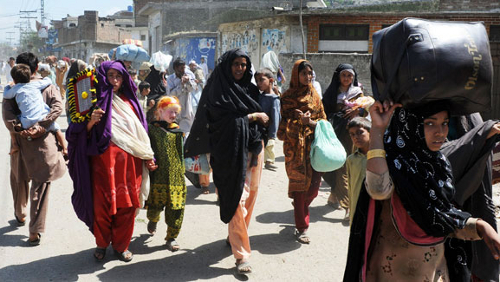
Hundreds of people lost their lives in the bloody conflict between the TNSM militants and Pakistani armed forces from November 1994 until early 1996. Thousands of people also left their homes in the region due to the conflict.
