
RULE & ROLE OF GOVERNMENT(S)
My curiosity to find out the governance model of Kosovo was met with utter surprise when Vedat started to explain the complex structure. “Our government?” he exclaimed adding there are five governments that are ruling the tiny landlocked republic. “Besides having a ‘government’ in Prishtina that is led by Kosovars, we have the International Civilian Office (ICO) that is led by EU special representative Peter Feith. Be aware of the fact that he is a very influential figure in Kosovo.
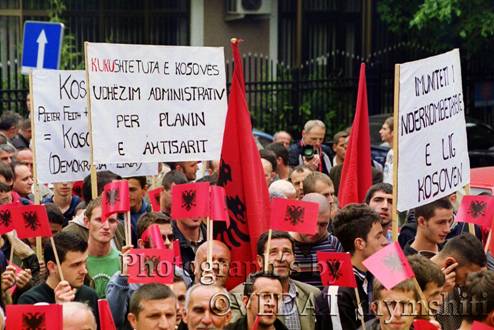
Thausands of ethnic Albanians in Pristina, Kosovo’s capital, have protested against the United Nations’ interim Kosovo mission (UNMIK), the Kosovo government, and the Ahtisaari Plan, demanding complete independence. Photo – Vedat Xhymshiti
“Then we have the European Union Rule of Law Mission in Kosovo (EULEX). Though its charter maintains that its mission is not to govern or rule Kosovo, the reality is just the opposite. Our judicial and law enforcement system is yet to function thanks to the ‘EULEX cooperation’,” added the sarcastic Kosovar photojournalist. The remaining powers, he added, are the UN Mission in Kosovo (UNMIK) and the Serbian government that effectively controls Serb dominated northern towns of Kosovo. His response towards these five entities was not welcoming either. “They’re corrupt (Kosovo government) and being corrupt they are forced to act in the interest of international politics rather than in the interest of Kosovar people,” said a very critical Kosovo national. “None of them are accountable to the people of Kosovo.”
The claims of this angry young man started to ring my bells. Though I trusted his claims and respected the fact that he spoke to me very freely and honestly about it, I still wanted some facts that corroborated his story. Very soon, I found something that substantiated his claims.
THE WATCHDOG SAYS
After having a look at the Amnesty International website, I was surprised and alarmed when I came across the following facts mentioned in the 2008 report. The report starts with AI accusing the UNMIK of failing to implement measures that ensured access to redress and reparations for violations of human rights committed by members of the international community. The watchdog also expressed its concern over the alleged violation of law committed by the UNMIK appointed Ombudsperson.
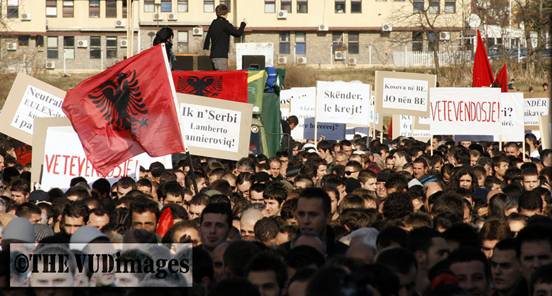
People taking part in a protest organised by an NGO called Çohu. The protestors demanded that EULEX leave the country immediately and opposed any UN-backed plan that failed to grant them complete independence. Photo – Vedat Xhymshiti
The report also highlights the case of two NGO activists who were killed and another activist who was injured by Romanian Formed Police Unit during a peaceful demonstration that took place on 10 February 2007 in Prishtina. AI goes on to say that the trial of Albin Kurti, the head of NGO that opposes Ahtisaari Plan and demands that the EULEX cease its operations in Kosovo and leave immediately, was not conducted in accordance with law applicable in Kosovo or international standards for fair trial.
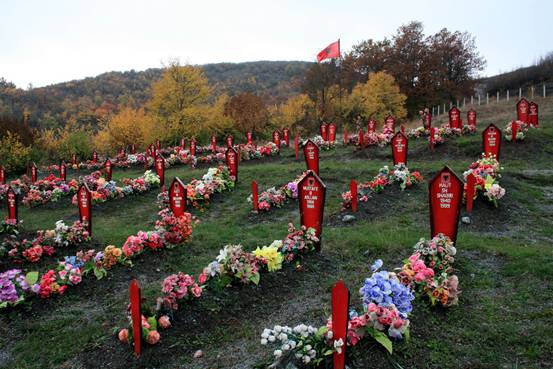
On 15 January, 1999 a massacre was carried out by Serb troops in the valley of Račak in Kosovo. At least 45 men, women and children died in hail of bullets. The oldest was 99 and had survived two world wars, the youngest was just 14. Photo – Barolodrinker
Expressing its disappointment over the progress of war crimes trials, the AI noted that some 1,998 missing persons remained unaccounted for at the end of the year, including 1,300 Albanians, 500 Serbs and 200 members of other minorities. “UNMIK failed to report to the Human Rights Committee, as required in 2006, on measures taken to address impunity for war crimes including enforced disappearances. A lack of prompt and effective investigation, the absence of witness protection, a backlog of appeal cases and a declining number of international judiciary and prosecutors to consider cases of war crimes, contributed to continuing impunity for these crimes,” mentions the report published by the respected human rights body.
