
So our mainstream press and the media is rife with reports, some of them based on speculations rather than facts, about the situation in Iran and how it is handled by the authorities in Tehran. Is this important country in the Middle East going through a political turmoil? Is the rift between the educated urban middle class and the rural working class widening? Are we going to witness a counter-revolution in Iran spearheaded by secular elements of the society that will take on the conservative religious regime? How deep is the impact of foreign intervention in the internal affairs of Iran given the fact that it is surrounded by the US-led troops on both its eastern and western flanks? Questions like these and many others linger on the mind of millions of people inside and outside Iran.

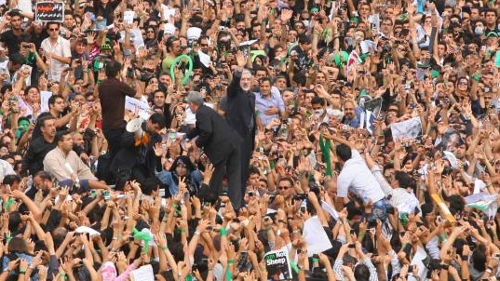
Mir Hossein Mousavi waves to the crowd at a rally in Tehran (Getty Images)
I’ve been in contact with a few Iranians for quite a long time but our discussions centered on food and culture rather than news and politics. “There is nothing new to report Mr. Journalist,” Afshan always told me when I tried to initiate a political conversation. “I know you’re a very curious creature so I’ll let you know as soon as there is some development,” said the 23 year old female student studying petrochemicals at the University of Tehran.
Saeed is my other friend in Iran. He also studies at the University of Tehran doing a diploma in bio-engineering. “I study during the day but in the evening I work in a restaurant. It’s hard work. I know I have to work hard in order to continue my studies and support my family,” the 25 year old said when asked about his routine.
Fascinating Frontier
To me Iran is one of the most fascinating countries in the world. From its diverse geography to magnificent history and from its rich culture to tempting cuisine, the country captures my attention and makes me learn more and more about one of the oldest civilizations of the world that rivaled the Romans and the Greeks. The fact that my grandmother spoke fluent Persian, as it was the language of Indian aristocracy, only fueled my interest and brought me closer to Iranian affairs.
Recent elections in Iran reignited my curiosity. My friends Afshan and Saeed sensed my new level of interest and gave me exclusive information about their political views and the type of activity they’re engaged in. Afshan passionately rallied for the reformist candidate and was certain about his win. Saeed, though admitting he had no time for politics, voted for current Iranian President Ahmedinejad. The zeal and vigor of my friends was something I have seldom come across in my life. “This is the election that will change the future of Iran,” both of them insisted. I wondered how wrong they could ever be.
The polling in Iran was brisk and the turnout was very high. People turned out in droves to vote for their candidate. Afshan and Saeed also flocked to the polling booths with their friends and family. Peaceful by nature, they both described the voting experience as exhilarating and waited impatiently for the results.
Changing Weather
I woke up to a bright sunny day with clear blue skies and gentle breeze blowing. It reminded me of the lovely days I had in Iran years ago. With pleasant memories of that trip on my mind, I switched on the television to get some news regarding the Iranian elections. Pretty confusing news was coming from the Iranian capital. News about protests and discontentment in the streets of Tehran dominated the headlines. Some media outlets talked about a counter-revolution brewing in the country on the same lines of 1979 Islamic revolution instigated by Imam Khomeini and his associates.
I rushed to close my bedroom window as warm sunshine was suddenly replaced by heavy thunderstorms. “Typical English weather,” I said and shrugged off the grim weather prospects only to notice that the political weather of Iran also changed abruptly. The hot spell of political campaigning came to an end when peaceful voting took place across the country. People waited for the election results anxiously, the same way they await the first rain of the summer. There were dark, thick clouds in the sky. No one knew if a political thunderstorm was on its way. Uncertainty made everyone anxious in the streets across the country.
It didn’t take me long to figure out that my friends in Iran were anxious. After a soft formal introduction, my friends began to tell their experiences and views. “I truly respect Mir Hussein Mousavi and find his policies interesting but I do not think they’re enough to steer our country out of severe problems we are facing today,” said Saeed in a very reconciliatory tone in the very beginning of our conversation. Afshan, on the other hand, was all set to explode.
“We need more than respect. We need more than recognition. We need justice. We need equality. We need to be treated as equal citizens of Iran and to be seen as part of the state rather than enemy of state,” charged the young Tehran woman adding that the state is taking measures to push people like her against the wall. “Where is impartiality when the state media gives more coverage to rallies held by the sitting president? Is it fair to block the voice of Mr. Mousavi and ban his newspaper? How can you let a candidate run an election while his campaigners’ movements are monitored and restricted?” Afshan asked in an upset tone.
Saeed began his defense by admitting that some unfair measures were adopted by the state machinery but it is not fair to say that Ahmedinejad benefited from them. “The president is the son of a blacksmith. He is an honest man who has lived a modest life. His popularity does not hinge on media and the Internet. His ground support comes from regions that lack modern communications. He has not prospered on Twitter, Youtube and Facebook. He lives in the hearts of millions of Iranian people,” Saeed said resolutely. He vehemently denied that Mr. Ahmedinejad is the candidate of the establishment.
“He is running against the tide. Many elements in the establishment do not like him, e.g. Mr. Rafsanjani. The West does not like him because he wants to restore our national pride and rejects imperial hegemony. The so-called ‘reformists’ do not like him because he wants to empower the powerless people of Iran.”
New Clear Policies
So what are the thorny issues that divide this nation of around 80 million souls that are frustrating the people on the streets of Tehran and have become the object of fascination for its Western rivals? Supporters of the current Iranian president are upbeat about his sound economic policies on the domestic front and his brave foreign policies on the external front. I asked Saeed to explain them.
“Ahmedinejad has done a great job for our country and has successfully restored the glory of Iran which was somehow overshadowed by our former reformist president Mr. Khatami. He has adopted a brave stance on the nuclear policy and has refused to bow before the bully ‘America’ and its allies. I strongly believe that he is the right person when it comes to foreign policy and national interests of the country,” Saeed’s defense of Mr. Ahmedinejad continued.
Afshan was quick to negate. “Mr. Ahmedinejad is not a good president and has failed our country at several fronts. We have achieved nothing so far on the international level except for sanctions and threats. The US forces invaded and occupied Afghanistan and Iraq. Now we feel like completely besieged. As far as Mr. Khatami’s stance is concerned, we are very proud of him. He did a very good job as the president of the Islamic republic and introduced many reforms that helped the country prosper. Women, especially, got many powers during his tenure as the head of government,” said an ardent Afshan.
“So how important is the nuclear energy issue to you both,” I asked my friends. Their views were forthcoming. Saeed insisted that the country’s future depends on foreign policies. “I don’t mean to say that internal policies are not important at all. Definitely they are. But at this juncture, when western powers are threatening us with sanctions and war, I think we need to adopt a clear foreign policy and strengthen our defences. We have to unite as a nation to face the challenges. We cannot abandon our right to a peaceful civilian nuclear energy,” said the 25 year old bio-engineering student, who hails from a prominent conservative family in Zanjan in northwestern Iran.
Afshan kept on shaking her head in negation while Saeed spoke. “Moign, let me make it clear that supporters of Mr. Ahmedinejad, like this gentleman here, think that Mr. Mousavi will abandon the nuclear energy program in favor of ties with the West. That’s absurd.
“If we reformists talk about negotiations with the West and break away from the decades long isolation imposed on us, it doesn’t mean that we are going to surrender our sovereignty and lose our rights. We want nuclear energy for peaceful purposes like other nations,” she countered.
Saeed asked if he could add his friend Khusrow to this conversation who wants to say something important. I welcomed the 27 year old pharmacist from Esfahan to the chat.
“My question is very clear. Why does Israel get away with its nuclear arsenal? Why does not the International Atomic Energy Agency (IAEA) inspects Israel’s nuclear installations? Why does Israel gets special treatment and is not subject to any international treaty on arms and peace? If the Israelis can have nuclear power, we also have the right to an atomic bomb.” Saeed’s friend charged foreign powers of intervening in his country’s internal affairs.
He added: “A weak and divided Iran is in the interest of imperial powers. The nuclear issue gives them the chance to interfere in our country’s affairs and punish our people for no reason. This is what we common Iranians feel.”
Feminine Freedom
So what really are the internal affairs of Iran that attract so much foreign interest, the next question came to my mind. I put this question before all the participants of this conversation. Saeed and Khusrow left the chat to say their afternoon prayers. Afshan capitalized on their brief absence and fed me her views.
“We are tired of rooting corruption in our society and the slow pace of reforms. We despise the morality police and its constant interference in our lives. We are shocked when we wake up in the morning and our newspaper is not delivered later to be found that it’s been banned by the establishment,” the University student said with frustration clear in her tone.
Clearly not happy with the situation she added: “I work in a petrochemicals firm in Tehran as business administrator. My work is challenging as it involves communication with our clients across the world. Though I work as hard as my male colleagues, I’m still underpaid. Why? Because I’m a woman.”
“Afshan, don’t get me wrong but gender discrimination exists in the West as well. Women complain they’re paid less than their male counterparts. It doesn’t happen only in Iran,” I said before she interrupted me. “I do not have family connections with people in the establishment. My parents are not the relatives of someone in the higher Iranian circles. We are ordinary people and this is the biggest hindrance,” Afshan revealed while confiding to me that other women who have links with the establishment, e.g. some cleric or military man, enjoy better salary and perks.
“I also liked the way Mir Mousavi’s wife Zahra Rahnavard participated in the campaign. She is the voice of talented women across Iran who speak for social justice and equal rights for women,” the Iranian added while showing a photograph in which she stood next to the former chancellor of Tehran’s bastion of liberal arts the Al-Zahra University. “I’m proud of her. She truly fits into the role of first lady of Iran,” she said with pride on her face.
“What other matters bug you the most Afshan?” was my next question to which she replied: “The women in Iran are opposed to the right of countless temporary marriages granted to men by the constitution. Marriage is a sacred rite for us so we want it to be honored and given legal protection.” She praised Mr. Mousavi’s stance on monogamy and welcomed his promise of giving women the right of representation in the highest decision making bodies of the country.
Internal Affairs
Once Saeed returned from afternoon prayers, internal affairs were again on the agenda. He started the conversation by telling how Iranian President Mahmoud Ahmedinejad managed to change the fortunes of the country’s poor by redistributing the wealth and empowering the majority of the people. He insisted that Mr. Ahmedinejad’s record as the mayor of Tehran is unrivaled by any other candidate in the presidential race. “It is the first time he went to the far flung villages of Iran and sat with ordinary people to listen to their problems. The people feel that he is the person who will make their lives better.
“He has managed very well given the fact that US imposed more economic sanctions on us and discouraged other countries to do trade with us. He has successfully managed to control inflation, increase salaries for working classes and continue subsidies on food and other public necessities,” Saeed explained about the record of the 52 year old Iranian head of government.
Though he praised Mr. Ahmedinejad’s economic policies he declined to completely support them. “My vote for Ahmedinejad is because of his brave foreign policies. He needs to work more on his economic policies as they are far from perfect. It is not easy to keep everyone in a nation of 80 million happy,” he hastened to add admitting that inflation has eaten up the real incomes of many Iranians.
Afshan, it seemed, as if she was waiting to seize this opportunity. “It is no secret that inflation and unemployment rose during the last four years to record levels. Real GDP growth is just below 7 per cent and budget deficit is soaring at an alarming rate. What else can prove his failed economic policies?” the young lady said in a perturbed tone. She insisted that basing all the economic plans on oil revenues was his biggest mistake.
“All the economists in the country cautioned him on his ambitious plans to revive the economy. Too much government intervention left the economy in tatters and fueled massive inflation. Instead of heeding to economists’ advices, the short man ridiculed them publicly,” she said while mocking Iranian president’s height.
Next Step
While my friends passionately supported their leaders and insisted they’ve got the vision for a better and prosperous future for Iran, they had no reply when I asked about the resolution of the present crisis.
“People are not really happy with the outcome of the elections. We think our vote has been stolen. We voted for our candidate, Mir Houssein Mousavi, in droves but our votes vanished! It’s impossible to believe that he lost from Tehran where he enjoys massive support,” said Afshan loudly. Her cousin Mani who was sat next to her and listening to the conversation jumped in.
“This system sucks. I abstained from the whole process as I know it will not work for the cause of the Iranian people. Iran will suffer as long as foreign intervention and rule of unelected clergy continues. We need to break away from it to be a strong nation,” the young Iranian teenager uttered passionately. It seemed he had no real interest in his country’s latest political situation.
Afshan wanted to conclude the conversation soon as she planned to attend a street protest later in the afternoon. The pretty urbanite had many friends stuffed in her drawing room where they were busy putting on some make up and getting ready to attend Mir Hussein Mousavi’s gathering in central Tehran. “Thanks a lot Moign for the chat and I will keep you posted. Please pray that we succeed in bringing about the change we need,” she said and left the room in a hurry.
Saeed, on the other hand, was going to watch football on the television and relax. “Some frustrated people are out on the streets making trouble. My friends say you can meet very beautiful girls in these rallies. No wonder many people turn up,” he said in a sarcastic tone before leaving the chat.
His friend Khusrow sat next to him wanted me to find out the answers to the following questions before leaving. He asked: “I’m not a big fan of Ahmedinejad but everyone should respect the mandate he got from the people of Iran. Why did Mousavi rushed to declare his victory and cried foul when the official results were announced? Why do we forget the fact that 90% Iranians do not live in Tehran? Why isn’t the Western media asking for the proof of election fraud? Why do we ignore the fact that foreign media was reporting the election coverage and observers were present to monitor the elections in the country?
“The answer is that the West wants to create a media frenzy and destabilize the situation in Iran. A direct war with Iran will be costly for any country but internal bleeding will leave us dead and our enemy victorious,” Khusrow said in a poignant tone.
After formal exchange of pleasantries and wishes my Iranian friends said good bye to me leaving me pondering over their next moves. While I was enlightened by their views, I was equally alarmed by the bitterness between them. I couldn’t help but remember the past revolutions and foreign interventions in Iranian affairs. Is this all related I asked myself. Only time will prove if history will repeat itself…
