
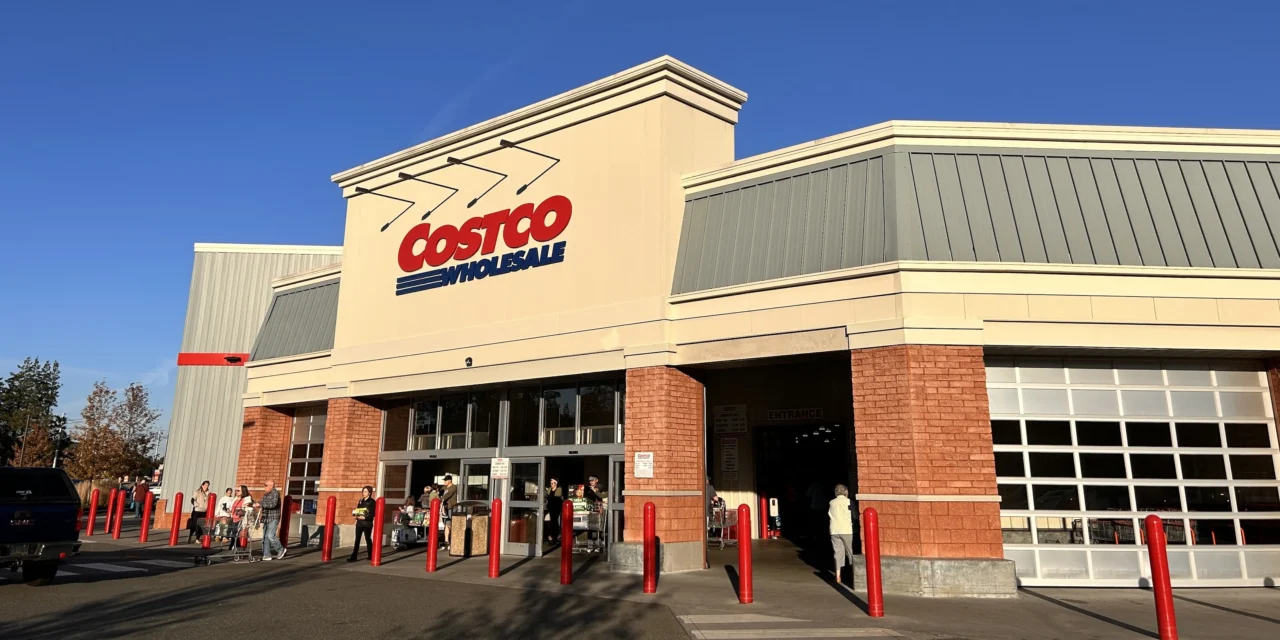
Costco (NASDAQ: COST) has continued to gain grocery market share at a pace no other major retailer has matched over the past five years, and a new round of pricing data confirms that its cost advantage over conventional supermarket competitors has grown meaningful enough to drive a structural shift in where American households direct their weekly spend.
A study commissioned by Consumer Reports, working with Strategic Resource Group market research firm, found Costco prices grocery baskets 21.4 percent below Walmart (NASDAQ: WMT), the accepted industry baseline, a gap that outperforms BJ’s Wholesale Club, the only other major warehouse club in the comparison, and dwarfs conventional retailers — Target runs 5.9 percent above Walmart, Kroger 14.8 percent above, and Publix 20.3 percent above.
Data from Numerator, cited by Grocery Dive, showed Costco grew its grocery market share from 7 percent in the 2020-21 period to 8.4 percent in 2024-25, making it the only top-20 retailer to post share gains in every single year of that stretch. Walmart grew the most in absolute terms, but Costco’s consistency is what stands out to analysts.
“We think the company continues to deliver compelling value, quality, and newness,” UBS analysts wrote following Costco’s most recent monthly sales report. “Its customers continue to consolidate their shopping at this retailer.”
JPMorgan analyst Christopher Horvers framed it as a structural moat. “Costco offers an unquestioned value prop with the best pricing, curated assortment, strong private label offering and treasure hunt atmosphere,” he wrote in a note to clients.
CEO Ron Vachris addressed pricing discipline on the second-quarter earnings call, confirming the company intends to keep investing in the business without raising prices. CFO Gary Millerchip specifically highlighted gasoline as a category where Costco is committed to maintaining its pricing authority, noting that members will travel further to save on fuel when pump prices rise.
The broader context is significant. With household budgets squeezed by elevated energy costs driven by the Iran war, the warehouse club model’s value proposition is amplifying rather than merely sustaining its appeal, as consumers who used it occasionally during strong economic times are now treating it as the primary destination for essential spending.
