
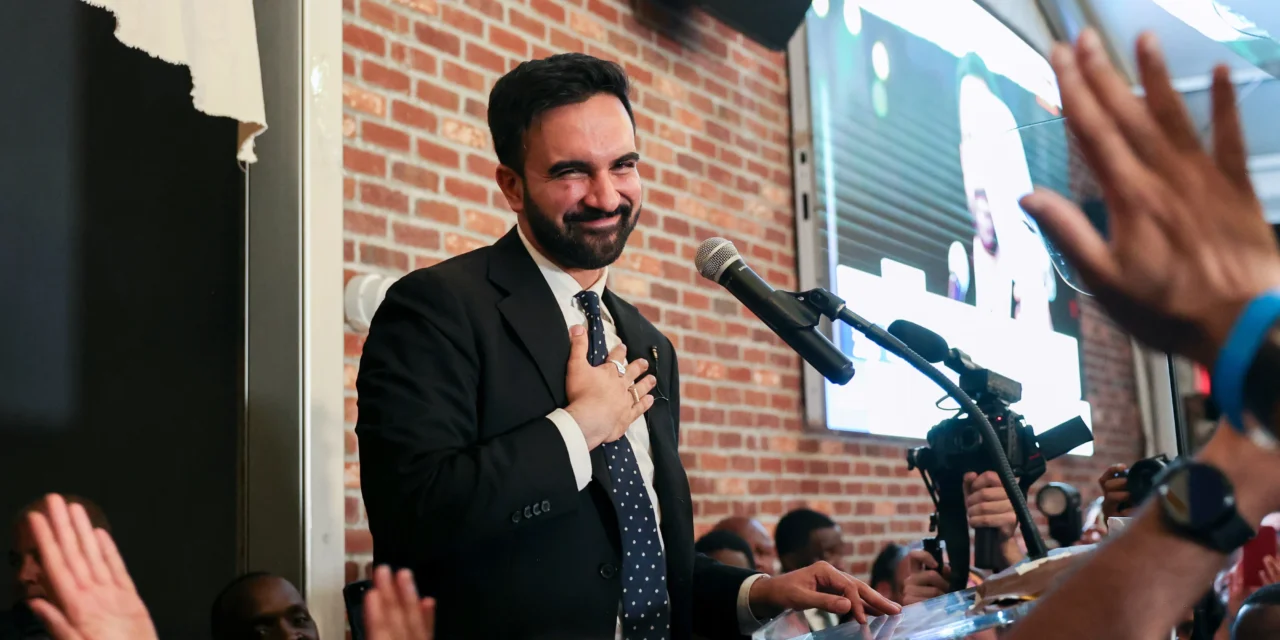
New York City Mayor Zohran Mamdani marked his first 100 days in office with a rally at a Queens concert venue, a series of new policy announcements and an unabashed defence of democratic socialist governance that drew Senator Bernie Sanders to the stage and signalled his intention to use the mayoralty as a platform for a much larger argument about what government can and should deliver.
The address, held at the Knockdown Center in Maspeth, showcased the performative energy that has become a signature of the Mamdani administration, with video montages, crowd-friendly sloganeering and an overflow of supporters drawn from the city’s labour movement, immigrant communities and young progressive left.
“I know there are many who use ‘socialist’ as a dirty word, something to be ashamed of,” Mamdani told the crowd. “They can try all they want, but we will not be ashamed of using government to fight for the many, not simply the few.”
The announcement of a city-run grocery store in East New York was among the most politically charged new policies, drawing immediate criticism from President Trump, who attacked the initiative online and accused Mamdani of “destroying” the city, a confrontation Mamdani appeared to welcome as confirmation that his agenda was threatening to the right people.
Among his substantive first-100-days accomplishments, the administration cited the filling of 100,000 potholes across the five boroughs, the delivery of expanded free childcare for two-year-olds secured through a $1.2 billion agreement with Governor Kathy Hochul, and the creation of an Office of Community Safety as an alternative public safety infrastructure to complement the Police Department.
A Marist poll released in the same week showed 48 percent of city residents approve of Mamdani’s performance so far, with 30 percent disapproving and 23 percent undecided, a significantly weaker opening position than the 61 percent approval that marked Eric Adams’s first 100 days, though Mamdani’s defenders note that he inherited a multi-billion-dollar budget deficit and an unprecedented level of national political hostility that Adams never faced at the same stage.
The mayor’s relationship with Hochul has become one of the defining structural tensions of his term, with the two having succeeded on childcare through alignment but heading in different directions on tax policy, where Mamdani is pushing the state legislature for a new levy on the wealthiest residents while Hochul has been non-committal on the scale of state support the city can expect for its broader agenda.
On the Iran war, Mamdani drew his sharpest contrast with Washington, describing the $30 billion spent on military operations as a moral obscenity when set against the administration’s resistance to funding city-run grocery stores. “To be told that a city-run grocery store is implausible, but spending more than $500 million a day to kill people in Iran and Lebanon is not only plausible but necessary, it speaks to a broken kind of politics,” he said.
Sanders, appearing in a cameo that was perhaps more symbolically meaningful than any single policy announcement, praised Mamdani for “providing hope and inspiration to people across the country,” a framing that positions the New York mayoralty as a proof point for the national left ahead of the 2026 midterms and whatever comes after them.
