
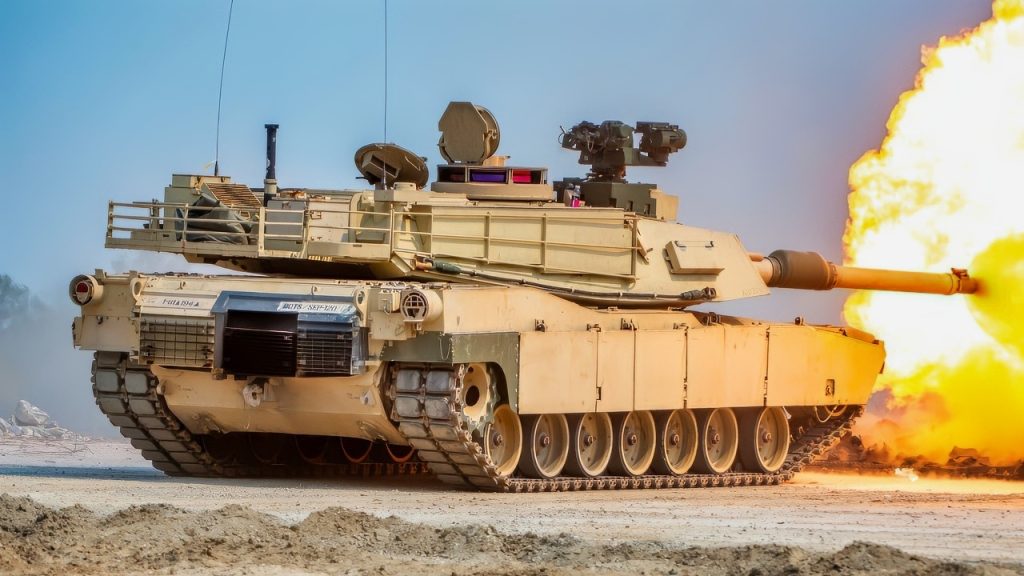
The M1 Abrams main battle tank has been the backbone of American armoured power for over four decades.
Developed by Chrysler Defense and first introduced in 1980, it was named after General Creighton Abrams, the Army chief of staff who served during the Vietnam War.
The original contract was awarded in November 1976, with the first production tanks rolling off the line at the Joint Systems Manufacturing Center in Lima, Ohio, which remains the only facility capable of producing and overhauling the Abrams to this day.
The tank entered service as a direct response to the Cold War threat of Soviet armour massing in Central Europe.
Its design priorities from the outset were firepower, protection and mobility in that order, and it has delivered on all three across every conflict it has entered.
Combat Record
The Abrams first saw combat during Operation Desert Storm in 1991, where the results were historically decisive.
US Army and Marine Corps Abrams units destroyed over 2,000 Iraqi armoured vehicles, including T-72s that were among the best Soviet export tanks of the era, while suffering zero tank-on-tank losses.
The performance cemented the Abrams’ reputation as the definitive Western main battle tank.
It saw further action in Operation Iraqi Freedom beginning in 2003, where it again demonstrated overwhelming lethality against conventional armoured opposition.
The only significant losses to Abrams tanks in Iraq came from rocket-propelled grenades fired at close range from the rear or flanks, and from improvised explosive devices, which no tank is specifically designed to defeat.
In 2023, the US transferred 31 M1A1 Abrams tanks to Ukraine as part of a broader Western aid package.
The results were more mixed and more instructive than the Gulf War had been.
Russian first-person-view drones costing between $500 and $2,000 apiece proved capable of destroying tanks worth $10 million, striking from above where armour is thinnest.
Ukraine eventually withdrew the remaining Abrams from frontline positions to preserve them, a decision that validated a growing consensus inside the US Army that the battlefield had changed and the Abrams programme needed to respond.
Specifications: M1A2 SEPv3
The current production variant is the M1A2 System Enhancement Package Version 3, which entered service in 2017 and represents the most capable Abrams ever built.
It weighs approximately 78 short tons, making it one of the heaviest main battle tanks in operational service anywhere in the world.
Power comes from a Honeywell AGT1500C multi-fuel gas turbine engine producing 1,500 horsepower, which gives the tank a top road speed of approximately 45 miles per hour and a cross-country speed of around 25 miles per hour.
The fuel consumption rate is the tank’s most frequently cited weakness: it burns approximately 10 gallons per mile, or achieves roughly 0.6 miles per gallon, and can consume up to 400 gallons per hour of sustained operation.
In practical terms, each Abrams requires a dedicated fuel truck to follow it during any sustained manoeuvre.
The main armament is the 120mm M256 smoothbore cannon, which can fire a range of NATO-standard ammunition including depleted uranium kinetic energy penetrators capable of defeating any known enemy armour at combat ranges.
Secondary weapons include two 7.62mm M240 machine guns and one .50-calibre M2 heavy machine gun mounted on the commander’s cupola.
The crew consists of four: commander, gunner, loader and driver.
Protection comes from Chobham composite armour with depleted uranium mesh layers in the turret and hull front, which provides the highest levels of ballistic protection among any tank currently in service.
The SEPv3 also incorporates the Trophy Active Protection System, originally developed by Israel’s Rafael Advanced Defense Systems, which detects and intercepts incoming anti-tank guided missiles and rocket-propelled grenades before they reach the hull.
Price
The cost of an Abrams depends heavily on whether the figure refers to a domestic procurement upgrade or a new-build export contract.
For the US Army, upgrading existing hulls to M1A2 SEPv3 standard costs in the range of $10 million to $15 million per vehicle depending on the scope of work and the contract year.
Export customers face higher prices that reflect full package costs including support, training and spare parts.
Poland’s 2022 contract for 250 M1A2 SEPv3 tanks came to approximately $1.148 billion, roughly $4.6 million per vehicle at that unit structure, though that figure is widely considered to reflect domestic contract economics rather than the full-capability export price.
For comparison, the original M1 cost $780,000 at 1980 prices, equivalent to approximately $2.8 million in 2024 dollars.
Annual operating and maintenance costs for a single Abrams are estimated at approximately $1.2 million per year.
Over a 20 to 25-year operational lifespan, that adds a further $24 million to $30 million on top of the acquisition price for each vehicle.
The M1A2 SEPv4 That Never Was
The Army planned a fourth-generation upgrade under the designation M1A2 SEPv4, which was intended to incorporate improved commanders and gunners’ primary sights, enhanced thermal imaging and additional armour.
A $311 million contract was awarded to General Dynamics Land Systems in September 2017 to begin the upgrade of seven prototypes.
But the programme was cancelled in September 2023.
Army leadership concluded that the Abrams had reached the limits of what incremental improvement could achieve without adding further weight to an already heavy platform.
The core problem was that every enhancement the Army wanted to add made the tank heavier, which in turn made it more logistically dependent, less mobile and more restricted by bridge weight limits and road infrastructure.
The SEPv4’s cancellation was the clearest signal yet that the Abrams family needed not another upgrade but a fundamental redesign.
The M1E3 Programme
The M1E3 Abrams Modernisation Programme is the Army’s response to the lessons of Ukraine, the threat of drone-saturated battlefields, and the structural weight constraints that made further incremental SEP upgrades unviable.
General Dynamics Land Systems received a contract from the Army in May 2024 to work closely with the service in shaping requirements for the new platform.
Rather than designating a single prime contractor with full control over subcomponents, the Army adopted what it calls a “teams of teams” acquisition approach, bringing in more than ten companies, the majority of them non-traditional commercial suppliers, to develop individual systems.
The engine is manufactured by Caterpillar, the transmission by SAPA, the seats by Recaro, the lightweight tracks by American Rheinmetall, and the cockpit development was led substantially by Roush, the American performance engineering company best known for its automotive work.
The M1E3’s propulsion architecture is the most significant departure from the current Abrams design.
The AGT1500 gas turbine, which has powered every Abrams since 1980 and is the principal cause of the tank’s notorious fuel consumption, is replaced with a hybrid configuration centred on a Caterpillar C13D six-cylinder diesel engine coupled to an ACT1075LP transmission.
The Army projects this will reduce fuel consumption by 40 to 50 percent compared to the SEPv3.
That improvement is not merely an environmental or logistics footnote.
In large-scale combat operations, fuel logistics are among the most constraining factors on armoured manoeuvre, and a tank that can go further on the same supply is operationally more capable, not just cheaper to run.
The hybrid system also enables what the Army calls a “silent watch” mode, in which the tank can operate all its sensors, communications and electronic systems while stationary with the main engine shut down, dramatically reducing the thermal and acoustic signature that enemy reconnaissance systems use to detect armoured vehicles.
The M1E3 is designed to weigh approximately 60 tons, a reduction of around 18 tons from the 78-ton SEPv3.
This weight reduction is achieved through lightweight tracks, hydropneumatic suspension, and a fundamental rethinking of the vehicle’s structure and armour distribution rather than simple weight-stripping.
The crew has been reduced from four to three.
The loader is replaced by a MEGGITT autoloader, allowing the turret to be designed without a crewed bustle.
The three remaining crew members, commander, gunner and driver, are all seated in the hull rather than in the turret, a layout that improves survivability by keeping personnel lower in the vehicle and away from the most common penetration paths.
The turret is effectively unmanned during firing operations.
The active protection system fitted to the M1E3 is the Iron Fist system developed by Elbit Systems, designated XM251 by the US Army.
It is capable of intercepting anti-tank guided missiles, rocket-propelled grenades, and certain classes of loitering munitions, directly addressing the threat profile that destroyed American-supplied Abrams in Ukraine.
The architecture is designed around modular open systems standards, meaning hardware and software components can be swapped out without redesigning the entire vehicle, a departure from the closed-architecture approach that made previous Abrams upgrades so expensive and time-consuming.
Timeline and Status
General Dynamics Land Systems delivered the first M1E3 prototype to the Army in early December 2025, approximately five years ahead of the original 2030 schedule.
The prototype was publicly unveiled at the Detroit Auto Show in January 2026, the first time a new Abrams platform had been shown outside a military context.
Army Chief of Staff General Randy George confirmed at the time that four prototypes would be delivered to operational units for soldier evaluation during the summer of 2026.
The intent is not to wait for a finalised configuration before putting the tanks in soldiers’ hands.
“When a vendor comes and says, ‘Hey, I’ve got something that’s better for active protection, there’s a better engine, there’s a lighter transmission to meet those specs,’ soldiers could, you know, plug in and play in that,” George told reporters at the Detroit show.
Production decisions are expected around 2027, contingent on the prototypes meeting survivability, mobility and sustainment benchmarks during that operational evaluation phase.
Initial operational capability is currently projected for the early 2030s.
The Army plans to phase the M1E3 in gradually to replace older M1A2 variants across its 11 active Armored Brigade Combat Teams and 5 National Guard ABCTs, each of which fields 87 Abrams tanks.
M1A2 SEPv3 production continues at a reduced rate in the meantime, providing a bridge capability until the transition to the new platform reaches scale.
A 2019 Army Science Board study that helped set the intellectual foundation for the M1E3 programme projected a seven-year, $2.9 billion investment as the basis for the effort.
Whether the final programme cost stays within that range or expands as the prototypes are refined through soldier feedback will be one of the key acquisition questions as the Army moves toward a production decision.
What is not in question is the strategic logic.
A $500 drone destroying a $10 million tank has become a defining image of modern warfare, and the Army is designing the M1E3 specifically to change that equation by combining lighter weight, lower thermal signature, an active protection system capable of engaging airborne threats, and a hybrid drive that reduces the logistical tail that makes heavy armour so vulnerable in contested environments.
