
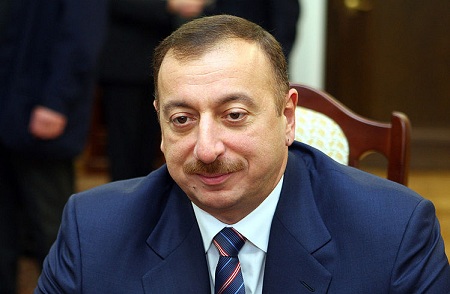
Azerbaijan President Ilham Aliyev
Nowruz is the symbolic time for reconciliation and neighborliness both in Azerbaijan and Iran – an old Persian tradition which celebrates the arrival of spring with anticipations of a better New Year.
While relations between Baku and Tehran have faced noticeable cooling after the US diplomatic cables leaked November 2010, quoting Azerbaijani president Ilham Aliyev’s concerns on Iranian provocations in his country, Azeris waited for four months to reconcile with Iranian leaders.
Elmar Mammadyarov, Azerbaijani Minister of Foreign Affairs, visited Tehran on March 27, 2011, to participate in the Nowruz celebrations, aiming to rebuild the bridge between his boss and the Iranian leaders.
One year later, the tensions between once-friendly neighbors not only remain, but have become worse than they have ever been; in fact, the relations have run a worrisome course.
For some analysts in Baku, Tehran leaders likely “didn’t forget Aliyev’s complaints to Americans”, in which he described the Iranian provocations in his country as
not only the financing of radical Islamic groups and Hezbollah terrorists, but also:
– [Iranian] financing of violent Ashura ceremonies in Nakhchivan,
– organizing demonstrations in front of Azeri consulates in Tabriz and Istanbul,
– organizing violent religious procession in Baku,
– using the President’s photo alongside the Star of David on the Azeri-language Seher TV broadcast into Azerbaijan, and
–causing the tension in the Caspian.
Hijab ban and arrests of the Islamists
A harsher tone has been evident since August 2011, when Iranian Armed Forces chief of staff Major General Hassan Firouzabadi warned President Aliyev over the government’s ban of the Hijab for teenage girls in Azerbaijani high schools.
In his statement that was published by Iranian state-run Fars and Mehr News Agencies, Firouzabadi called on Aliyev to “strengthen his government by respecting Islamic rules and people’s demands.”
“Otherwise he [Aliyev] will face a dark future since people’s awakening cannot be suppressed,” Iran’s Armed Forces Chief of Staff Major General Hassan Firouzabadi said, FNA reported.
Naturally, the hijab ban aroused the ire of the religious Islamic community in Azerbaijan with their periodic demonstrations since the end of 2010.
But Firouzabadi’s remarks were a reaction to latest demonstrations where Azeri police reportedly used force against the protestors of Hjab ban.
Baku officials sharply reacted to general’s remarks by summoning Iran’s ambassador to the Foreign Ministry. Tehran renounced Firouzabadi’s speech.
But a day after, Azeri National Security Ministry and the Prosecutor General’s Office issued a joint statement, announcing the arrest of three men suspected of establishing a radical religious group Jafari, with financial support from the Iranian Cultural Center in Baku, which is actually, a cultural body of the Iranian Embassy. Tehran declined commenting the accusations.
However, the tensions between the two countries mounted again two month later, when an Azeri court on October 7 sentenced the leader of the outlawed and overtly pro-Iranian Islamic Party of Azerbaijan Movsun Samadov to 12 years, who was arrested earlier that year after he posted videos denouncing President Aliyev.
Samadov was convicted of “preparing acts of terrorism, concealing weapons, and inciting his supporters to revolution”. The Islamic Party of Azerbaijan was outlawed in 1995.
On October 25, a top Iranian Jurisprudent warned against the Islamophobia in Azerbaijan calling the country’s officials “to learn from the [collapse of the] Soviet Union and current crisis in the Muslim world” and warned them “to be eradicated should they continue the measures against the people.”
Ayatollah Nasser Makarem Shirazi, in his weekly teaching session referred to the worsening Islamophobia in Azerbaijan and said, “The majority of the people in Azerbaijan are Shia but the government has recently started to destroy mosques and attacks the people”.
Azeri officials condemned Shirazi’s remark, accusing him “of spreading slander and attempts to put the religious people against Azeri state”.
Following Shirazi’s speech another Grand Ayatollah Jafar Sobhani later in October sent a message to Presiden Aliyev, strongly denouncing a ban on Islamic dress code recently imposed in Azerbaijan as a move against Islam and the human rights laws.
Border tensions
While Iranian Ayatollahs were continuing slamming Azerbaijan, the tensions flared when an unexpected border clash between Azeri soldiers and Iranian border guards left one Iranian guard dead.
The incident happened on the southern Azerbaijani border on October 19. The breach cost 20-year-old Akber Hasanpour his life and resulted in an exchange that once more laid bare the repressed antagonism between Baku and Tehran.
Iranian Foreign Ministry summoned the Azerbaijani ambassador day after the incident.
On October 22, a delegation led by Deputy Commander of the Iranian Border Service, Ahmad Garavandi, visited Azerbaijan’s Bilasuvar region to discuss the reasons of the incident.
In the meanwhile, according to Jasur Sumarinli, Head of a “Doctrine” Military Research Centre of Journalists, the two countries have tightened security along all of their its join borders since then.
“In a wake of the recent border incidents, and political tension between the two both Iran and Azerbaijan have involved an enormous amount of troops to their shared borders”, he said during a phone interview from Baku.
A writer’s murder
On November 19, Azeri physician and journalist Rafig Tagi, who had been a persistent critic of Azerbaijan’s authoritarian government and of the influence of Iranian clerics on Azeri politics and religious life, was stabbed seven times by unknown assailants.
Tagi survived the attack and while in the hospital gave an interview in which he speculated that he was targeted because of a recent article in which he wrote that President Ahmadinejad was “discrediting Islam through his actions.”
Somewhat mysteriously, as he was recovering from his wounds, Tagi died the day after he gave that interview.
Ayatollah Fazil Lankarani, the cleric who had called on believers to kill Tagi in 2006, has since died, but his son, Mohammad Javad Lankarani, also a cleric, applauded Rafiq Tagi’s murder, praising the killers for “sending the reprobate who insulted the Prophet to hell.”
Many Azeris believe that Iran has killed Tagi in reprisal for his recently published criticisms of the country.
In the meantime, some like Arastun Orujlu, former intelligence officer, a Head of East-West Research Center in Baku, says, Azeri government is “not interested in opening this crime like it didn’t before in case of other critics.”
“I don’t believe that someone from outside could dare to organize Tagi’s murder in daylight, downtown and in front of everyone eyes, this is probably something connected to internal forces here [in Azerbaijan]”, he said in an phone interview.
Baku-Tehran agreement: “If you respect my values, I will respect you”.
As Tagi’s murder was drawing the relationship to low ebb, both sides in December have realized things have gone too far and are keen to patch up the damage: to that end, Azerbaijan’s Presidential Administration chief official Ali Hasanov flew to Tehran December 2.
“We noted that recently the Iranian military and religious leaders and politicians admitted insulting remarks against Azerbaijan and sometimes even threatened Azerbaijan’s statehood”, Hasanov said before his visit.
In Tehran, however, he announced that the neighbors have come to an agreement on non-interference and mutual understanding.
“If you respect my values, I will respect you,” he said. “If you do not interfere in my domestic affairs, I will not interfere either. I said during the talks that whatever we do in Azerbaijan, we do it based on the will of the Azerbaijani people. We oppose the artificial introduction of any sects, religious groups, as well as various political, ideological, spiritual currents in Azerbaijan. They aim to create anarchy in Azerbaijan under the guise of democracy. We stop and will stop this.”
Back then, for many in Baku Hasanov’s visit was fairly significant, much more than the usual protocol-heavy trips. The substance of his comments was that Baku and Tehran have explicitly agreed to end their recent cold war, most of which was, in any case, out of the hands of the upper echelons of government.
Border threats, Cyber attacks
But the “gentlemen agreement” between Baku and Tehran didn’t last that long.
A new year started with Iranian Border Police Chief General Huseyn Zulfuqari’s message to his Baku counterparts saying that, “it’s unacceptable that Azerbaijan poses double standards towards its neighbor.”
Zulfugari, who later visited Baku on February 11, also highlighted the border incidents between the two.
On Jan.16, Iranian sites launched cyber-strikes against 25 Azeri Internet sites, mainly the sites of state agencies—(president.az), (rabita.az), (din.gov.az, mia.gov.az), (constcourt.gov.az), and several others.
A notice was placed on some of the sites accusing the Azerbaijani authorities of “serving Jews” and on some a message was placed stating “Hacked by Azerian Cyber army.”
A month later, Azeri State TV, AzTV and several others were hacked by Iran.
Terror plot
On Jan. 25, Baku has announced it had foiled an Iranian plot to assassinate the Israeli ambassador to Baku, Michael Lotem.
There were also reportedly plans to blow up a Jewish school near Baku — though these reports were later denied.
Tehran took matters a step further and claimed that Mossad operatives in Azerbaijan allegedly worked out plans to assassinate Iranian nuclear scientists — a claim Baku angrily denounced on Feb. 13 as “a lie, a fabrication and a libel.”
Tehran seemed to raise the stakes on Feb. 21, when Baku announced that an Iranian helicopter had violated Azerbaijani airspace at the border town of Astara.
Such incidents should not intimidate Azerbaijan into backing away from Israel, said Vafa Guluzade, a former presidential foreign policy aide.
A murder of the Iranian scientist
The tension escalated again in early February when the Iranian Foreign Ministry summoned Azerbaijan’s ambassador, accusing the country of colluding with the Israeli intelligence in the killing an Iranian nuclear scientist.
Mostafa Ahmadi-Roshan, who worked at the Natanz uranium enrichment facility, was killed in a car bomb attack in Tehran on January 11.
The Ministry handed a protest note to Azeri envoy Javanshir Akhundov and demanded that the oil-rich former Soviet state prevent Israel’s Mossad spy agency from using its territory to carry out operations against Tehran, the report said.
Azerbaijan denied those allegations, calling them “absurd” and “slander.”
After the nuclear scientist was killed, an intelligence official in Tehran was quoted as saying, “None of those who ordered these attacks should feel safe anywhere.”
Israel arms deal
Azerbaijan’s rocky relationship with Iran has hit an historic low in late February, when Israeli officials confirmed a deal worth $1.6 billion (almost equal to Azerbaijan’s stated 2012 defense budget of $1.7 billion) to sell Azerbaijan drones, anti-aircraft and missile defense systems.
Along with these weapon systems, many trainers, technicians and advisors will also go to Azerbaijan, a standard practice in large-scale arms transfers.
Tehran summoned Azerbaijan’s ambassador warning Baku against allowing its “territories to be used by Israel for terrorist attacks.”
Baku insisted that Azerbaijan would never attack Iran or permit other countries to use Azerbaijan’s territory for that purpose, reaffirming the content of a March 7 joint statement of the Foreign Ministers of Azerbaijan, Turkey and Iran in Nakhchivan.
Azeri Defense Minister Safar Abiyev visited Tehran on March 12 to assure Iranian leaders that the arm deal is against Armenia, not Iran.
President Ahmadinejad assured Abiyev that, “The Islamic Republic of Iran always supports the independence, grandeur, and territorial integrity of the Republic of Azerbaijan.” He also claimed that, “The mutual enemies of the two countries seek to halt the enhancement of ties between Tehran and Baku.”
But day after Abiyev’s return from Tehran, Azerbaijan’s National Security Ministry announcement that it arrested 22 Azerbaijani citizens allegedly linked to an Iranian-plot to attack the Israeli and US embassies in Baku.
Tehran denied any connections with the arrestees.
On March 26, Iranian Hezbollah sent a letter to Azeri President calling him to “stop his government’s anti-Islamic policy” and decline launching the Eurovision wing in Baku, this summer. “Otherwise, we will destroy Azeri consulate in Tabriz”, the letter says.
The tension mounted further after a new report in Foreign Policy magazine, which said that Israel has gained access to airfields in Azerbaijan, possibly so that Israeli aircraft could land there after attacking Iran.
On April 3, during his meeting with Russian FM Sergei Lavrov in Baku, Azeri FM Elmar Mammadyarov repeated that, Azerbaijan “will never support initiatives and proposals that could harm relations with Iran.”
Rallies
In the meanwhile, the tension between the two countries escalated early May with the government-sponsored rallies in Tabriz.
More than ten dozens of students, professors, clergymen gathered in front of Azerbaijan’s Consulate, May 8, “World gays in Azerbaijan, Islamic activists in jails,” “Aliyev fear God’s judgment” and other slogans were chanted during the rally.
And last week, Azeris stroke back, by holding the protest in front of Iranian embassy.

It’s certainly an excellent overview of what’s transpired over the past year – really like the breakdown. Looks like Teheran’s about to begin a new round of anti-Azeri rhetoric..
One question regarding Israel-Azerbaijani negotiations – when reviewing the recent Israel-Azerbaijan connections, especially, FM Lieberman’s April visit to Baku, I can’t see Baku establishing an ambassadorial presence in Israel. I wonder why?
Alakbar, congratulations.
It turned out to be a very interesting read
As we have discussed before, this is a volatile region of the world and the Iranian regime is extremist. I think we can never be complacent about the potential for miscalculation and conflict.
In regional point of view, the number one concern in any conflict will be short term impact on world oil supplies. Any disruptions from a significant producer impacts the whole system. In addition, the straits are an import route for transport of oil.
In my view another big story is the focus on Turkey and Syria — and of course Iran’s involvement. That will have an impact on the whole region, including Azerbaijan.
Turkey is now the key party helping to communicate with Iran on behalf of the United States. This places Turkey in a very precarious position.
Thanks,
Alina
Azeri dictator one the one side – the Irani mullahs another…
Seems that neither Azerbaijan nor Iran is really into this whole ‘friendly relations’ thing.
Looks like 2013 could be another rocky year. ;)
A very good review of the current tension. Indeed, Azerbaijani-Iranian relations have always been like a mined zone. Unfortunately,some very important issues which are the behind-the-scenes factors igniting this aggravation of the bilateral relations have not been touched upon in this article. The presence of a large Azerbaijani community in the northwest of Iran(roughly 30 million who have been denied their basic national rights) is the very factor characterizing this deterioration. Iran is strongly concerned about the possibility of the rise of nationalist sentiments amongst Iranian Azerbaijanis who might object to the violation of their national rights(e.g. There is no single school in Iran where Azeris can study in their native language)or even unification with the Republic of Azerbaijan motivated by the national independence and secularism the citizens of the RA enjoy.
In addition, Iran’s increasing support to Armenia prompts Azeris to feel resentful since Armenia happens to be country having occupied 20% of the territory of Azerbaijan. Iran’s backing Armenia prompts Armenia to be less willing to sit around the negotiations table and to withdraw her armed forces from occupied Azerbaijani territories