
To Clairie, this was all a marked change to the chronic political indifference that had once been the serene refuge of most Greeks. After a century of history permeated by conflict—World Wars, Balkan Wars, Civil Wars, and dictatorships—most talk centered on food and other trivialities to escape the divisive topics of the past. Even today the Greek-speaking visitor might get an impression that all Greeks talk about is eating: what did someone eat last night, what they will eat for lunch, how was it cooked, etc, etc. This obsession with food is a holdover habit from the post-dictatorship’s retroactively labeled golden age, which has swiftly come to an end. Presently, for most Greeks, the future was fraught with growing uncertainty and underpinned by an air of resignation. Food talk and doting on children or grandchildren were the last refuge of a people whose fate was entirely out of their hands, a future no amount of talk could shape.
After a full minute of contemplative silence, my hosts changed topics, afraid that they had painted a one-sided picture of their country. Despite cloudy economic and political forecasts, the air in the backyard held a subtle ray of hope (it was not just the whiskey talking). Contrary to what was being reported in the press, many of the people at the party did not harbor a desire to leave Greece for greener pastures. Yes, growing numbers of young people were seeking work abroad, but others had given up lucrative or more prestigious jobs elsewhere to return to their country. Although Greece has no shortage of faults, it is infused by an idea of the good life that is rare.
Young professionals in other developed countries were incrementally giving up more and more of the rights their grandparents struggled for, working 10-20 extra hours a week without additional pay just to demonstrate enthusiasm to their bosses. “At least I have a job,” was the common refrain of many of my DC peers, when questions of fairness and satisfaction were raised. Union membership was declining as new workers demurred joining an organization tarnished by a subtle smear campaign waged by capital over the course of decades. Workers’ rights and unions seemed anachronistic in service-industry orientated present. Unions were perceived as blue-collar and vulgar, something that steamfitters and bricklayers joined; they became anathema to self-important workers wearing ties and suits, personal assistants and program analysts. In the fog of class war, the average person had stumbled behind enemy lines and took to sympathizing with their former enemy.
To ingratiate myself with the evening’s hosts, I made a joke about the spate of mocking that Greeks have been subjected to in some of the international press accusing them of being lazy: “Foreigners only say those things because ‘they hate your freedom.’” Bad Bush impression aside, there is something distinct about the Greek work ethic that eludes the broad generalizations of the foreign media. Many Greeks are (relatively) debt-free homeowners that inherited property from their parents. Thanks to demographic trends, family fortunes, much atomized in years past, are no longer being divided among multiple offspring; there is a surplus of paid-off homes available to rent out. Most people do what they need to do to get by and might have multiple sources of income: working odd jobs, renting out property, or working out of their home in addition to a steady job.
The supposedly underworked Greeks have earned their leisure time and pass these privileges, in the form of accumulated but modest wealth, on to their children. They are not lazy; their society has not been yet been structured to incentivize the 60-hour workweeks—necessary for the proper functioning of a consumption-based economy—that many professionals of North America and Northern Europe have accepted with little complaint. The consumerist mentality is new to this part of the world, which for decades saw its people only buying what was needed and jury-rigging the hell out of anything and everything. Only in the last decade has there emerged a new Greek ideal, molded by a substandard educational system and ubiquitous advertising deifying a mass culture made of plastic instead of marble.
The next day, I was back at my cousins’ house for our daily sit-down lunch together. It’s a cultural sea-change from afternoons at my parents’ home on Long Island, where lunch is usually eaten standing up or shoveled down one’s throat to permit a quick return to the internet or the History Channel. The Old World branch of my family would discuss and argue—meals became full-contact sport. Talk predictably and rapidly turned to politics, after a brief interlude where I was induced to describe the previous night’s events (Did I meet any nice Greek girls? What did they do for a living? What did the host put out for everyone to eat? Etc, etc); an inevitable byproduct of Greeks’ unabashed nosiness. The best way to get people talking is to say something controversial, so I wondered aloud whether all the doom and gloom was really warranted or whether it was Greeks who lacked pluck and had gone soft since the war generation began dying out. That was my big fat Greek mistake and my strategy was rewarded with an extra hour of post-dessert discussion.
The extreme pessimism expressed over ice cream cake (purchased from Lidl) stems from the fact that the government is suffused with an endemic ethos of corruption. Since the state usually sets the tone for its citizens, there is a chronic failure in Greece of Greeks to abide by the law. Two systemic problems reinforce this detrimental tendency that undermines Greece’s economic progress. The first is low-level corruption among the government’s minor bureaucrats, which has tainted the relationship between citizen and state. Regulation is complex and open to interpretation and often, if one fails to include ‘fakelakia’—small envelopes stuffed with cash—with one’s administrative request, it is indefinitely delayed. The bureaucrat class is seen as predatory and, more importantly, inept. A common perception among the Greeks I spoke with is that the civil servants they deal with on a regular basis got their jobs not because they were the most qualified, but because they were the best connected. Anti-corruption laws on the books are rarely enforced and bureaucrats often behave with a sense of entitlement, as these fraudulent practices are so widespread as to be de facto acceptable. Few cases of bribery actually get reported. This creates and perpetuates a mentality among Greeks that the best course of action is to avoid any interaction with the machinery of the state—cars go uninsured, business go uninspected, and, as we shall see, taxes go uncollected.
The second related and intractable problem is Greece’s tax code, which is dizzyingly complex. Like many Greek regulations, the applicability of some tax provisions is open to interpretation. Businesses and individuals pay small bribes to influence tax collectors or avoid taxes altogether by operating in Greece’s massive shadow economy. This erodes tax revenue and drives up the tax rate on law-abiding citizens and businesses, perpetuating a vicious circle and driving an ever-growing number of people into the shadow economy. These two principle problems, unchecked petty corruption and a tax code of Byzantine complexity, could be addressed by reducing the amount of regulation on the books and effectively enforcing existing anti-corruption law. Simplified laws would circumvent multiple interpretations and a rational tax code would prevent privileged industries—their owners friends of the ruling elite—from hiding their wealth in loopholes and shelters. Unfortunately, as with everything in Greece, nothing is as easy as it should be. Not only is there a deficit of political will, but the politicians victorious in the recent elections are the same ones responsible for fostering the current lack of trust in public institutions.
The Greek state has lost both the faith of the international community and its own citizens and thus limits its options for effective intervention in the country’s economic processes. Greece’s paradox is that the massive public sector employs a sizable portion of the electorate, who are loath to see a sweeping transformation of the creaky bureaucracy. There are also powerful domestic interests who are blocking tax code revisions and other reforms that could erode their privileged positions. Despite most citizens’ lack of positive feeling towards the government, enough of them benefit from the status quo as to make the job of reform extremely difficult for the party in power, as any governing coalition formed on the basis of reform is inherently unstable. Although the green shoots of unofficial non-governmental solutions—meant to sidestep the dysfunctional state apparatus—are appearing all over Greece, domestic business and civic organizations are too under-developed to pull the country out of a tailspin. The victory of the pro-bailout parties can a avert a short-term crisis but it will not inspire Greeks to pay their back taxes or relocate savings from mattresses to bank accounts.
Corruption’s omnipresence evolved over time, although the die had been cast early. New Democracy and PASOK had taken turns running the country as a kakistocracy for the last 30 years. Instead of engaging in the difficult task of tackling institutionalized graft and incestual cronyism, the party in power—with the opposition’s covert blessing—borrowed like there was no tomorrow to pay off the well-connected and curry voter favor. The ND/PASOK clientist juggernaut enabled and encouraged business (usually operated by party associates) to take out expansion loans and created public sector jobs out of thin air for their friends and family. For entrepreneurs, this created a boomtown atmosphere that benefitted both dynamic and inefficient companies alike. As long as Greece was able to borrow on reasonable terms, it strengthened the First World veneer PASOK erected over a Third World state.
The crisis ended the cognitive dissonance of a generation in a wave of business closures that bears little resemblance to the phenomenon of creative destruction. Every other shop window reads ‘for rent’. Athens’s primary retail zone, Ermou Street, the equivalent of New York’s 5th Avenue or Paris’s Avenue des Champs Elysées, was pockmarked by vacant stores, unimaginable a few years back and indicative of the collapse in demand for commercial space. Loans have dried up for all businesses, not just the inefficient ones. The government’s promise of a new era of prosperity for all turned to sand; simultaneously, a slow trickle of scandalous revelations of politicians’ abuse of power turned into a flood.
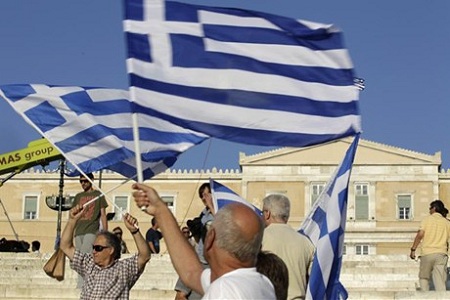
It was a perfect storm—each successive party hack questioned about his involvement with Siemens or Bayer during the past 15 years coincided with another news story about German calls for austerity. The old guard’s death knell came with the signing of the bailout agreement, which convinced conspiracy-minded Greeks that the politicians had taken one last massive kickback, sold their country to the highest bidder, and saved their amassed fortunes in the process. It’s only through this mud-tinted lens that one can interpret the Greek’s attitudes towards elections, bailouts, protests, Troikas, and chances for a reversal of Greece’s fortunes. The vacuum left by the government’s de facto abdication of its responsibility, amid a flurry of infighting, is pushing regular Greeks to look elsewhere for sources of salvation.
This loss of centralized legitimacy has precipitated the emergence of the far-right Golden Dawn (GD) as a viable party. In the June 17 elections, it captured ten percent of the vote, up from seven percent in the May 6 elections. After a leading member of GD physically lashed out at fellow politicians during a televised debate between the elections, the party’s popularity actually grew. They now have enough seats in Parliament to influence debate and enough of a mandate—in their eyes—to issue a stream of on-air al-Qaeda-style pre-recorded videos tinged with jingoistic promises to resolve the Macedonian issue and create an ethnically pure Greece. This is the same party that gained notoriety by ejecting reporters from a press conference for refusing to stand in honor of the party’s leader, Nikolaos G. Michaloliakos, a convicted criminal.
Regardless of how shocking this party’s anachronistically fascist behavior might be, it is not as worrying as the growing embrace of their methods by a Greek electorate who feels like the political old guard is incapable of handling the problems that GD has sworn to attack. And GD’s ‘grassroots campaigning’—random beatings of illegal immigrants, physically harassing political opponents in public view, and escorting old ladies to the cash machine because normal people are afraid to go out at night (thanks to a constant stream of crime reporting by the press)—is working alarmingly well. In addition, their appeal is not just limited to reactionary country bumpkins who have never left the village. Some among the educated professional class have said that only a vote for GD is a vote against the entrenched political elite. This belief owes much to the most effective tactic in the far right’s repertoire: their unprecedented commitment to repeal Parliamentary immunity and prosecute those in the Greek elite who supposedly sold out their country.
The next few weeks and months will see a confluence of forces coming to a head. A push for greater austerity will begin in earnest, stymied by the efforts of the opposition through strikes and protests. Greek debt will increase as the country appeals for more time and more money, the two things the Troika can no longer spare. My Athenian cousins will hopefully receive a letter from HSBC informing them that their euro-denominated life savings have been transferred to a newly minted offshore account, another drop in the massive capital-flight bucket. Taxpayers will evade what they can to hold on to their precious euros in fear of an eventual return to the drachma, sparking a self-fulfilling prophecy. Young educated Greeks, finally squeezed dry of hope or options, will seek U.S. and Canadian visas or enroll in German lessons, exacerbating Greece’s brain-drain. An emboldened Golden Dawn, in a country that upholds the virtue of manliness and rallies around charismatic and disastrous leaders, will grow its base while its hard-core members commit reprisals against innocent illegal immigrants every time an assault by an alleged foreigner splashes across the nightly news. The spiral of mounting social, economic, and political pressures will get much worse before—maybe—getting slightly better. Can Greece succeed in pushing its boulder up a hill and withstand the disappointment of seeing it roll down the other side? The verdict on the street is that, after three years of free fall, what Greeks want more than anything is a return to normalcy, and that they will do anything necessary to get there—even if it means embracing authoritarian means.
