
Given the record of U.S. interference in the state affairs of Iran and clear policy of regime change, it is possible if not likely that the U.S. had a significant role to play in helping to bring about the recent turmoil in an effort to undermine the government of the Islamic Republic.
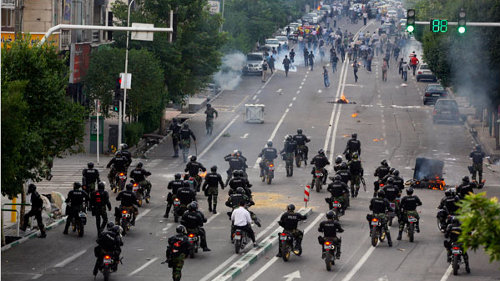
Following the announcement of victory for Mahmoud Ahmadinejad over his main opponent Mir Hossein Mousavi in Iran’s presidential election on June 12, the country erupted in turmoil as supporters of Mousavi flocked to the streets to protest what they claimed was a fraudulent election, while state security and militia forces cracked down on dissenters, sometimes violently. Iran claimed that the unrest was being fueled by foreign interference, a charge reported but generally dismissed in Western media accounts. But there is ample reason to believe that the U.S. likely had a hand in fomenting the chaos that has since plagued the country many commentators have compared to the 1979 revolution that overthrew the Shah.
The role of the U.S. in overthrowing the democratically elected Prime Minister of Iran Mohammed Mossadegh in 1953 and installing the brutal regime of Shah Mohammad Reza Pahlavi is by now well known. In his speech in Cairo last month, President Barack Obama even referenced the CIA-backed coup, acknowledging that “In the middle of the Cold War, the United States played a role in the overthrow of a democratically elected Iranian government.”[1]
The U.S. lost their principle ally in the Middle East, however, when the Shah was in turn overthrown as a result of the Islamic revolution that swept the country in 1979, resulting in the clerical regime that continues to this day under Supreme Leader Grand Ayatollah Ali Khamenei, who took over the title from the leader of the revolution, Ayatollah Ruhollah Khomeini.
During the Reagan administration, the U.S. illegally sold arms to the Iranian regime even while supporting Saddam Hussein in Iraq’s devastating war against the Islamic Republic. And while neoconservatives in Washington had their eye on Iran as a target for regime change throughout the Clinton years, it wasn’t until George W. Bush came to be president that a strategy for bringing this about began in earnest. Whether the policy of regime change implemented under Bush has been quashed or continued by the administration of President Barack Obama remains to be seen, but what is incontrovertible is that the U.S. has a long and sordid history of interference in Iranian affairs.
The National Endowment for Democracy
One mechanism by which the U.S. interferes in the internal political affairs of other nations is the National Endowment for Democracy (NED), a quasi-governmental agency with funding from both Congress and private individuals whose purpose is to support foreign organizations sympathetic to U.S. foreign policy goals.
NED’s website states that its creation in the early 1980s was “premised on the idea that American assistance on behalf of democracy efforts abroad would be good both for the U.S. and for those struggling around the world for freedom and self-government.”[2]
The idea behind NED was to create an organization to do overtly what the CIA had long been doing clandestinely, and the organization has developed its own history of foreign interference. “A lot of what we do today was done covertly 25 years ago by the CIA,” acknowledged Allen Weinstein, one of NED’s founders.[3]
In Nicaragua, for instance, the CIA provoked opposition activities in the hopes that it would prompt an “overreaction” from the Sandinista government. The NED was there, also, providing money to opposition groups while the CIA armed contra terrorists (using money from the sale of arms to Iran, incidentally).[4]
In the Bulgarian elections of 1990, NED spent over $1.5 million in an effort to defeat the Bulgarian Socialist Party (BSP). When the effort failed and the BSP won, NED backed opposition groups that sowed chaos in the streets for months until the president and prime minister finally resigned. [5]
The NED was in Albania supporting the opposition to the communist government that was elected in 1991. Once again, turmoil in the streets led to the collapse of the government, forcing a new election in which the U.S.-backed Democratic Party won.[6]
Between 1990 and 1992, NED financed the Cuban-American National Foundation, an anti-Castro group out of Miami that in turn funded Luis Posada Carriles, a terrorist harbored by the U.S. who was responsible for the bombing of a Cuban airliner in 1976 that killed 73 people.[7]
NED was present in Mongolia helping to unite opposition parties under the National Democratic Union to defeat the Mongolian People’s Revolutionary Party that had won elections in 1992. With backing from NED, the NDU won in 1996 and U.S. media lauded the economic “shock-therapy” that the new pro-West government would implement. Under the new government, the National Security Agency (NSA) also set up shop with listening posts to spy on China. [8]
During the Clinton administration, NED was in Haiti working with the opposition to ousted president Jean-Bertrand Aristide.[9]
And NED was in Venezuela financing the opposition to President Hugo Chavez, including groups involved in the attempted coup in 2002 that nearly succeeded in his overthrow.[10]
NED is also active in Iran, granting hundreds of thousands of dollars to Iranian groups. From 2005 to 2007, NED gave $345,000 to the Abdorrahman Boroumand Foundation (ABF).[11] The group claims “no political affiliation” on its website, but is named for the founder of the National Movement of the Iranian Resistance (NAMIR), an opposition group to the clerical regime founded in 1980. According to the group’s website, Boroumand was murdered by agents of the Iranian government in Paris, France, in 1991.[12] The website is registered to the Boroumand Foundation, listed at Suite 357, 3220 N ST., NW, Washington, D.C.[13]
Another recipient of NED grants is the National Iranian American Council (NIAC), which received $25,000 in 2002, $64,000 in 2005, and $107,000 in 2006. The 2002 grant was to carry out a “media training workshop” to train participants representing various civic groups in public relations. The 2005 money was given in part to “strengthen the capacity of civic organizations in Iran”, including by advising Iranian groups on “foreign donor relations.” The 2006 grant was similarly designed to “foster cooperation between Iranian NGOs and the international civil society community and to strengthen the institutional capacity of NGOs in Iran.”[14]
The group’s president is Dr. Trita Parsi, whose parents fled political repression in Iran when he was four. He studied for his Doctoral thesis at the Johns Hopkins’ School for Advanced International Studies under Professor Francis Fukuyama.[15]
Fukuyama wrote in 2007 that “Ahmadinejad may be the new Hitler”, but that the use of military force against Iran “looks very unappealing”, and that airstrikes “would not result in regime change”, which was “the only long-term means of stopping” Iran’s alleged nuclear weapons program.[16] The NIAC similarly opposes the use of military force against Iran, and instead “supports the idea of resolving the problems between the US and Iran through dialogue in order to avoid war.”[17]
Following the Iranian election and subsequent violence, NIAC issued a statement saying that “The only plausible way to end the violence is for new elections to be held with independent monitors ensuring its fairness.”[18]
Last November, the Iranian ambassador to the United Nations Mohammad-Javad Zarif charged the U.S. with attempting to orchestrate a “velvet revolution” in Iran. One of the means by which this was being carried out, he said, was by means of workshops. “American officials have been inviting Iranian figures to so-called scientific seminars over the past few years”, he said. “However, when the Iranians attend these sessions, they realize they have gathered to discuss measures to topple the Iranian government”.[19]
The Office of Iranian Affairs
In February, 2006, Secretary of State Condoleezza Rice requested emergency funding from Congress to the amount of $75 million, on top of a previously allocated $10 million, “to mount the biggest ever propaganda campaign against the Tehran government”, in the words of The Guardian. The money “would be used to broadcast US radio and television programmes into Iran, help pay for Iranians to study in America and support pro-democracy groups inside the country.” The propaganda effort would include “extending the government-run Voice of America’s Farsi service from a few hours a day to round-the-clock coverage.” In announcing the request, Rice said the U.S. “will work to support the aspirations of the Iranian people for freedom and democracy in their country.”[20]
The Christian Science Monitor reported candidly on the “implicit goal” of the requested funds as being “regime change from within”, and similarly noted that “The money will go toward boosting broadcasts in Farsi to Iran, support for opposition groups, and student exchanges.”
A former specialist on the Middle East from the National Security Council, Raymond Tanter suggested the U.S. could work with an Iranian opposition group, the Mujahideen-e-Khalq (MEK). “If we are serious about working with groups from within,” he said, “it will have to be with the MEK, because there’s no other opposition force the regime cares about.”
Mehdi Marand, a spokesman for the Council for Democratic Change in Iran, similarly said that some in the Congress were ready to remove the MEK from the terrorist list. “If the US really wants to help the democratic forces inside Iran,” he said, “the only way is to remove restrictions from the opposition.”[21]
The problem is that the MEK is on the State Department’s list of terrorist organizations. Based in Iraq, the group came under the sway of the U.S. after the 2003 invasion that overthrew the regime of Saddam Hussein.
According to former U.N. weapons inspector Scott Ritter, who was among a few lone voices pointing out prior to the invasion of Iraq that there was no credible evidence the country still possessed weapons of mass destruction, the U.S. was already working with the MEK. Well prior, in 2005, Ritter wrote that the Bush administration had authorized a number of covert operations inside Iran. “The most visible of these”, he wrote, “is the CIA-backed actions recently undertaken by the Mujahideen-e-Khalq, or MEK, an Iranian opposition group, once run by Saddam Hussein’s dreaded intelligence services, but now working exclusively for the CIA’s Directorate of Operations.” The MEK’s CIA-backed operations within Iran included “terror bombings”, Ritter charged.[22]
A State Department cable unclassified in March, 2006 and entitled “Recruiting the Next Generation of Iran Experts” began by asserting that “Effectively addressing the Iran challenge ranks as one of the highest foreign policy priorities for our Government over the next decade.” The document outlines a plan developed under then Secretary of State Condoleezza Rice to “promote freedom and demoncracy [sic] in Iran.”
To this end, the State Department created the Office of Iranian Affairs (OIA) under the Bureau of Near Eastern Affairs, which would “reach out to the Iranian people” and bring more Iran experts into the Foreign Service and more Persian-speaking officers into the OIA, the Intelligence and Research Bureau (INR), and other branches of the State Department. Part of the “outreach” effort would be based in Dubai, a “natural location” for a regional office due to its “proximity to Iran and access to an Iranian diaspora”.[23]
The Dubai office would be modeled on the listening station in the Latvian capital of Riga, according to the document, which was where the U.S. had a listening station to gather information on the Soviet Union during the 1920s (George Kennan was at one time stationed there). The Iranian media has referred to the station as the “regime-change office.” A State Department official based in Dubai said the office’s purpose “is to get a sense of what’s going on in Iran. It is not some recruiting office and is not organizing the next revolution in Iran.”[24]
But the State Department cable also stated that among responsibilities of the Deputy Director of the Dubai station would be to seek “ways to use USG programs and funding to support Iranian political and civic organizations” and “to alert Washington on [the] need to issue statements on behalf of Iranian dissidents.”
The OIA would also create an International Relations Officer Generalist (IROG) position in Istanbul to advance “U.S. policy objectives with the Iranian [expatriate] community” in Turkey and Israel. A similar position would be created for the same purpose in Frankfurt, London, and Baku.[25]
In an op-ed in the Los Angeles Times critical of the Bush administration’s designs on Iran, Charles A. Kupchan, a professor of international affairs at Georgetown University and senior fellow at the Council on Foreign Relations (CFR), and Ray Takeyh, also a senior fellow at the CFR, observed that the objective was “not just to contain Tehran’s nuclear ambitions but also to topple the Iranian government.” Their main criticism with the new “strategy for regime change” is that it was likely to “backfire and only strengthen Tehran’s hard-liners” by giving them cause to decry “U.S. ‘interference’” and thus lending them political leverage to implement a crackdown on dissidents.[26]
When asked whether the OIA was intended to promote regime change, a State Department senior official told CNN it was “to facilitate a change in Iranian policies and actions” before acknowledging, “Yes, one of the things we want to develop is a government that reflects the desires of the people, but that is a process for the Iranians.”[27]
Then US ambassador to the United Nations John Bolton acknowledged in October 2006 that regime change was the “ultimate objective” of the U.S. sanctions policy, and adding that it “puts pressure on them internally” and “helps democratic forces” within the country and amongst the Iranian diaspora.[28]
Administration officials told the New York Times that then Vice President Dick Cheney was promoting the “drive to bring Iranian scholars and students to America, blanket the country with radio and television broadcasts and support Iranian political dissidents.” The program was to be “overseen by Elizabeth Cheney, a principal deputy assistant secretary for Near Eastern affairs, who is also the vice president’s daughter.”[29]
A Washington Post article on the new office noted money would be spent on “opposition activities” and observed that “Although administration officials do not use the term ‘regime change’ in public, that in effect is the goal they outline as they aim to build resistance to the theocracy.” The Post also noted that a “setback” for the Bush administration had come when Congress cut $19 million from the funding that would mainly affect broadcast operations, thus affecting plans to increase Voice of America (VOA) broadcasts into Iran to 24-hours a day.[30]
The Financial Times reported in April, 2006 that the effort was being coordinated with the U.K. and noted that criticism of the administration’s strategy included some of the same Iranians the program was designed to bolster. “Serious Iranian opposition politicians are virtually unanimous in saying that foreign funding of activities designed to promote democracy, especially by the US or UK, would be counter-productive”, the Financial Times reported. The article also quoted Ali Akbar Javanfekr, a press adviser to President Ahmadinejad, as saying that Iranians are “alert” to the “propaganda of enemies”.[31]
In May, the Los Angeles Times reported that the OIA was headed by David Denehy, a specialist at the International Republican Institute (IRI).[32] The IRI has been a recipient of NED funds, and was active in Venezuela, including the year of the attempted coup, when the IRI received $299,999 from NED to “train” political parties (including the IRI, over $1 million in grants was given by NED to groups operating in Venezuela in 2002).[33]
NIAC president Trita Parsi explained the goal of the U.S. policy by saying, “The administration is trying to make regime change through democratization the policy, instead of making confrontation by military means the policy.”
The L.A. Times also reported that “at the Pentagon, an Iranian directorate will work with the State Department office to undercut the government in Tehran.” The new Iranian directorate, the report noted, “has been set up inside its policy shop, which previously housed the Office of Special Plans [OSP]”.[34]
The OSP was the office headed by Douglas Feith that was created to bypass the normal intelligence review process and stovepipe information bolstering the policy of regime change in Iraq, including information from Iraqi dissidents like Ahmad Chalabi, who was afforded little credibility outside Feith’s office.
In an article for Rolling Stone, author James Bamford revealed how a member of Feith’s cabal at the OSP, Michael Ledeen, set up a meeting with Iranian dissidents to further the goal of regime change in Iran. Ledeen had served as the Reagan administration’s intermediary with Israel during the illegal arms deal that became known as the Iran-Contra Affair.
At the meeting in Rome, Ledeen, along with Larry Franklin and Harold Rhode, met with an Iranian named Manucher Ghorbanifer in a safehouse provided by Nicolò Pollari, the director of Italy’s Military Intelligence and Security Service (SISMI). Pollari had just months before been responsible for providing to that Bush administration what would later be revealed to have been fabricated documents purporting to show that Saddam Hussein had obtained yellowcake uranium from Africa. The men discussed the possibility of using the MEK to further their goal of regime change in Iran, according to Bamford’s sources who were familiar with the meeting.
Additionally, Larry Franklin, who worked under Feith in the OSP, later met with two other men “who were also looking for ways to push the U.S. into a war with Iran.” The two men were Steven Rosen and Keith Weissman of the American Israel Public Affairs Committee (AIPAC). With the FBI watching, Franklin illegally passed classified information on a National Security Presidential Directive dealing with U.S. policy on Iran to AIPAC with the goal of having the influential Israeli lobby exert pressure on the White House to adopt the draft directive.
In the July 24 article, Bamford wrote, “Over the past six months, the administration has adopted almost all of the hard-line stance advocated by the war cabal in the Pentagon…. To back up the tough talk, the State Department is spending $66 million to promote political changes inside Iran—funding the same kind of dissident groups that helped drive the U.S. to war in Iraq.”
Writing in the New York Times Magazine in June, 2007, Negar Azimi wrote about how the Iranian newspaper Kayhan “editorializes almost daily about an elaborate network conspiring to topple the regime. Called ‘khaneh ankaboot,’ or ‘the spider nest,’ the network is reportedly bankrolled by the $75 million and includes everyone from George Soros to George W. Bush to Francis Fukuyama to dissident Iranians of all shades.”
Azimi added, “If the spider’s nest had a headquarters, it might well be the Office of Iranian Affairs, which sits on the second floor of the State Department” and “was charged with outlining, in close consultation with Denehy, how to spend the democracy fund.”
$36.1 million of the funds was to go to VOA Persian and Radio Farda. VOA has often featured Reza Pahlavi, son of the former Shah, who now lives in Maryland. On April 1, 2007, VOA featured the head of the Balochi terrorist group Jundallah, Abdel Malek Rigi, who was “introduced as the leader of an armed national resistance group.”
Mehdi Khalaji, a fellow at the Washington Institute for Near East Policy who previously had worked for three years at Radio Farda, told Azimi that the VOA’s new administrators “do not seem to be able to distinguish between journalism and propaganda…. If you host the head of Jundallah and call him a freedom fighter or present a Voice of America run by monarchists, Iranians are going to stop listening.”[35]
U.S. Covert Operations in Iran
In April, 2006, investigative journalist Seymour M. Hersh wrote in the New Yorker magazine that “The Bush Administration, while publicly advocating diplomacy in order to stop Iran from pursuing a nuclear weapon, has increased clandestine activities inside Iran and intensified planning for a possible major air attack.”
A source with ties to the Pentagon told Hersh that American units were operating in Iran and “working with minority groups in Iran, including the Azeris, in the north, the Balochis, in the southeast, and the Kurds, in the northeast.” The principle goal was to “‘encourage ethnic tensions’ and undermine the regime.”[36]
Asia Times Online reported shortly thereafter that a “former Iranian ambassador and Islamic Republic insider” had provided details “about US covert operations inside Iran aimed at destabilizing the country and toppling the regime – or preparing for an American attack.” According to the source, “The Iranian government knows and is aware of such infiltration.”
Richard Sale, intelligence correspondent for United Press International, corroborated the charges made by Hersh, saying that “The Iranian accusations are true,” but that “it is being done on such a small scale – a series of pinpricks – it would seem to have no strategic value at all.”
The Asia Times Online article continued, noting recent unrest in Iranian ethnic minority communities, including amongst Kurdish, Arab, and Balochi populations. In one incident “in late January, a previously unknown Sunni Muslim group called Jundallah (Soldier of Allah) captured nine Iranian soldiers in the remote badlands of Sistan-Balochistan province that borders Afghanistan and Pakistan.”[37]
In July, Seymour Hersh repeated in an interview with NPR that the U.S. was supporting anti-regime terrorist groups including the MEK, Jundallah, and the Party of Free Life of Kurdistan (PJAK). “The strategic thinking behind this covert operation is to provoke enough trouble and chaos so that the Iranian government makes the mistake of taking aggressive action which will give the impression of a country in acute turmoil”, Hersh said, in order to give the White House a casus belli.[38]
In a July 29 article, Scott Ritter wrote that “American taxpayer dollars are being used, with the permission of Congress, to fund activities that result in Iranians being killed and wounded, and Iranian property destroyed…. The CIA today provides material support to the actions of the MEK inside Iran. The recent spate of explosions in Iran … appears to be linked to an MEK operation….”[39]
Hersh wrote another article in the New Yorker in November noting that the Pentagon was increasingly conducting covert operations that had traditionally been the CIA’s domain and giving further details about its activities in Iran. “In the past six months, Israel and the United States have been working together in support of a Kurdish resistance group known as the Party for Free Life in Kurdistan”, which has conducted raids into Iran. He repeated that the “Pentagon has established covert relationships with Kurdish, Azeri, and Balochi tribesman, and has encouraged their efforts to undermine the regime’s authority in northern and southeastern Iran.”[40]
On Democracy Now! with Amy Goodman, investigative journalist Seymour Hersh joined Scott Ritter in a conversation about the topic of Ritter’s book, Target Iran: The Truth About the White House’s Plans for Regime Change, which claimed the U.S. was conducting operations in Iran using the MEK. Ritter said the Israeli intelligence agency Mossad was building a station in Azerbaijan to work with Iran’s Azeri population and was also working closely with the MEK.[41]
On February 27, 2007, the London Telegraph reported, “America is secretly funding militant ethnic separatist groups in Iran in an attempt to pile pressure on the Islamic regime to give up its nuclear program.
“In a move that reflects Washington’s growing concern with the failure of diplomatic initiatives, CIA officials are understood to be helping opposition militias among the numerous ethnic minority groups clustered in Iran’s border regions.
“The operations are controversial because they involve dealing with movements that resort to terrorist methods in pursuit of their grievances against the Iranian regime.
“In the past year there has been a wave of unrest in ethnic minority border areas of Iran, with bombing and assassination campaigns against soldiers and government officials.
“Such incidents have been carried out by the Kurds in the west, the Azeris in the north-west, the Ahwazi Arabs in the south-west, and the Balochis in the south-east.”
A former high-ranking CIA official told the Telegraph that the CIA’s funding for opposition and separatist groups was “no great secret”.
Fred Burton, a former US State Department counter-terrorism agent and author of Ghost: Confessions of a Counterterrorism Agent (published in 2008), also told the Telegraph that “The latest attacks inside Iran fall in line with US efforts to supply and train Iran’s ethnic minorities to destabilize the Iranian regime.”
And John Pike of the Global Security think tank in Washington said, “The activities of the ethnic groups have hotted up [sic] over the last two years and it would be a scandal if that was not at least in part the result of CIA activity.” Pike also said that “A faction in the Defense Department wants to unleash” the MEK. “They could never overthrow the current Iranian regime but they might cause a lot of damage.”[42]
Journalist and later author of The Iran Agenda: The Real Story of U.S. Policy and the Middle East Crisis (published in October 2007) Reese Erlich told Amy Goodman on Democracy Now! in March 2007 that the U.S. was using Kurdish groups against Iran. “In the case of one group,” he disclosed, “the P.K.K. or the Kurdistan Workers Party and they are, along with Israel, sponsoring them to carry out guerilla raids inside Iran, and it’s part of a much wider plan by the United States to foment discontent and actual terrorist activities by ethnic Iranians in various parts of Iran. And when I was in northern Iraq, I was able to determine that that kind of activity is going on from Iraqi soil under the Kurdish controlled areas of Iraq, into Iran.”
Erlich also explained how the PJAK was formed as a breakaway group from the PKK and added that “they’re playing a very similar game with the Mujahideen-e-Khalq, another Iranian Group, and with groups in Balochistan, which is near the Pakistan Iranian border where some revolutionary guard bus was blown up.” He added that Israel was also “backing various Kurdish groups.”[43]
Further corroboration was given in April, according to the ABC News blog “The Blotter”, which reported that according to U.S. and Pakistani intelligence sources, the Balochi group Jundullah, operating out of the Balochistan province in Pakistan, was carrying out deadly operations inside Iran under the guidance and encouragement of the U.S. Funding for Jundullah was not provided directly, but instead, “Tribal sources tell ABC News that money for Jundullah is funneled to its youthful leader, Abdel Malik Regi, through Iranian exiles who have connections with European and Gulf states.”
Referencing the attack on the bus Erlich spoke of in his interview with Amy Goodman, ABC News noted that Jundullah had taken credit for a number of terrorist attacks and kidnappings, including “an attack in February that killed at least 11 members of the Iranian Revolutionary Guard riding on a bus in the Iranian city of Zahedan.”[44]
Again in May, ABC News reported that “The CIA has received secret presidential approval to mount a covert ‘black’ operation to destabilize the Iranian government,” according to current and former intelligence officials. The presidential finding “reportedly includes a coordinated campaign of propaganda, disinformation and manipulation of Iran’s currency and international financial transactions.”
Retired CIA senior official Bruce Riedel said he couldn’t “confirm or deny whether such a program exists”, but added that “it would be consistent with an overall American approach trying to find ways to put pressure on the regime”.
Vali Nasr, adjunct senior fellow for Mideast studies at the Council on Foreign Relations, told ABC News, “I think everybody in the region knows that there is a proxy war already afoot with the United States supporting anti-Iranian elements in the region as well as opposition groups within Iran”.[45]
The same day as the ABC News report, the Telegraph also reported that “President George W Bush has given the CIA approval to launch covert ‘black’ operations to achieve regime change in Iran, intelligence sources have revealed.” The official document endorsed “CIA plans for a propaganda and disinformation campaign intended to destabilize, and eventually topple, the theocratic rule of the mullahs.” The plan would also include sabotaging Iran’s economy “by manipulating the country’s currency and international financial transactions.”[46]
In July, 2008, former Pakistan Army Chief General Mirza Aslam Baig went public with the charge that the U.S. was backing Jundullah operations based out of Balochistan province.[47]
Jundullah claimed responsibility for the suicide bombing of the Amir al-Mohini mosque in the city of Zahedan on May 14, 2009, and said the target had Revolutionary Guards holding a meeting inside. Iran accused the U.S. of being behind the bombing.[48]
Jalal Sayyah, an official at the governor’s office in Sistan-Baluchestan province, told state radio, “The terrorists, who were equipped by America in one of our neighboring countries, carried out this criminal act in their efforts to create religious conflict and fear and to influence the presidential election”.[49] Interior Minister Sadegh Mahsooli similarly said, “Enemies try to influence the election by terror, just as they did in Zahedan yesterday…. The terror agents are neither Sunni nor Shiite but American and Israeli seeking a Sunni-Shiite divide.” Opposition candidate to President Ahmadinejad Mir-Hossein Mousavi also blamed “foreign forces” for the bombing.[50]
The U.S. naturally denied the charge. “We condemn this terrorist attack in the strongest possible terms,” said State Department spokesman Ian Kelly. “We do not sponsor any form of terrorism in Iran.”[51] White House spokesman Robert Gibbs issued a statement saying, “The United States strongly condemns the recent terrorist attacks in Iran…. The American people send their deepest condolences to the victims and their families. No cause justifies terrorism, and the United States condemns it in any form, in any country, against any people.”[52]
The next day, gunmen attacked President Ahmadinejad’s campaign headquarters in Zahedan, and three men were arrested as they tried to escape.[53] The Islamic Republic News Agency (IRNA) reported that three people, including a child, had been wounded in the attack. According to Al-Arabiya, a Saudi-financed channel in Dubai, Jundullah had claimed responsibility for the attack.[54]
On June 9, 2009, just days before the presidential election, the Iranian state news agency Press TV reported that the brother of Jundullah leader Abdel Malik Rigi, Abdulhamid Rigi, had confirmed in an interview that the U.S. had met with the group since 2005 and helped to arm them. He himself had also met with the Americans in Islamabad, Pakistan, he said, according to the report.[55]
A ‘Velvet Revolution’
Two months before the election, Iran announced that its Revolution Guards Corps (IRGC) had uncovered a plot to overthrow the regime and accused the Netherlands of conspiring with the U.S. and U.K. to provide financial support to opposition groups and websites for “anti-government activities” to bring about a “soft overthrow” of the government.[56]
Following the disputed election that resulted in an overwhelming win for the incumbent candidate President Ahmadinejad, rallies erupted in the streets of Tehran, with protesters charging that the election had been fraudulent and calling for an annulment of the announced result. Protests in some cases turned into riots resulting in property destruction and acts of arson. State security forces responded violently to some protests, and the state-backed Basij militia was blamed for storming Tehran University and killing 13.[57] The Basij was also blamed for other atrocities, including the murder of a young woman identified as Neda Agha Soltan. Neda was captured on a grisly video that has gone viral on the internet showing her lying in the street bleeding to death after apparently having been shot.[58]
Amid the chaos and charges of foreign interference in the elections, Iran cracked down further on dissent, blocking websites and issuing a ban on foreign reporters. During the confusion, the social-networking internet site Twitter reportedly became an important means for protesters to organize and keep each other updated. A Twitter user posts brief updates (“tweets”) via a web browser or cell phone text messaging. Other users may subscribe to that user’s tweets to receive instant updates. Thus, despite efforts to block other internet sites, Iran could not put a stop to Twitter activity without blocking all SMS communications.
But the “Twitter Revolution”, as some Western media have dubbed it, may not be all it appears. Blogs in the U.S. exploded with unconfirmed reports based on anonymously submitted tweets, many ostensibly coming from inside Iran. But as the Washington Post observed, “It is hard to say how much twittering is actually going on inside Iran.”[59]
While much of what was being Twittered has since been confirmed, there has been no shortage of dubious information going around. The New York Times observed that “just as Twitter has helped get out first-hand reports from Tehran, it has also spread inaccurate information, perhaps even disinformation.” Among the false information spread via Twitter and repeated by bloggers were: “That three millon protested in Tehran last weekend (more like a few hundred thousand); that the opposition candidate Mir Hussein Moussavi was under house arrest (he was being watched); that the president of the election monitoring committee declared the election invalid last Saturday (not so).”[60]
The popularity of the latter claim was in no small part due to a post by Andrew Sullivan in his popular blog “The Daily Dish” at The Atlantic. Sullivan reported, “Yes, the president of Iran’s own election monitoring commission has declared the result invalid and called for a do-over. That is huge news: when a regime’s own electoral monitors beak [sic] ranks, what chance does the regime have of persuading anyone in the world or Iran that it has democratic legitimacy?”[61]
Sullivan linked to a Farsi language website as his source, Peykeiran.com,[62] but Sullivan admittedly cannot read Farsi, so he was clearly merely relaying information he saw elsewhere, perhaps on Twitter, without attribution. Sullivan’s relayed claim, whatever its true origin, was promptly repeated in blogs across the net following his posting it at The Daily Dish.
But when shown the post and the linked-to page in Farsi, Kourosh Ziabari, an Iranian journalist and correspondent for Foreign Policy Journal, replied, “Actually, Andrew Sullivan has made a mistake, as far as I see. The one who asserted that the election results were invalid was Ali-Akbar Mohtashami, the Administrator for the Committee of Votes Preservation at the national campaign of Mir-Hossein Mousavi.”[63] This is hardly the same “huge news” Sullivan claimed it to be.
The New York Times also observed that “Not only is it hard to be sure that what appears on Twitter is accurate, but some Twitterers may even be trying to trick you.” An example cited is that of fabricated posts purporting to be from ABC News reporter Jim Sciutto.[64]
In that case, Sciutto said, the Iranian government attempted “to turn technology against the protesters. Officials have started a number of fake opposition pages on Twitter, which are tweeting propaganda and misleading information.”[65]
Sciutto offered no evidence that it was actually the Iranian government that was responsible for Twittering in his name, but then, of course, it is easy to accept that the Iranian government is using Twitter to spread misinformation simply as a matter of faith. And yet, despite the great amount of false or unsubstantiated claims made by apparent supporters of the opposition, there’s reluctance on the part of the mainstream media and bloggers to attribute to it the word “propaganda”, much less to suggest that there might have been a coordinated effort by anti-regime groups or foreign intelligence services to spread misinformation or foment unrest.
Evgeny Morozov, a blogger for Foreign Policy and a fellow at the Open Society Institute, questioned the “Twitter revolution” in an op-ed for the Boston Globe. He pointed out that “social media could do wonders when it comes to making many people aware of government’s abuse or the venue of a rally”, but “organizing protests is quite different from publicizing them; the former requires absolute secrecy, that latter one strives for the opposite.”
“However tempting it might be to attribute the Iranian protests to the power of Twitter, Facebook, and other social media,” Morozov added, “we should be extremely careful in our conclusions, especially given that the evidence we are working with is extremely sparse.”[66]
Morozov also told the Washington Post that it “is not at all certain” that Twitter “has helped to organize protests”, but “in terms of involving the huge Iranian diaspora and everyone else with a grudge against Ahmadinejad, it has been very successful.”
During a live discussion with readers, he observed that many posters had listed their location as Tehran in “solidarity” and that the Iranian diaspora was highly active in using social media. He also pointed out that it isn’t known whether a person with an Iranian sounding name posting content Farsi about events in Tehran was actually “in Tehran or, say, Los Angeles”.[67]
When Twitter Inc scheduled maintenance for the website, the U.S. asked the company to postpone the work so the service would not be interrupted as it was being used to rally people into the streets to protest the election. “One of the areas where people are able to get out the word is through Twitter,” a senior State Department official told reporters. “They announced they were going to shut down their system for maintenance and we asked them not to.”[68]
Iran shortly thereafter summoned the Swiss ambassador, who also represents U.S. interests in the country since the U.S. severed diplomatic relations after the 1979 revolution, to complain about American interference in Iranian affairs.[69]
One might be tempted to argue that the strategy for regime change implemented under the Bush administration that including funding for propaganda, support for Iranian dissident groups, and backing for anti-regime militants and terrorists has changed under the new administration of President Barack Obama. There is no evidence, many have pointed out, of U.S. meddling in the Iranian election.
But then, neither is there any clear indication that Obama ever revoked the policy strategy implemented under Bush. The most likely scenario is that Obama has put the military option favored by some in the Bush administration on the back burner in favor of other means to carry out a change of regime in Iran.
Whatever the case may be, given the record of U.S. interference in the state affairs of Iran and clear policy of regime change, it certainly seems possible, even likely, that the U.S. had a significant role to play in helping to bring about the recent turmoil in an effort to undermine the government of the Islamic Republic.
Certain name variants in this report have been changed within quoted text for consistency. British spellings have also been changed to American English.
An earlier version of this report said that Al-Arabiya was a “state owned” channel. It is a Saudi-financed channel operating out of Dubai and the text has been changed to reflect this.
[1] Remarks by President Barack Obama in Cairo, Egypt, White House, June 4, 2009
http://www.whitehouse.gov/the_press_office/Remarks-by-the-President-at-Cairo-University-6-04-09/
[2] David Lowe, “Idea To Reality: A Brief History of the National Endowment for Democracy”, National Endowment for Democracy, Accessed June 22, 2009
http://www.ned.org/about/nedhistory.html
[3] William Blum, Rogue State: A Guide to the World’s Only Superpower (Monroe, Maine: Common Courage Press, 2000), p. 180
[4] Susan F. Rasky, “C.I.A. Tied to Nicaragua Provocations”, New York Times, September 21, 1988
http://www.nytimes.com/1988/09/21/world/cia-tied-to-nicaragua-provocations.html
William Blum, Rogue State, p. 175
[5] William Blum, Rogue State, p. 157
[10] William Blum, “US coup against Hugo Chavez of Venezuela, 2002” (Excerpted from Freeing the World to death: Essays on the American Empire), KillingHope.org, accessed June 22, 2009
http://killinghope.org/essays6/venez.htm
Eva Golinger, “The Proof is in the Documents: The CIA Was Involved in the Coup Against Venezuelan President Chavez”, VenezuelaiFOIA.info, accessed June 22, 2009
http://venezuelafoia.info/evaenglish.html
[11] Information on grants for years 2005-2007 available on the National Endowment for Democracy website, accessed June 22, 2009
[12] Information from the Abdorrahman Boroumand Foundation website, accessed June 22, 2009
[13] WHOIS domain lookup, accessed June 22, 2009
[14] National Endowment for Democracy website, accessed June 22, 2009
http://www.ned.org/grants/06programs/grants-mena06.html#iran
[15] Information from the National Iranian American Council website, accessed June 22, 2009
http://www.niacouncil.org/index.php?option=com_content&task=view&id=826&Itemid=28
[16] “The neocons have learned nothing from five years of catastrophe”, The Guardian, January 31, 2007
http://www.guardian.co.uk/commentisfree/2007/jan/31/comment.usa
[17] National Endowment for Democracy website, accessed June 22, 2009
[18] “NIAC Calls for New Election in Iran”, National Iranian American Council Press Release, June 20, 2009
http://www.niacouncil.org/index.php?option=com_content&task=view&id=1452&Itemid=2
[19] “US plotting Velvet Revolution in Iran?”, Press TV, November 18, 2008
http://www.presstv.ir/detail.aspx?id=75784§ionid=351020101
[20] Ewen MacAskill and Julian Borger, “Bush plans huge propaganda campaign in Iran”, The Guardian, February 16, 2006
http://www.guardian.co.uk/media/2006/feb/16/usnews.iran
[21] Howard LaFranchi, “A bid to foment democracy in Iran”, Christian Science Monitor, February 17, 2006
http://www.csmonitor.com/2006/0217/p03s03-usfp.html
[22] Scott Ritter, “The US War with Iran has Already Begun”, Al Jazeera, June 20, 2005
http://www.commondreams.org/views05/0620-31.htm
[23] “Recruiting the Next Generation of Iran Experts: New Opportunities in Washington, Dubai and Europe”, Unclassified State Department Cable, released March, 2006
http://images1.americanprogress.org/il80web20037/ThinkProgress/2006/0293_001.pdf
“New ‘Office of Iranian Affairs’ Outlined in State Department Cable”, Think Progress, March 1, 2006
http://thinkprogress.org/2006/03/01/iran-doc/
[24] Lionel Beehner and Greg Bruno, “Intelligence on Iran Still Lacking”, Council on Foreign Relations, December 4, 2007
http://www.cfr.org/publication/12721/
[25] “Recruiting the Next Generation of Iran Experts”
[26] Charles A. Kupchan and Ray Takeyh, “The wrong way to fix Iran”, Los Angeles Times, February 26, 2006
http://articles.latimes.com/2006/feb/26/opinion/oe-kupchan26
[27] Elise Labott, “U.S. to sharpen focus on Iran”, CNN, March 2, 2006
http://www.cnn.com/2006/POLITICS/03/02/us.iran/
[28] Guy Dinmore and Daniel Dombey, “Bolton: sanctions ‘help regime change’”, Financial Times, October 24, 2006
http://us.ft.com/ftgateway/superpage.ft?news_id=fto102420061730242214&page=2
[29] Steven R. Weisman, “Cheney Warns of ‘Consequences’ for Iran on Nuclear Issue”, New York Times, March 8, 2006
[30] Peter Baker and Glenn Kessler, “U.S. Campaign Is Aimed at Iran’s Leaders”, Washington Post, March 13, 2006; A01
http://www.washingtonpost.com/wp-dyn/content/article/2006/03/12/AR2006031201016.html
[31] Guy Dinmore, “US and UK develop democracy strategy for Iran”, Financial Times, April 21, 2006
http://us.ft.com/ftgateway/superpage.ft?news_id=fto042120061741075322&page=1
[32] Laura Rozen, “U.S. Moves to Weaken Iran”, Los Angeles Times, May 19, 2006
http://articles.latimes.com/2006/may/19/world/fg-usiran19
[33] Grant information obtained from the National Endowment for Democracy website, accessed June 23, 2009
http://www.ned.org/grants/02programs/grants-lac.html
[34] Laura Rozen, “U.S. Moves to Weaken Iran”, Los Angeles Times, May 19, 2006
http://articles.latimes.com/2006/may/19/world/fg-usiran19
[35] Negar Azimi, “Hard Realities of Soft Power”, New York Times Magazine, June 24, 2007
http://www.nytimes.com/2007/06/24/magazine/24ngo-t.html?_r=3&oref=slogin&pagewanted=print
[36] Seymour M. Hersh, “The Iran Plans”, New Yorker, April 17, 2006
http://www.newyorker.com/archive/2006/04/17/060417fa_fact
[37] “Tehran insider tells of US black ops”, Asia Times Online, April 25, 2006
http://www.atimes.com/atimes/Middle_East/HD25Ak02.html
[38] “Seymour Hersh On Covert Operations in Iran”, NPR, June 30, 2006
http://www.npr.org/templates/story/story.php?storyId=92025860
[39] Scott Ritter, “Acts of War”, Truthdig, July 19, 2008
http://www.truthdig.com/report/item/20080729_acts_of_war/
[40] Seymour M. Hersh, “The Next Act”, New Yorker, November 27, 2006
http://www.newyorker.com/archive/2006/11/27/061127fa_fact
[41] “Target Iran: Former UN Weapons Inspector Scott Ritter and Investigative Journalist Seymour Hersh on White House Plans for Regime Change”, Democracy Now!, December 21, 2006
http://www.democracynow.org/2006/12/21/target_iran_former_un_weapons_inspector
[42] William Lowther and Colin Freeman, “US funds terror groups to sow chaos in Iran”, Telegraph, February 25, 2007
http://www.telegraph.co.uk/news/worldnews/1543798/US-funds-terror-groups-to-sow-chaos-in-Iran.html
[43] “Report: U.S. Sponsoring Kurdish Guerilla Attacks Inside Iran”, Democracy Now!, March 27, 2007
http://www.democracynow.org/2007/3/27/report_u_s_sponsoring_kurdish_guerilla
[44] “ABC News Exclusive: The Secret War Against Iran”, ABC News ‘The Blotter’, April 3, 2007
http://blogs.abcnews.com/theblotter/2007/04/abc_news_exclus.html
[45] “Bush Authorizes New Covert Action Against Iran”, ABC News ‘The Blotter’, May 22, 2007
http://blogs.abcnews.com/theblotter/2007/05/bush_authorizes.html
[46] Tim Shipman, “Bush sanctions ‘black ops’ against Iran”, The Telegraph, May 27, 2007
http://www.telegraph.co.uk/news/worldnews/1552784/Bush-sanctions-black-ops-against-Iran.html
[47] “Former Pakistan Army Chief General Retired Mirza Aslam Baig says Iran and Pakistan under siege of western conspiracies”, Pakistan Daily, July 8, 2008
“‘US backs Jundullah to destabilize Iran’”, Press TV, July 9, 2008
http://www.presstv.ir/Detail.aspx?id=63054§ionid=351020101
[48] ‘Gunmen attack’ south Iran election office”, BBC News, May 29, 2009
http://news.bbc.co.uk/2/hi/middle_east/8074640.stm
[49] “Iran official blames U.S. in deadly mosque bombing”, Reuters, May 29, 2009
http://www.reuters.com/article/topNews/idUSTRE54R5O320090529?feedType=RSS&feedName=topNews
[50] “Gunmen attack Ahmadinejad election office”, Agence France-Presse, May 29, 2009
http://rawstory.com/news/afp/Gunmen_attack_Ahmadinejad_election__05292009.html
[51] “‘Gunmen attack’ south Iran election office”, BBC News, May 29, 2009
http://news.bbc.co.uk/2/hi/middle_east/8074640.stm
[52] “US condemns ‘terrorist attacks’ in Iran”, Agence France-Presse, May 30, 2009
http://www.google.com/hostednews/afp/article/ALeqM5jj8UWc4-2zQ2Ix1VBz_0RwB7iVGQ
[53] “‘Gunmen attack’ south Iran election office”
[54] “Gunmen attack Ahmadinejad election office”
[55] “Rigi’s brother exposes US ties with Jundullah”, Press TV, June 9, 2009
http://www.presstv.ir/detail.aspx?id=97484§ionid=351020101
[56] “Iran ‘uncovers cyber plot to topple gov’t’”, Press TV, April 11, 2009
http://www.presstv.ir/detail.aspx?id=91129§ionid=351020101
[57] Johns Lyons, “Students slaughtered in Tehran university attack”, The Australian, June 19, 2009
http://www.theaustralian.news.com.au/story/0,25197,25658596-601,00.html
[58] Michael Weissenstein and Anna Johnson, “Amateur video turns woman into icon of Iran unrest”, Associated Press, June 23, 2009
http://www.google.com/hostednews/ap/article/ALeqM5jeJnPi6AOx5JpqWi2Wwv3AaesBPAD9902QK00
[59] Mike Musgrove, “Twitter Is a Player In Iran’s Drama”, Washington Post, June 17, 2009
http://www.washingtonpost.com/wp-dyn/content/article/2009/06/16/AR2009061603391.html
[60] Noam Cohen, “Twitter on the Barricades: Six Lessons Learned”, New York Times, June 20, 2009
http://www.nytimes.com/2009/06/21/weekinreview/21cohenweb.html
[61] Andrew Sullivan, “Follow-Up On Earlier Posts”, The Atlantic ‘The Daily Dish’, June 13, 2009
http://andrewsullivan.theatlantic.com/the_daily_dish/2009/06/followup-on-earlier-posts.html
[62] Peykeiran.com webpage, accessed June 23, 2009
http://www.peykeiran.com/Content.aspx?ID=2104
[63] E-mail correspondence with Kourosh Ziabari
[65] “ABC’s Jim Sciutto’s Twitter Account ‘Hijacked’ By Pro Iranian Government Messengers”, ABC News ‘The World Newser’, June 18, 2009
[66] Evgeny Morozov, “The repercussions of a ‘Twitter revolution’”, Boston Globe, June 20, 2009
[67] Evgeny Morozov, “Iran Elections: A Twitter Revolution?”, Washington Post, June 17, 2009
http://www.washingtonpost.com/wp-dyn/content/discussion/2009/06/17/DI2009061702232.html
[69] Ali Akbar Dareini, “Iran accuses the US of meddling in election crisis”, Associated Press, June 17, 2009
http://news.yahoo.com/s/ap/20090617/ap_on_re_mi_ea/ml_iran_election
